

Not Michelin, Not Bridgestone: This Winter Tire Took First Place In A 2026 Tire Test
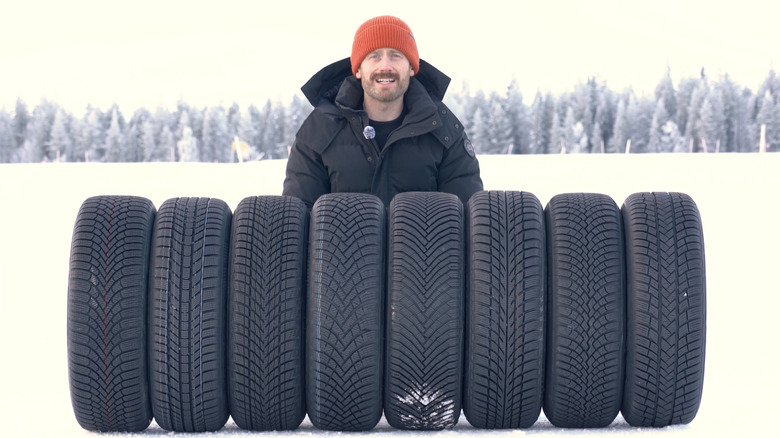
The world of tires is brimming with options. You can get ultra-high-performance summer tires for the best hot-weather performance possible; you can get dedicated studded ice tires that excel at keeping traction on ice; or you can get all-season tires that should let you do most things without swapping tires every season change.
However, if you live in a particularly cold climate and you want the very best 2026 winter tire out there, you'd be surprised by who took first place in a 2026 TyreReviews winter tire test: the Goodyear UltraGrip Performance 3. The test put nine winter tires through 13 disciplines in size 205/55 R17, all mounted on a Volkswagen Golf Mk 8.5.
The nine tires came from Goodyear, Continental, Pirelli, Michelin, Bridgestone, Nokian, Hankook, Vredestein, and Triangle, the last of which was the budget option. Testing covered snow, wet, and dry performance, along with comfort, noise, and rolling resistance. Wet performance carried 40% of the final score and snow carried 37.5%, with dry and comfort at 10% each and rolling resistance at 2.5%.
Out of all nine contenders, it was the Goodyear that came out on top. It's not Michelin or Bridgestone, and that makes sense, since there are winter tires that outperform Michelin in both price and performance. Here's what the Goodyear UltraGrip Performance 3 did better than the other tires, where it fell short of the leaders, and how its results stacked up against the Continental, the tire that finished right behind it.
How Goodyear rubber took the win
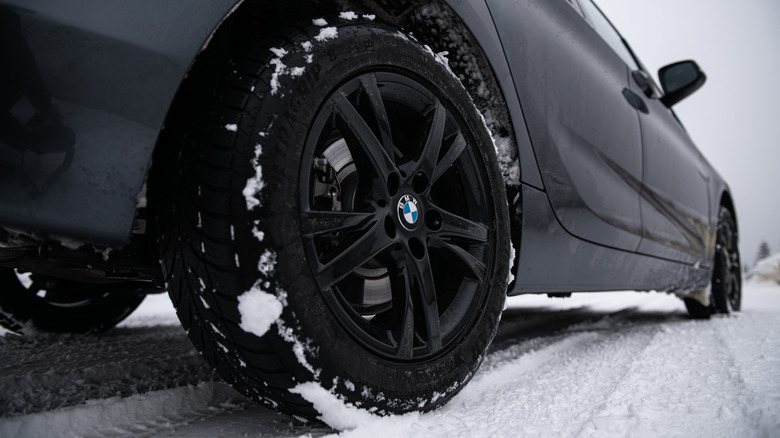
The UltraGrip Performance 3 won this test on the strength of its snow results. Slowing from 22 mph (35 km/h) to 6 mph (10 km/h), it needed just 45 feet (13.7 meters), the shortest distance of all nine tires. It was also quickest in the snow acceleration run and set the fastest snow handling lap at 76.15 seconds, 0.78 seconds ahead of the Continental. Jonathan Benson from TyreReviews noted that the UltraGrip Performance 3 "dominated the snow."
The Goodyear was not the best at everything, though. In the wet, slowing from 50 mph (80 km/h) to 6 mph (10 km/h), the Continental WinterContact TS 870 P needed 95 feet (29 meters), while the Goodyear needed 97 feet (29.6 meters), which left it fifth. The Continental also took the wet handling lap, finishing 0.94 seconds ahead of the Goodyear in third.
On dry pavement, slowing from 62 mph (100 km/h), the Nokian Snowproof 3P needed 130 feet (39.7 meters), with the Goodyear third at 132 feet (40.3 meters). The Goodyear's rolling resistance measured 7.9 kg/t, fifth of nine, while the Bridgestone Blizzak 6 led at 7.4 kg/t. Elsewhere, it finished third in aquaplaning resistance and second quietest in the cabin at 54.3 dB. These results come from TyreReviews' testing, and they don't guarantee that Goodyear will win every comparison.
In Consumer Reports' top-ranked tires for winter and snow, the Goodyear did not appear among the winners or runners-up in any category. Nokian, Michelin, Continental, and Vredestein took the winning spots instead. TyreReviews scored 13 disciplines in a single size, 205/55 R17, so the two tests aren't directly comparable, and the best tire still depends on whose test you trust.
What makes a good winter tire
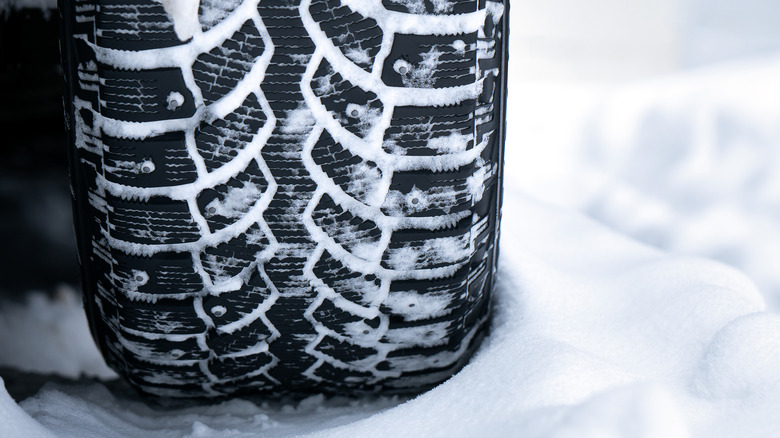
As this test has shown, the way Goodyear managed to beat all of its competitors isn't by winning each and every category. A tire is bound to have certain compromises that will make it better in one area and worse in others. For example, this test also included the Triangle WinterX TW401 as the budget tire choice, and in almost all categories, it finished either last or near last, except for comfort, where it finished second.
All of this shows that the winning element has to do with how manufacturers balance these drawbacks and benefits to make the most complete package with the least subpar performances in each category. This is also apparent in our rundown of the best Goodyear tires for SUVs, which picks five different Goodyear tires for summer, all-season, off-road, winter, and longevity use, because no single tire wins every job.
The winter pick is the same UltraGrip Performance 3 that won this test. What carried it to the win was the lack of a bad result, since it never finished lower than fifth in any of the 13 disciplines. Where you drive should decide which trade-offs matter most. A driver who mostly sees cold rain and slush has good reason to care about wet braking, where the Goodyear placed fifth, while someone facing real snow would value its first-place snow results. A good winter tire, then, is the one with the fewest weak spots for the roads you actually drive on.