

What Is The Notch On An Axe Or Hatchet For?
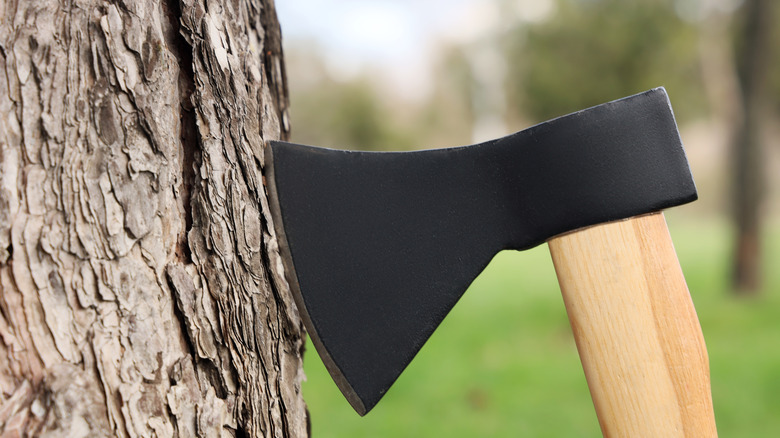
What is the notch on an axe or a hatchet even for? It depends on what notch you're referring to. If it's the V-shaped notch at the bottom of the axe's blade, it's a feature that drastically improves the balance. It lightens the weight on one end of the blade, thus improving the precision when you swing the axe horizontally. The larger the notch, the easier the tool is to control, which is helpful for tasks like carving. By simply moving the hand behind the axe's cutting edge, you can easily direct the movements.
If your axe or hatchet also has the notch on the cutting side (the blade itself), it's generally used for pulling nails. For instance, you can use it to keep the nail steady, or it can provide space when you're prying up boards to avoid damaging the blade. It's also sometimes found with axes that are made for specific uses, such as roofing or lathing hatchets.
Though many people overlook them when listing essential homeowner tools, axes and hatchets are undoubtedly nifty. While they're amazing for chopping wood, having even a small axe could make yardwork easier (say, for trimming bushes or branches) and can also assist you in a wide array of projects. Best of all, axes and hatchets can last you a lifetime with proper maintenance, which thankfully isn't rocket science: Avoid sharpening at the wrong angle (as with any other blade), sharpen both sides of the blade, and you're good to go.
How many types of axes exist?
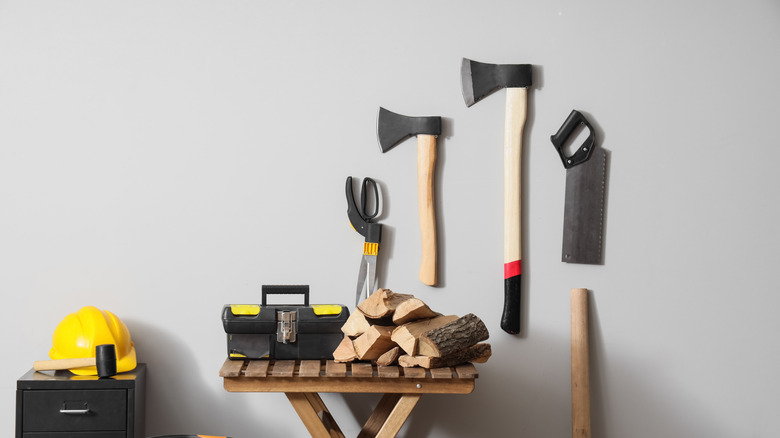
Axes and hatchets aren't exactly a monolithic tool, so to speak. Even if you have a certain idea of how this tool looks, there's a wide spectrum of axes and hatchets — all of which have slight design differences and functions. For example, felling axes (which you can identify by the longer handle and a flared blade) are perfect for cutting wood across the fiber, meaning they can be used for chopping down trees and landscaping.
The contrast to a felling axe is the classic hatchet, which has a short handle and is great for one-handed use. The in-between version is the Hudson Bay axe. Since it's hefty enough to be used two-handed, you can technically use it on smaller trees, while it can also fulfill the role of the hatchet since it's light enough to be used with one hand.
Then, there are axes that are more precise and, as such, often employed by carpenters and woodworkers. For instance, a carpenter's axe has a straight blade and is larger than a hatchet, often with a flat butt that can replace a hammerhead. There's also a double-beveled axe, which has large notches on both sides, and is designed for hewing and making scalloped cuts. In addition to the aforementioned roofing axe, there are countless other variations, like broad axes, hunter's axes, and so on. It may be confusing, but for most purposes around the house, you can probably get away with a felling axe and a hatchet, unless you plan on getting into woodworking and fine-precision work.