

Should You Sharpen Both Sides Of An Axe Or Hatchet?
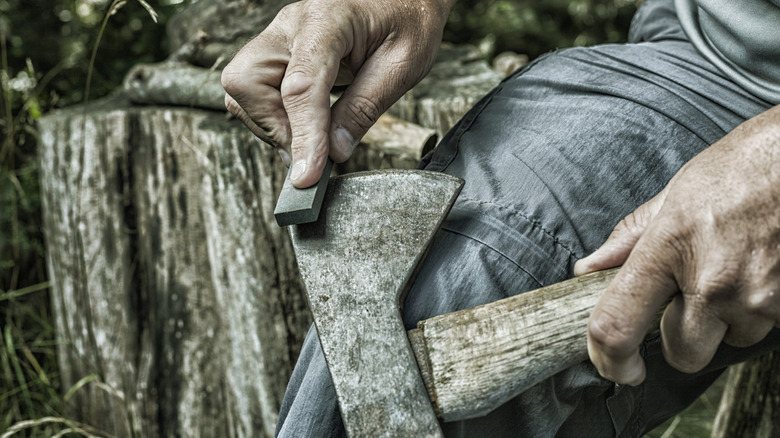
A sharp blade is important regardless of the tool, as it helps ensure a smooth and clean cut every time. It's also important to know if both sides of a blade should be sharpened, whether it's a lawn mower blade, or an everyday pocket knife. And when it comes to a conventional axe, both sides of its cutting edge should be sharpened.
The USDA Forest Service recommends working on one side until a small burr, or raised edge of metal, develops, then turning the ax over and working on the other side. The process continues back and forth so the edge stays evenly shaped, rather than removing metal from just one side. The goal is a slightly rounded cutting profile, with both sides shaped evenly. This method also applies to a double-bit axe, though the blades can be given different profiles depending on how they will be used.
The same basic idea applies to a conventional hatchet, which should also be sharpened on both sides. The process involves working on one side of the cutting edge before flipping the hatchet over and repeating the process on the other side. The same should be done when using a fine sharpening stone, as it allows both sides to be refined and honed. Because hatchets are often used for more controlled jobs like making tinder and preparing kindling, the best move is to take the edge to a finer finish than would typically be necessary for a larger chopping axe.
Different axes and hatchets need different care
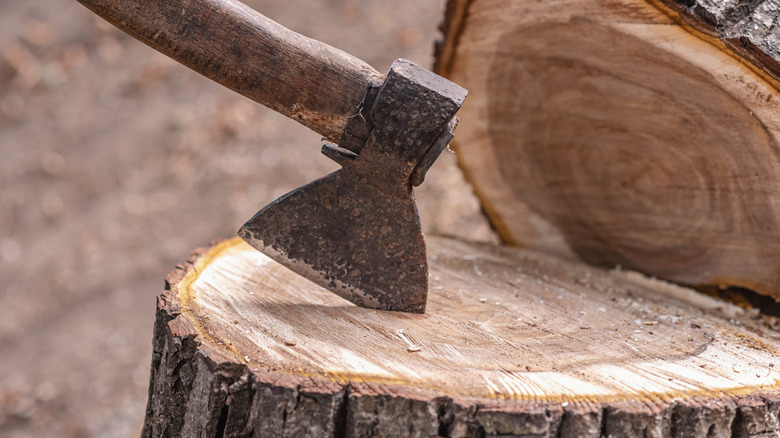
Not every axe has a cutting edge that needs to be sharpened on both sides. For example, broad axes used for hewing timber can have a single-sided "scissor grind," which means only one side of the edge is ground. The opposite side of the axe head remains flat. This setup allows for a smoother surface than other blades when hewing. Sharpening the flat side of the axe would change the edge from the single-sided profile the tool was designed to use.
Hatchets can also differ in how their cutting edges are shaped. While many conventional hatchets have a double bevel, with both sides of the edge angled toward the cutting edge, other types have just a single bevel. Both styles should be treated as separate configurations, which means that each type should be sharpened according to its existing bevel. Klein Tools' tool-care guidance specifically provides separate instructions for hatchets with double bevels and those with single bevels.
The right choice for sharpening an axe or hatchet depends on the tool's age and condition of the edge, as well as personal preference. An axe file can be used for larger damage, while diamond files and sharpening stones can be used for maintaining the edge. A handheld sharpener can also be used on an axe or hatchet, as long as it is specifically designed for those tools. For example, Smith's makes a sharpener with carbide blades for sharpening axes, hatchets, and machetes.