

These High-Tech Buoys Are Turning Ocean Waves Into Usable Electricity
When you think of renewable energy, the chances are what springs to mind are wind turbines and solar panels. Of course, hydroelectric schemes that harness the power of flowing water are also worthy of note. However, some "water-based" renewable energy methods that don't get as much press are those that harness the power of our oceans. The use of high-tech buoys to generate electricity is being increasingly explored as a green energy source.
There are already smart buoys being used for various other purposes at sea, but these buoys use the power of waves to generate electricity, and there's plenty of power in those waves to be harvested. According to Oregon State University, the coast of Oregon contains enough potential wave energy to power 28 million homes annually. Scaling up, the U.S. Energy Information Administration estimates that wave energy along the U.S. coastline could supply about 63% of the country's electricity generation capacity (in 2023). And as data centers continue to strain the power grid, this resource could become an important part of U.S. energy strategy.
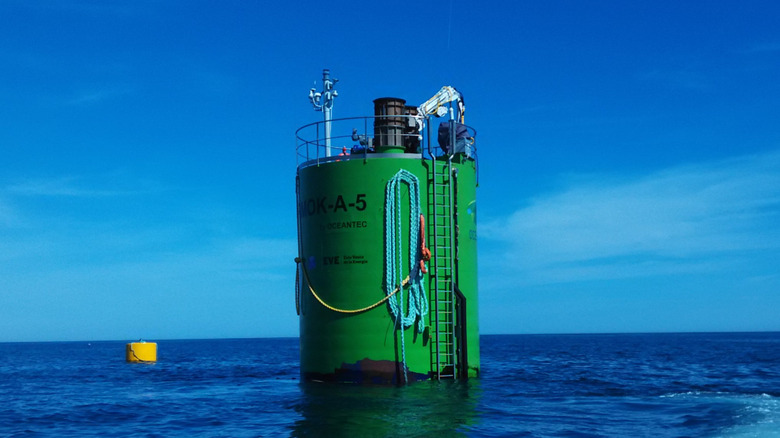
That's why already working systems like Spain's MARMOK-A-5, the Finnish WaveRoller system, the OE-35 buoy deployed in Hawaii, and others are attracting increasing interest. We cover some of the major schemes in more detail later, but put simply, these devices work by capturing the kinetic and potential energy within waves and converting that energy into electricity. Let's have a closer look at these buoys and how they could help the transition from fossil fuels.
Meet the buoys
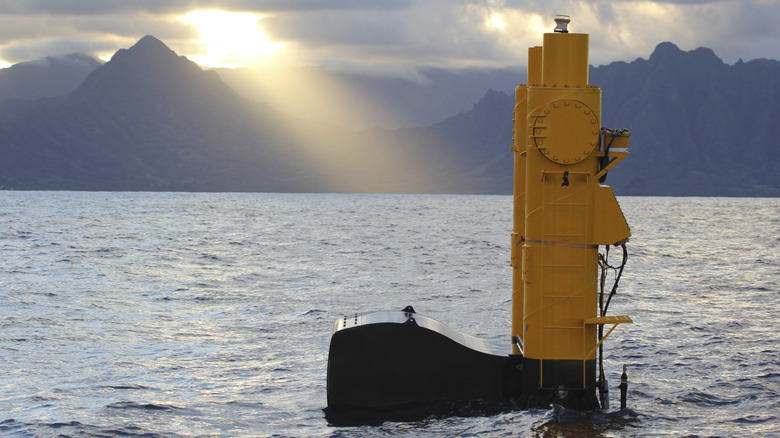
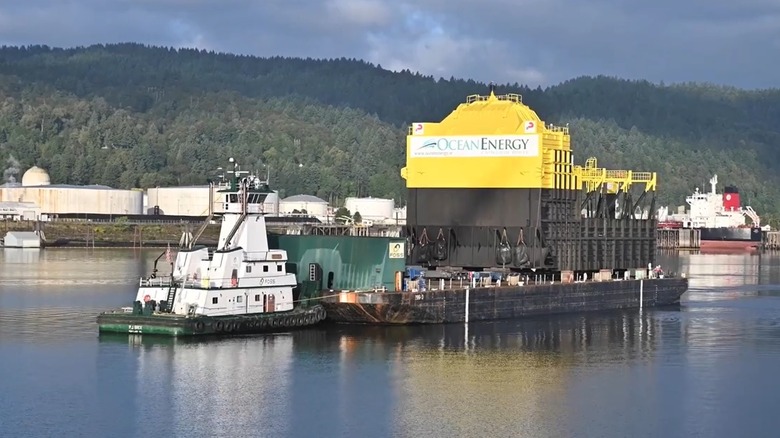
Let's begin in the waters just off the Hawaii coastline. It's here that we meet the 826-ton OE-35 wave energy converter (WEC) buoy. Developed by Ocean Energy USA LLC (part of the Ocean Energy Ireland Group), in partnership with the U.S. Marine Corps and the University of Hawaii. The buoy was deployed at the U.S. Navy's Wave Energy Test Site in Kaneohe Bay in July 2024 and was used to supply power to Marine Corps Base Hawaii until it was decommissioned in 2025. Despite being sea-borne, this device actually uses air pressure within the buoy to drive the turbine that creates the electricity, in this instance up to 1.25 megawatts. This has the advantage of keeping the only moving part (the turbine) away from the seawater and less susceptible to corrosion.
Next we shift to the Bay of Biscay to look at the MAMORK-A-5 buoy. This program first went live in 2016 when it was connected to the Spanish electricity grid. In May 2026, the original MAMORK-A-5 was replaced with an upgraded buoy with a maximum rated capacity of 30 kilowatts. This system also uses air to turn a turbine, but it works slightly differently from the OE-35 buoy. The MAMORK buoy uses an oscillating water column system. Essentially, the 'water column' acts like a giant piston inside the buoy; as the piston moves, it draws and pushes air through the turbine to produce electricity.
These are just two examples of schemes, but this is still an emerging technology. The latter point might seem strange given how much renewable power is locked up in our oceans.
Why wave energy isn't widespread
We'll begin this section with another wave power fact — According to the EuropeWave program, there is enough wave energy in our oceans to meet the entire planet's energy requirements. Given this, it seems reasonable to ask why we aren't using this resource more. There is no one factor we can point at and say — that's why!
Several challenges are holding the technology back. First, there's the sea itself. This can be a brutal environment with — as we've established — a lot of energy contained within it. Building buoys that can survive and keep working in such circumstances has always proved difficult. They're also still far more expensive than wind or solar to deploy, and the industry hasn't yet converged on a single design.
That being said, although the lifespan of ocean buoys can vary dramatically, the technology is improving, and the tide could now be turning. The technology needed to deploy commercial systems is now mature enough for full-scale farms to become a reality. While the growing impetus towards harnessing wave power has been European-led, the U.S. and China are beginning to play catch-up. In 2024, the U.S. sector received $141 million in funding; the majority of this was allocated to wave schemes (as opposed to tidal schemes). A similar story unfolds in China, where a wave of 2024 policy updates was introduced to boost ocean energy development.