

How Do Offshore Wind Turbines Stay In Place In The Ocean?
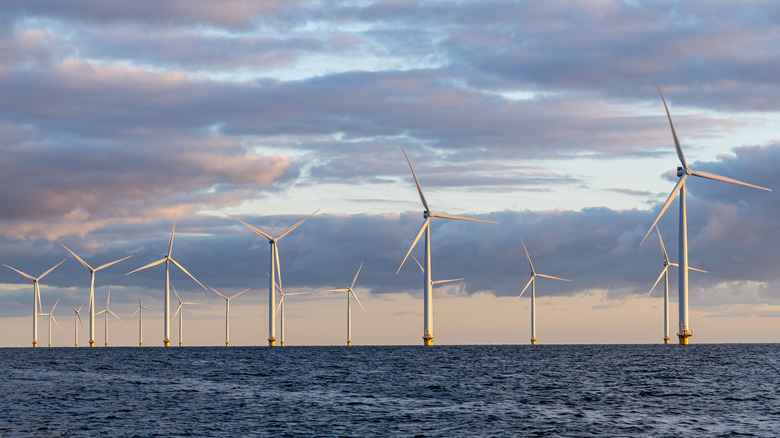
Wind turbines are a great source of green energy, but they aren't perfect. One of the biggest drawbacks is the fact that land-based wind farms can reduce the level of moisture in the soil. One solution to that problem is to put them out to sea.
Similar to how offshore buoys stay in place in treacherous waters, floating wind turbines are installed on floating platforms made out of hard materials like concrete or steel. The platforms are then connected to the seabed via lines and anchors. These particular installations are better suited for depths of 230 feet and over. In shallow water, on the other hand, it's more common to go with monopile foundations lowered to the bottom with cranes. Then, a hydraulic hammer drives them into the seabed.
Apart from slightly ruining the view from the beach, offshore wind farms are much less harmful than the ground-based turbines. When comparing offshore and onshore wind farms, the former are generally physically larger. Due to their rather imposing size, they also tend to outmatch land-based turbines: a wind turbine on land can deliver up to 4 MW, while an offshore turbine can provide as much as 15 MW of power output.
Do offshore wind farms harm the environment?
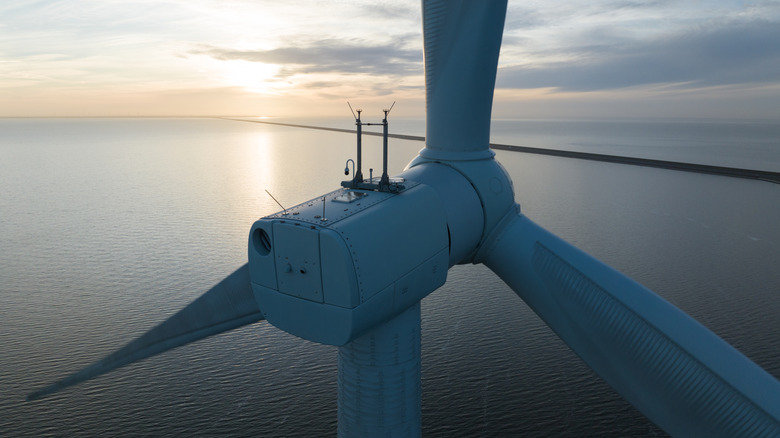
Some challenges associated with traditional installations still apply, like the fact that composite blades (that are often made of fiberglass) are hard to recycle. Add to that the tricky installation and maintenance, meaning that the upfront and lifetime costs are much greater when compared to their solid ground counterparts. Meanwhile, the environmental impact of offshore turbines is inconclusive.
There are both negative and positive effects on biodiversity. Surprisingly enough, while the existence of wind farms themselves isn't a major issue, construction and decommissioning can affect the populations of various marine species. The monopile foundations (wind turbines with the foundation on the sea floor) are worse. Pile-driving noises may pose danger to sea critters big and small: from killing fish to disorienting large mammals such as whales. This damage can be mitigated by limiting pile-driving activities during migratory periods and deploying mitigation measures such as bubble curtains.
It takes approximately 800 wind turbines to match the output of a nuclear reactor. The problem is that such an operation would take up 1000 times more space. Since 71% of Earth is water, it makes perfect sense to prioritize offshore wind farms, as they provide more energy and aren't as damaging and wasteful in terms of space. But building on water is more expensive, so it will come down to the developers to determine which has the most value.