

How Do Ocean Buoys Stay In Place In Deep Water?
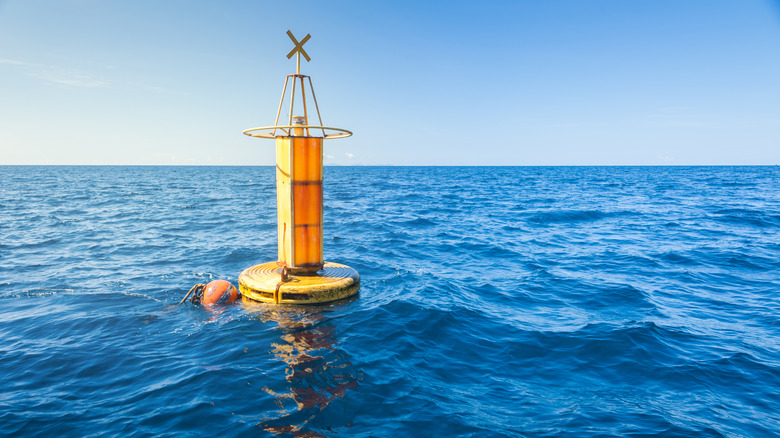
There are many types of buoys, which come in a variety of shapes and colors. Captains need to be familiar with what a yellow buoy means for boating, for instance. Some buoys are designed to remain in the same place, essentially marking an area for the purposes of navigation or to alert vessels to sensitive areas. Those used over the Florida Keys Marine Sanctuary are mooring buoys designed to allow boats to tether to them, rather than damage the sensitive coral with traditional anchors. For those wondering if modern ships still hit icebergs, it's largely avoided due in part to special buoys monitoring the movement of floating ice masses.
A stationary buoy must be anchored in order to prevent it from floating away. Saturation divers can plunge to depths of nearly 400 feet to physically drill or jackhammer steel pins, U-bolts and shovel-shaped anchors into the rocks or sediment.
Buoys over an even deeper section of ocean are another matter. Instead of punching into the sea floor, deep sea buoys use extremely heavy weights as anchors that sit on the ocean floor connected by lengthy runs of cabling. The concept sounds simple enough, but there are several considerations and additional equipment required to counteract all the forces these buoys must endure.
Deep water buoys need sophisticated mooring systems
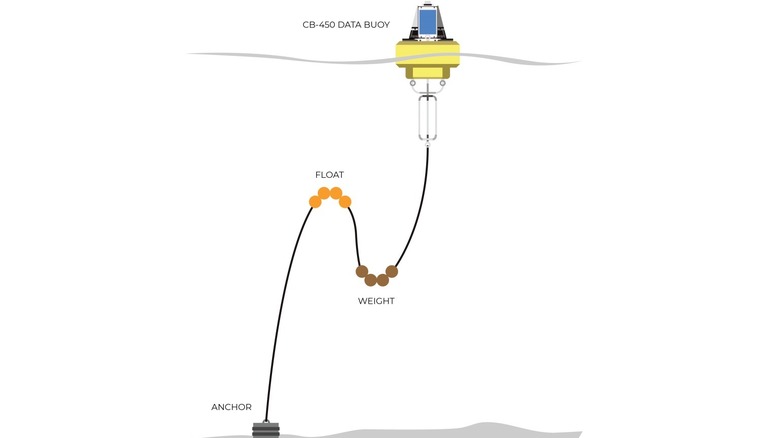
A mooring system describes all the different parts required to secure a floating vessel, device, or structure in the water including anchors, weights, lines, and connections. In the case of a buoy floating over water thousands of feet in depth, engineers are required to design workable solutions that'll remain in place without failing. The ocean presents challenges such as strong currents, massive waves, corrosive salt water, and even marine life that grabs onto underwater equipment, making it heavier over time, called biofouling.
Engineers need to create equilibrium between the different forces acting upon a mooring system. For example, while an anchoring weight provides the necessary downward pull for the buoy, the length of the line must be carefully considered. In some cases, the connecting line can't simply be taut, as this places far too much stress on it during periods of high wind and wave activity, potentially causing it to fail.
Adding plenty of extra line would seem to address that, except there is another problem. The line, which can made from steel, nylon and Kevlar, among other materials, needs some form of buoyancy. Without an upward force applied to the line, its own weight pulling downward would cause undue stress. Deep water buoys often use more complex S-shaped moorings, which feature a combination of floats and weights to help absorb shocks from the surface, like waves.