

Offshore Vs. Onshore Wind Turbines: What's The Difference & Which Generates More Energy?

Wind turbines can be installed both on land and at sea, with each offering its own advantages. In terms of power generation, those installed in the ocean far surpass their land counterparts. According to a study published by the journal Wind Engineering, some wind turbines installed at sea can achieve up to 15 MW (Megawatts) of output, while onshore units can manage up to 4 MW. While 4 MW is nothing to scoff at, the number of wind turbines it would take to replace a nuclear reactor is estimated to be around 800, but efforts to reduce this gap are under way.
However, offshore units are far larger than their land-based peers. Among the largest wind turbines in the world, China has some true giants, such as Dongfang Electric Corporation's 26 MW offshore unit, which stands at 600 feet (over 55 stories) tall at the rotor. It isn't just size that allows offshore wind turbines to generate significantly more energy, but also higher wind speeds, and a lack of structures or natural features blocking airflow.
It's difficult to quantify how much power a single Megawatt offers. However, there are estimates that can help provide context. For instance, following a record-breaking power demand in Texas in 2023, Rice University associate professor of environmental engineering Daniel Cohan explained to CBS Austin, "What the data shows is that on average, a home is only using about one and a half kilowatts, if we average over the entire year. That would mean that one megawatt is enough to power 670 homes."
Offshore wind turbines are more expensive and include additional challenges
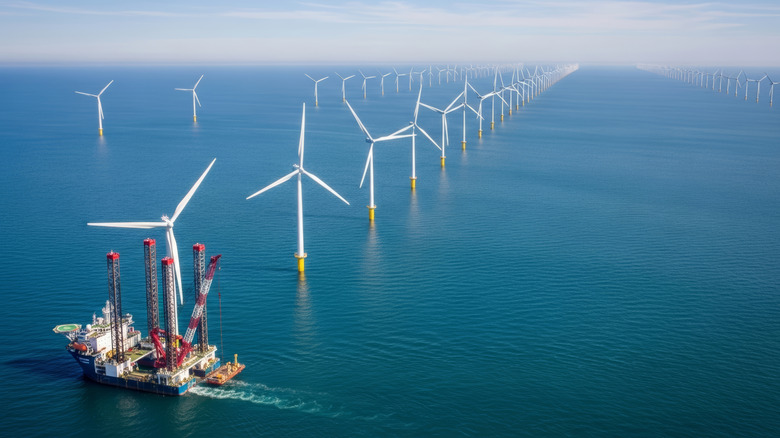
While installing these alternative energy generating units out at sea can result in greater power output, it's also costly. According to Solar Tech Online, an offshore wind turbine runs between $12 and $20 million per unit, whereas an onshore turbine is around $2.6 to $4 million each. It's not difficult to understand why, as there are several hurdles to overcome on the water. For instance, offshore installation teams must utilize jack-up barges, which raise the vessel out of the water on legs that reach the sea floor, to keep it stable and in place.
A offshore wind turbines require unique ships to haul them several miles from land, projects can take far longer than onshore installations, which can be completed in a matter of months. And while maintenance engineers can easily reach a wind farm located on land, reaching an offshore site offers more logistical challenges. Offshore wind turbines that sit on the seabed can be a as far as 18.5 miles (30 km) from the coast.
In terms of longevity, while the average lifespan of wind turbines may surprise you, the fact is these massive machines don't run forever. In the event of a catastrophic failure, such as the 2024 incident in Nantucket where an offshore turbine blade fell into the water, it's a much more complex operation than on land. On the water, it requires large salvage crews to carefully retrieve the debris, while contending with the changing conditions offshore.