

5 Companies Making Some Of The Coolest Boating Tech Right Now
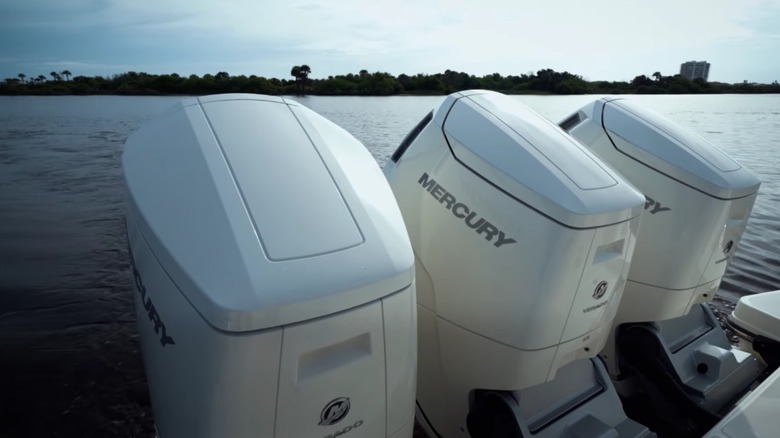
If you don't live near the water or visit often, you may have little reason to stay up to date on what's happening in boating technology. For others, these developments are a vital part of everyday life. Thanks to advances in technology, we can more easily monitor, minimize, or even remove annoyances and dangers that boaters face. These developments, of course, are the results of refinement, testing, and innovation from boating tech companies.
The boating world offers many exciting possibilities. Submarines and underwater drones, for instance, surveillance systems, and the different inventive craft used by domestic and international law-enforcement institutions are just some of the examples. In recent months, one particular company demonstrated its high-tech drones that could autonomously scope out undersea mines.
All in all, an enormous array of technology, both in the works and already in operation, is making the oceans more explorable, safer, less mysterious, and simply more fun for those who enjoy leisure boating. Some manufacturers have expanded into territory that hasn't really been explored before. Let's take a look at some of those companies that are really making a splash with something new.
SEA.AI
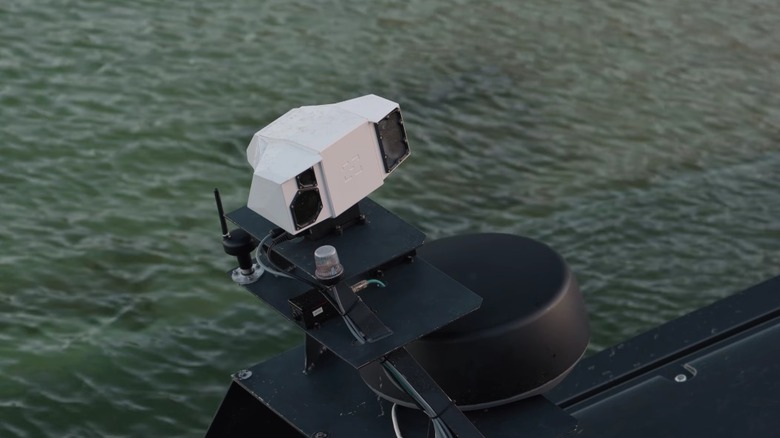
Sophisticated cameras, as technically impressive as they may be, aren't a technology that's particularly unique in 2026. They can be found as standalone devices, installed in vehicles, and as parts of scientific equipment all around the world. Even so, there's a lot of innovation at the heart of these systems, and nowhere is that more evident than with the devices that SEA.AI is producing. What sets this company apart from a lot of producers of boating tech is the way that they've incorporated AI into their gear. It's the key to a system that SEA.AI calls Machine Vision, one of the company's most interesting innovations.
This additional camera functionality not only locates but also provides classification for people in need of rescue, buoys of different types, larger and smaller vessels, and more. It's far from revolutionary to have systems in place to provide means of locating these hazards, but the concept of SEA.AI is to be comprehensive enough to locate those dangers that more conventional systems, such as radar, could miss.
To do so, the company makes use of its own AI systems to bolster the capabilities of thermal cameras. SEA.AI goes on to explain that this is made possible through "proprietary machine vision AI, trained on millions of maritime images collected since 2018, to detect, classify and track objects in real time." There's potential here for such a system to improve existing capabilities and strategies, making boating safer for vessels of all sizes and types of utility.
AquaAmp
The technology powering some of the most significant innovations in the boating sphere takes many forms. In some cases, they're the huge, in-your-face developments, like the latest and most formidable new cruise ship or even aircraft carrier. Then there are the smaller innovations, those gadgets and accessories that can transform the experience on such vessels. These are the sorts of items that veterans are sure to appreciate, because of how valuable and unique the inventions are.
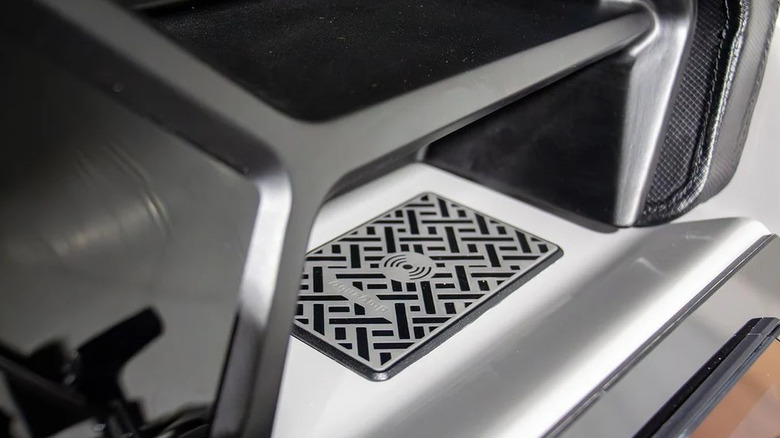
AquaAmp is a brand based in the Floridian city of Tampa. It might not be a familiar name to those who aren't keen boaters, but its range of products is unique. AquaAmp reports that it "specializes in custom waterproof OEM electronics for outdoor specialty vehicles that seamlessly integrate into the dashboard," and its range includes a Qi2-certified charger offering 25W, a world first in the field. As those who spend a lot of time on the water will know, other products can be quite unreliable in this role, and there's a danger of being left without power for essential devices if you don't have a dedicated, versatile, and sufficiently powerful solution.
Some of the range's products also feature MIL‑STD‑810H-tested magnet retention, which means that they can typically be relied upon to remain in place on a vessel against the elements. For dedicated boaters, this is an essential virtue, because an AquaAmp may be your only means of charging a certain device while on the water, and you need to know where it is and be able to rely on it to stay secure in the worst conditions. After all, there are some essential tools you'll want to keep on your boat at all times, but whether they're safe and accessible when you need them can be another matter.
Seakeeper
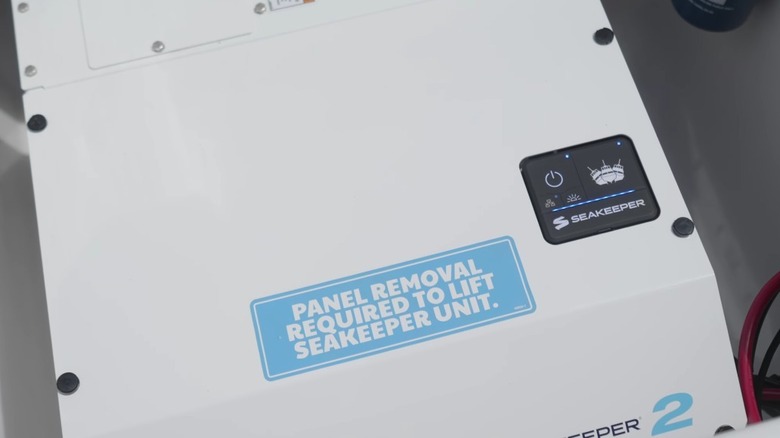
For centuries, humankind has reached new frontiers of travel, diplomacy, trade, and even troop logistics by traveling the oceans and waterways. This also means that, for centuries, we've contended with one of the greatest travel scourges ever: seasickness. It's often said that larger vessels, like cruise ships, experience less pitch and yaw than smaller ones. This is because these supersized ships have much improved stability over their smaller cousins. With this in mind, two of Seakeeper's more interesting innovations are its gyro technology and its Ride system family, which effectively aim to make smaller vessels glide across the oceans, as larger ships tend to do compared to their smaller counterparts.
To accomplish this, the gyro technology creates what's known as gyroscopic torque, thereby cutting down the ship's movement using a flywheel spinning in a vacuum. The momentum created by this spinning component produces this force, which reacts against the natural force of the vessel's rocking in the waters. In addition, Seakeeper has developed its Ride family of systems, which can be used similarly to dramatically improve the experience of those susceptible to seasickness on board a boat.
Seakeeper's Ride systems are affixed to the transom of a boat, where they can detect the movement of the water. To do this, Seakeeper reports, they use "custom, proprietary inertial sensing hardware and software ... the system understands how the boat is behaving in all three axes and commands deployment of the rotary blades to counteract pitch, roll, and yaw."
Sunreef Yachts
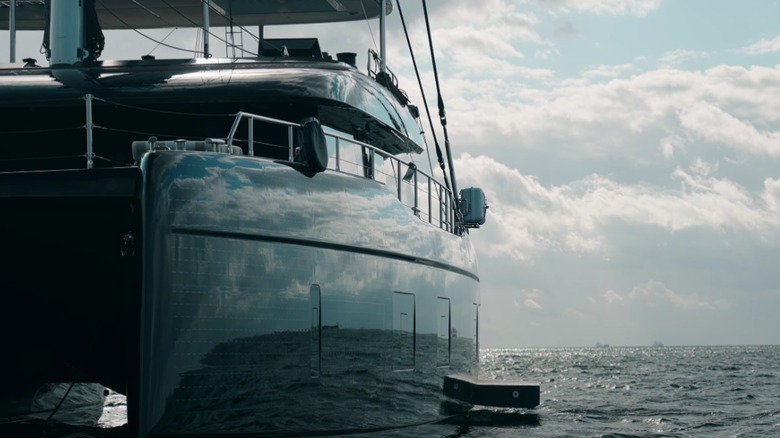
Sunreef Yachts is at the forefront of some impressive technology in the solar (and more) sector for luxury yachts and other vessels. This includes means of not only powering vessels efficiently, but doing so in a way that also makes additions like solar more practical to use.
One of the primary focuses of Sunreef Yachts' Eco range is on eco-friendly catamarans. One of the most prominent technologies that powers these vessels is, of course, the solar panel, though the models used are designed by the brand's own teams for specific suitability for Sunreef's vessels. This means that they can be mounted in various parts of the catamaran, while also being designed to be easily modified for surface area, shape, and convenient detachment. "They are the industry's lightest panels," the developer boasts. This can be helpful because a catamaran differs a lot from some other vessels on the sea, structure-wise.
Two further crucial innovations are the solar panels implemented directly in the bimini roofs, which no other competing brand has yet done. On top of that, the shipyard is also working on a system that will allow the solar energy to power the vessel's boilers. Of course, eco-friendly measures are also employed by other luxury yacht and other greener vessel makers, but there are several developments that are exclusive to the models by Sunreef. One of them is the aforementioned Solar Skin tech, which prevents solar panels from taking up valuable space on a vessel. Running costs are also sharply reduced by the models' unique gas-based air conditioning systems. Sunreef Yachts claims that this AC technology "operates throughout the night on batteries and consumes 70% less energy than most systems in the yachting industry."
Simrad
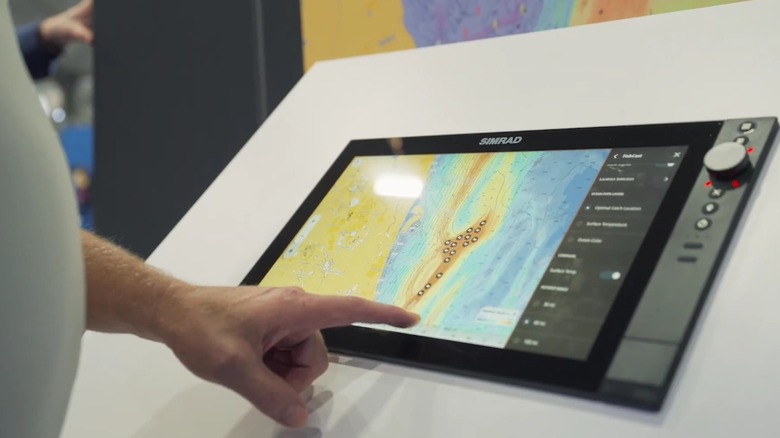
Simrad is a brand with Norwegian roots; it can trace right back to Willy Simonsen, a scientist who developed equipment with which to spy on German plans during World War II. The brand continues to operate internationally today, and unsurprisingly, with its Scandinavian roots and Simonsen's technical savvy, its innovations are focused primarily on the marine sector.
Simrad's FishCast is a subscription service that works through the C-MAP charts of Simrad displays, providing a wealth of information using ROFFS (Roffer's Ocean Fishing Forecasting Service) data and AI to provide anglers with a wide range of valuable information to give them a better chance of success. It produces a series of the likeliest current spots for a given fish, clearly indicated on the display. The system provides regular forecasts of the best spots in which to find target fish species, using a decade's worth of established fishing data. It takes into account elements such as the temperature of the water, established historical patterns, and the currents of the water, with an understanding of how these factors can affect fish movement and habitats. Those hotspots are simply marked by fish symbols, and anglers can scroll along a timeline of three-hour predictions that's updated every day.
Another especially notable Simrad tech is its AutoCaptain Autonomous Boating System. Simrad issued a press release unveiling this innovative system in October 2025, declaring that it was equipped to handle "full auto-docking capabilities, including docking, undocking, and short-distance maneuvering." According to Simrad, its AutoCaptain technology is more capable of performing this autonomously than other systems before it. The press release adds, "Unlike assistance-based systems currently on the market, AutoCaptain delivers true autonomous maneuvering, engineered from the ground up with exclusive Mercury Marine propulsion integration."