

Muncie M20 Vs M21 Vs M22 Transmissions: What's The Difference?
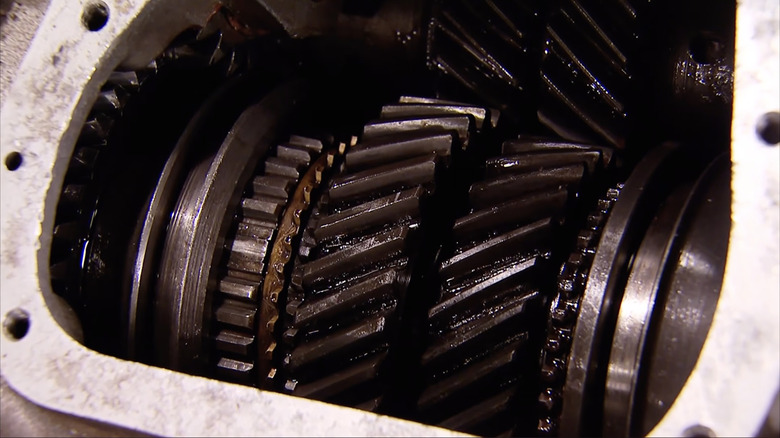
While automatic transmissions dominate the U.S. market today, some drivers still prefer the total control that a manual transmission provides. The popularity of automatic transmissions may also explain some of the common manual transmission myths, such as stick shifts being harder to drive or wearing out faster. That said, a manual transmission is still the preferred option for muscle cars, and some of the best-known examples are the Muncie four-speed transmissions used in various General Motors vehicles during the muscle car era — namely, the M20, M21, and M22. All three of them may look similar, but different gear ratios and internal designs give each a distinct personality.
For starters, the main difference between M20 and the other two is that M20 is a wide-ratio transmission. Compared to M21 and M22, M20's lower first gear gives the car more pulling power when starting from a complete stop. Those bigger steps between gears also make the M20 a natural fit for relaxed driving around town. During its production run, the M20's gear ratios changed, starting at 2.56:1 for the first gear in 1963, to 2.52:1 in 1966 and beyond. The second, third, and reverse gears saw similar changes, while the fourth gear ratio is the same in all Muncie transmissions: 1:1.
Differences between M21 and M22
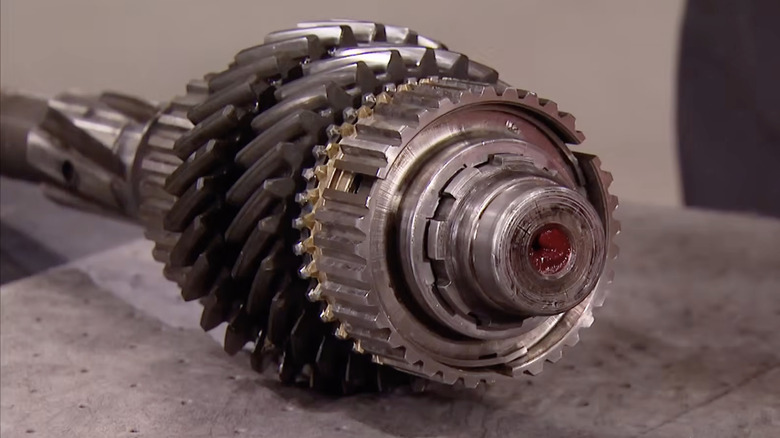
Compared to M20, both M21 and M22 are close-ratio transmissions. Out of the two, M21 came first in 1963, while M22 appeared a couple of years later. The M21 has closer gear ratios, so the engine stays nearer to its power band as the driver shifts up through the gears. It runs 2.20:1 in first, 1.64:1 in second, 1.28:1 in third, and 2.27:1 in reverse gear. That made it better suited to performance driving, since the revs didn't drop as far on each upshift, though the trade-off was less leverage off the line. It's no surprise that the M21 found its way into '60s SS and Yenko Camaros.
Finally, the M22 transmission is similar to the M21, and you can think of it as a heavy-duty version. It uses the same M21's gear ratios, but it has a higher torque capacity. The M22's gears are made from higher content of nickel alloy, and cut at a lower helix angle compared to the M21,making it more durable. Interestingly, the M22 transmission is also called the "Rock Crusher" due to the loud gear whine it makes, caused by the straighter-cut design of the internal gears. It was most often used in big-block muscle cars and Corvettes, and was offered with the LS6-powered 1970 Chevelle SS 454, which is arguably among the most impressive muscle cars ever built by Chevy.