

What Does Rake And Trail Mean On A Motorcycle?
Why is it that a sport bike can handle the tightest of corners at great speeds while a cruiser struggles? The thing is, a sports bike is built to be inherently twitchy, thanks to a series of design decisions. Two of those decisions — rake and trail — play a particularly significant role. Both describe how a motorcycle steers, or more specifically, how one's front end is set up.
You may have noticed that, on almost every type of motorcycle, the front fork doesn't point straight down toward the ground. Instead, it goes down at an angle from the rider to the wheels. Rake (also known as caster angle) measures exactly this — the angle of that backward lean. It's measured in degrees, and the bigger the number, the greater the angle, and the more laid-back the front end.
Meanwhile, trail is different because it's a distance. When a rider turns a bike's handlebars, the front wheel swivels around this imaginary line called the steering axis. Extend it down to the road, and on the average motorcycle, it lands a few inches ahead of the front tire. Measure the distance between that spot and where the tire actually touches down, and you get the trail. It's called that because the tire rolls along slightly behind the point it steers around. Both rake and trail impact how easily the bike handles.
Why rake and trail matter
A better idea of the role trail plays can be derived from a shopping cart. A shopping cart has swivel wheels at the front that touch the floor slightly behind the point they swivel around. Because of this, as soon as you start to push the cart, the wheels swing around and line up behind it, keeping it on an effortless straight line. A motorcycle's front wheel works pretty much the same way. Having a trail helps keep that wheel locked in position as the motorcycle travels straight. Increase the trail and changing directions becomes slightly tougher because the front is now fighting harder to stay straight.
Trail doesn't work independently of rake, though — both are, in fact, tied together. Again, trail is the gap between where the steering axis hits the road and where the tire touches down. When that axis is leaned further back, it reaches the road at a point further ahead of the tire. But since the tire itself stays where it is, the gap grows. In other words, more rake generally means more trail. That's why a bike with lots of rake tends to behave like a bike with lots of trail. Sure, it may feel steadier, but it also asks for more effort to turn.
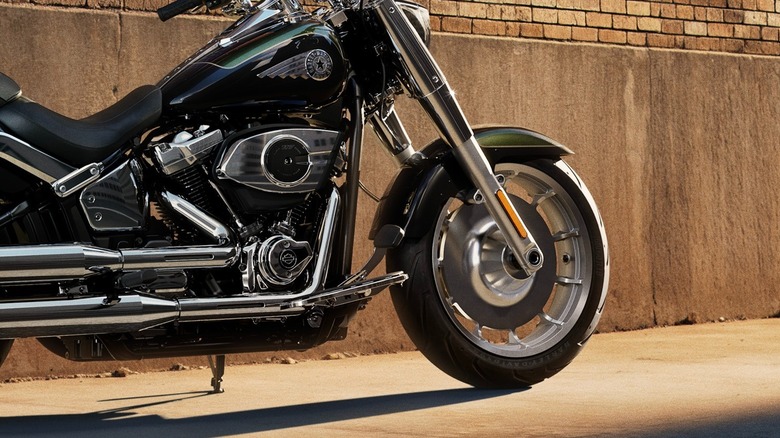
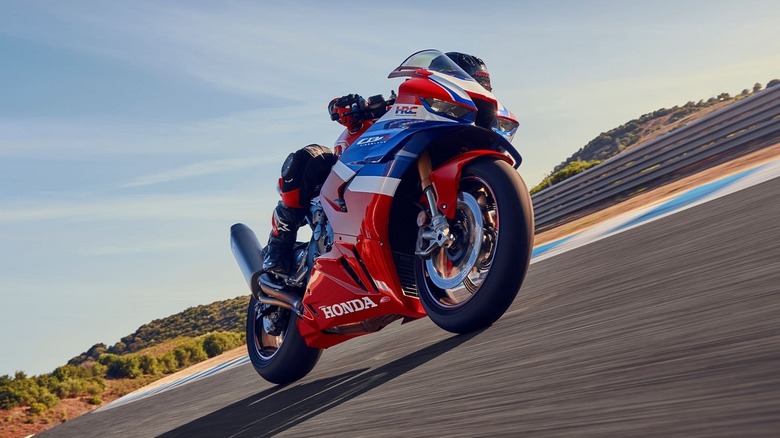
The Harley-Davidson Fat Boy cruiser and Honda's CBR1000RR-R Fireblade SP superbike together are great examples of these principles. Where the Harley has 30 degrees of rake, the Honda's is just 24 degrees. You can guess which one takes less effort to turn. That said, the Harley's trail is barely any longer than the Honda's, at 4.1 inches versus 4 inches, so the takeaway is that a relaxed rake doesn't mean a long trail goes with it.
How rake and trail play out on the road
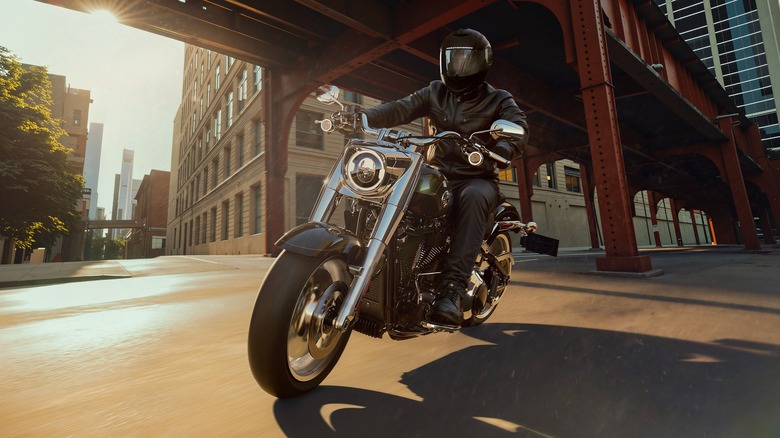
It's actually a pretty common theme: Superbikes generally have lower rake and trail levels compared to cruisers and choppers, allowing for niftier cornering. The downside is these bikes are generally more likely to develop speed wobble, which is a rapid shaking of the handlebars from side to side. Shock absorbers installed on superbikes are designed to help prevent this.
Cruisers and choppers, on the other hand, pay for that extra rake with slower steering. In fact, Honda's engineers once put a number on that. In 1978, Cycle World described a computer study by Honda's R&D team. The team started with a stock Honda CB750 that had a rake of 27 degrees, then modeled the same bike with the rake stretched to 40 degrees. Both bikes were then simulated at a gentle 30 mph to test them out. At the end, it was found that the modified version took half a second longer to respond to turns once it was leaned all the way over.
It's also worth highlighting that the rake and trail don't really stay fixed while on the road. The thing is that the figures you'd find on the owner's manual or spec sheet were measured by the manufacturers as the bike was parked with nobody on it. However, once the bike starts moving, the suspension starts moving up and down, tilting the steering axis with it. This changes both numbers.