

What Does A Road Sign With A Right Or Left-Pointing Chevron Mean?
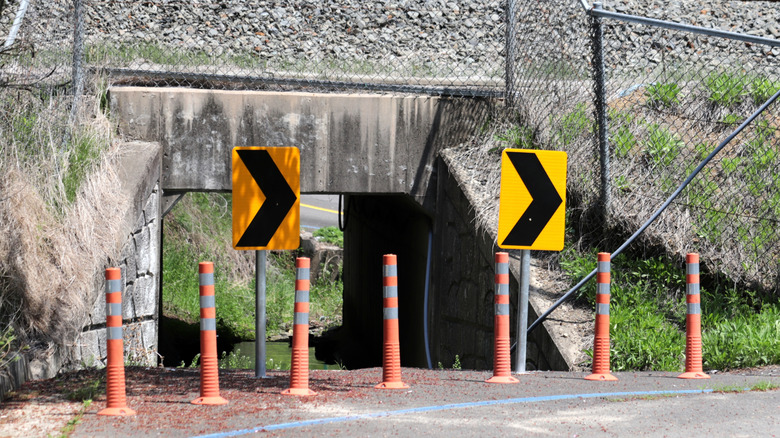
Drive across America and the roads might get better or worse as you pass through different states, but the traffic signs will stay mostly the same. That's because their appearance and usage are governed by the MUTCD, which establishes national standards for traffic signs and other traffic control devices. For those professionals, it's a document that dictates how roads should look and what considerations they have to make when they're designing a new one. For everyone else, it's a good place to brush up on exactly what all those road signs you might come across on your travels actually mean.
A common sign that most drivers will have encountered is the rectangular sign with a yellow background that has a chevron pointing either left or right. According to the MUTCD, it's a sign used to provide additional guidance through a change in horizontal alignment. In plain English, it means that the sign is warning you of a curve in the road, with the chevron pointing in the direction that the road is curving. It will always be placed on the outside of the curve.
To work out where to put chevron signs, road planners have to do a few calculations. First, they have to establish what speed the traffic approaching the curve in the road is likely to be traveling. Next, they need to calculate the advisory speed that traffic should travel through the curve. If drivers are likely to need to slow down 20 mph or more from their straight-line speed to reach the recommended cornering speed, the MUTCD says that chevrons may be required.
Chevron signs sometimes don't appear on quiet roads
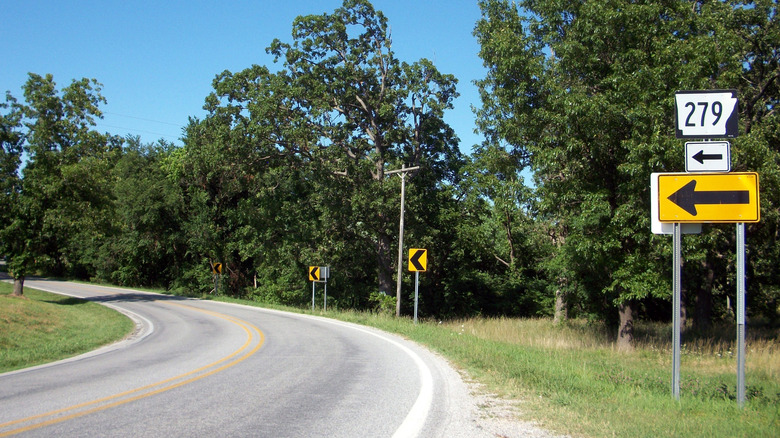
Since a chevron sign is an indication that you might need to slow down to take the curve in the road ahead safely, it might be easy to assume that if there are no chevron signs, you don't need to slow down. Unfortunately, it isn't quite that simple. That's because the MUTCD says that signs to indicate curves in the road are only mandatory on certain types of roads.
Assuming the curve in question has a speed differential of 20 mph or more, road planners are required to install them on expressways and freeways, as well as some busy major roads. However, on minor roads with less daily traffic, they might not always be present. They're also not required to be installed on curves with a speed differential of less than 20 mph, regardless of the road type, even if some other types of warning devices like delineators might be needed.
In some cases, road planners also don't have room to put the required number of chevron signs to properly warn about the curve ahead. You might see the curve marked by a rectangular sign with a large, one-directional arrow instead, or see both chevron signs and an arrow sign.
These signs are just two of the plethora of different signs that are designed to warn you about potential hazards on the road. Before you head out on your next road trip, it's also worth knowing about the different types of side road signs and the yellow and black striped signs that can sometimes be found at the roadside.