

What Does A Side Road Sign Mean & Are There Different Types Of Them?
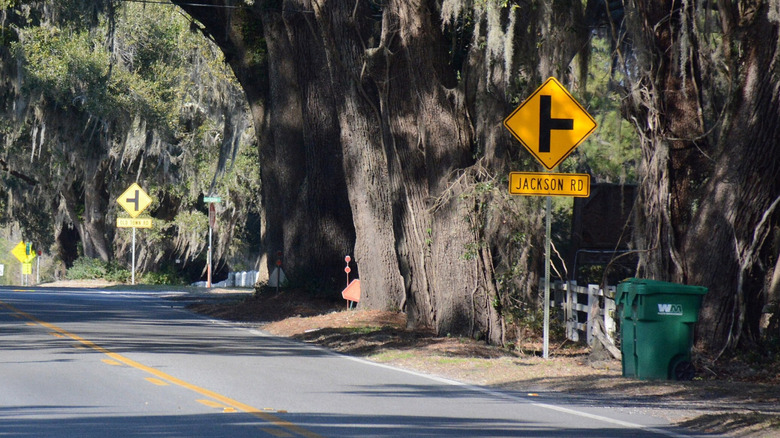
During virtually any journey on public roads, you're bound to pass by a large number of traffic signs. They serve a critical role, informing you of things like state-mandated speed limits, providing information about hazards to be aware of, and giving various other instructions that you must follow. Being able to read and understand them is a key part of staying safe on the road.
One common road sign you're likely to find around the country is the side road sign. It's one of a number of intersection warning signs that road planners use to let drivers know that an intersection is just ahead. A side road sign indicates that some vehicles on the road you're currently traveling on might be looking to turn, and it also serves as a reminder that vehicles from that side road might be looking to join the road you're on.
There are two main types of side road signs, both of which can show side roads to the left or right of your direction of travel. The first type displays the road you're traveling on, which is represented as a straight vertical line, connected to a horizontal line at a 90-degree angle. This sign indicates that a side road is coming up soon that's roughly perpendicular to the road you're traveling on. A side road sign will only have a horizontal line on either the left or right side of the vertical line — if the horizontal line intersects the vertical line and points both left and right, you're approaching a crossroads instead.
The angled side road sign is slightly different
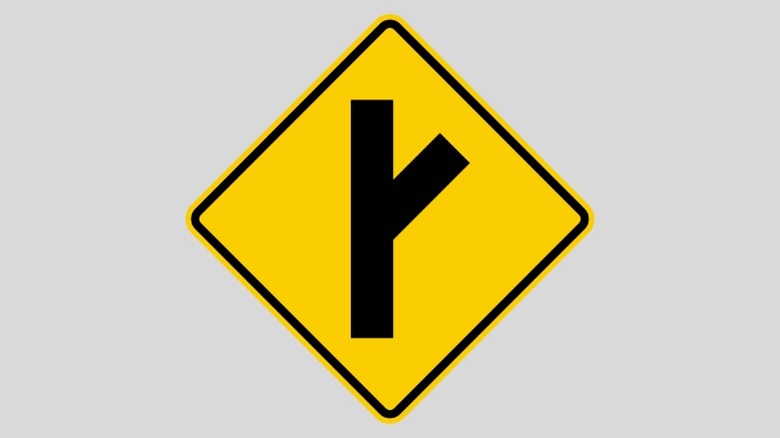
Alongside the first type of side road sign, there's a second type that looks very slightly different and gives drivers some extra information. A sign with a vertical line and a second line branching off from one side at an angle indicates that a side road is approaching with a layout that follows the direction of that angled line. For example, the sign pictured above shows that a side road is approaching at an angle on the right hand side.
Drivers looking to turn right out of that side road and onto the road you're traveling on may have a restricted view of traffic in the other direction, so it's worth being extra vigilant around the intersection. If you see a side road sign that shows the angled line pointing downwards rather than upwards, you should also be aware that traffic on the road you're traveling on might need to slow down considerably to take the corner.
Thankfully, once you've familiarized yourself with what the directions of the lines mean, side road signs shouldn't be a particularly confusing road sign to understand. They're easy to spot, as they always feature yellow backgrounds with black lines. In contrast, some other road signs vary in color, and their meaning can change based on the color of the sign background. If you're a new driver or want to brush up on your sign knowledge, it's worth checking that you know the difference between yellow and white speed limit signs, since you could end up with a ticket if you don't.