

What Does A Diagonal Yellow And Black Striped Road Sign Mean?
A motorist passes all sorts of road signs while driving. Some, like the classic red stop sign, are extremely familiar and so baked into our visual memory that we react instinctively, without a conscious thought. Other road signs, like the yellow or white signs that display speed limits, provide important information clearly and unambiguously.
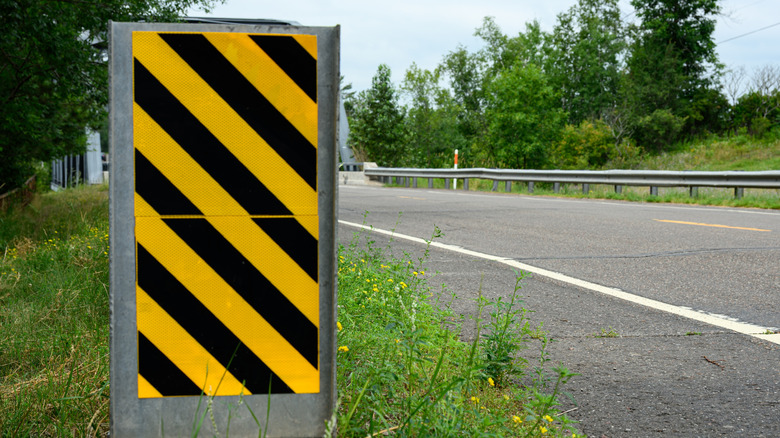
Then there are signs we may pass and notice but which may not offer immediately obvious information or guidance. One of these signs comes in different shapes and sizes, and while simple in design, doesn't always have a clear purpose. We are talking about the black-and-yellow, diagonally striped road signs that are known as warning signs, hazard signs, or object markers.
Depending on the road, weather conditions, and time of day, these signs may seem redundant or unnecessary, but they have a distinct and important purpose. That purpose is to warn and direct drivers around objects and hazards that may encroach on the roadway or shoulder.
A simple and effective marker
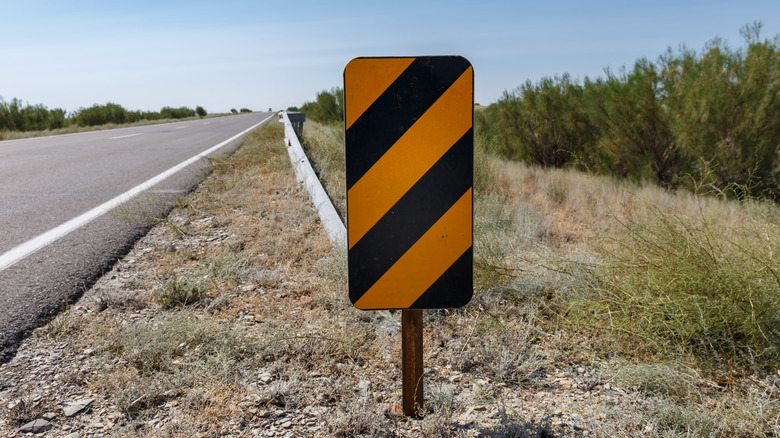
These black-and-yellow signs are quite common on roadways but are also among the most confusing traffic signs you may encounter. However, in this case, it's not because the signs are complicated or wordy. Instead, it's because motorists may not be sure of what the signs are trying to convey beyond attracting attention. As we'll discuss in a moment, though, that might actually be all they need to do.
The NHTSA's Manual on Uniform Traffic Devices calls for object marker signs as a visual warning for objects and structures that are either in the roadway or near the roadway shoulder. These can include things like piers, bridge abutments, handrails, walls, or anything else that may reduce shoulder width or otherwise alter roadway alignment.
The design and placement of these signs is quite simple, and once you know what they are communicating, they're easy to understand. Those diagonal, often reflective, stripes aren't just there to catch the eye as you drive by. The stripes are aligned downward at a 45-degree angle in the direction that traffic should pass by the obstacle.
Quietly doing their job
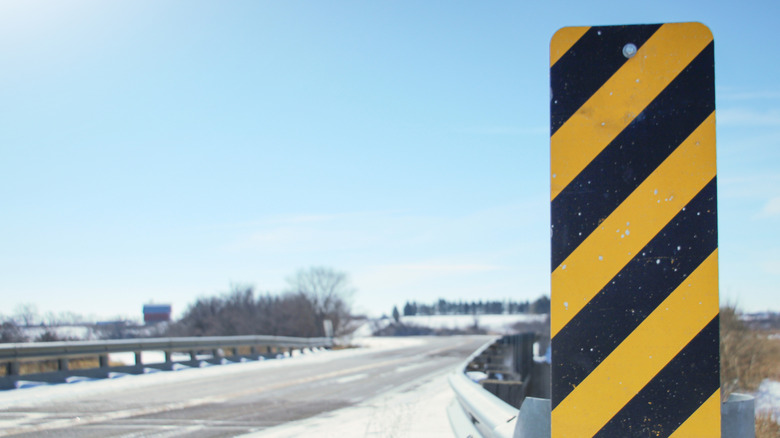
In some cases, like when these signs are placed in front of a highway bridge where the driving surface narrows, it might already be obvious that the road ahead is changing, leading some to think the signs are unnecessary. However, if you were approaching that same bridge while driving at night or in inclement weather, the black-and-yellow signs can play an important role in warning drivers what's ahead.
The purpose of the angled stripes on these signs might be less obvious than the arrows used on other traffic signs, but they probably don't need to be. Even if most passing motorists don't know what these signs are called, why their stripes go a certain direction, or exactly why they're placed where they are, they can still play a big role in improving safety simply as a visual marker. Like a red stop sign or a flashing yellow light, object markers can help a driver stay safe by catching their eye before they encounter changes in the road.