

Can You Use Regular WD-40 As Contact Cleaner?
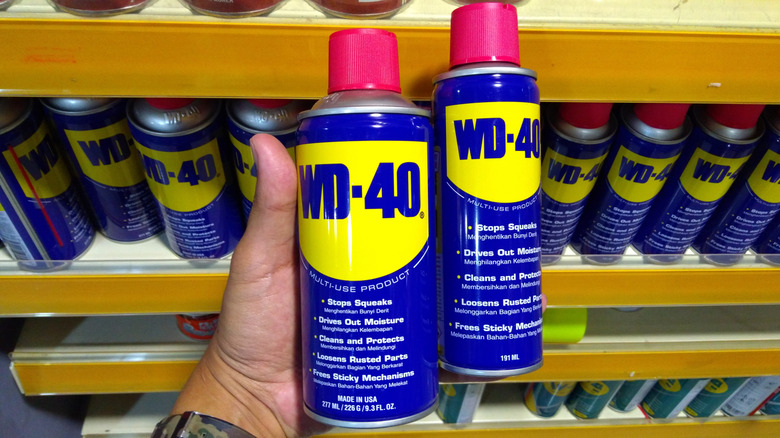
WD-40 is like a Swiss Army knife of the household. Two things are very likely: You've got a can of it somewhere, and you probably used it at one point in your life for anything from lubricating door hinges to cleaning stubborn stains. While it seems somewhat magical because it has so many uses, a miracle tonic it is not. In fact, there are plenty of surfaces you should never use WD-40 on. Take contacts, for example. The good old WD-40 is technically safe for contacts and won't cause any damage, but it's petroleum-based and will leave behind residue, meaning it's not the best option when you stack it up against solutions made for cleaning contacts.
Yes, WD-40 can prevent battery corrosion, but with something like WD-40 Specialist Contact Cleaner (or any other brand), you get no gunk and moisture protection. On the other hand, if you just need something to clean electronic contacts in, say, a PC, the company has you covered with its WD-40 Specialist Electric Parts Cleaner, which is static-free.
Are these WD-40 variants a marketing gimmick?

It sure looks like a perfect marketing trick when you think about it. Take a famous product and make a bunch of offshoots to encourage new purchases. Yet, it's far from the truth. For starters, regular WD-40 was never a contact cleaner in the first place. It was a chemical created for the aerospace industry to prevent rust, and was first used on the Atlas missile. The 'WD' part is an acronym for "Water Displacement," while, funnily enough, the '40' stands for the attempt on which they got the formula right.
When you dig into the chemical composition of different products, the classic WD-40 is petroleum-based, with a dash of additional chemicals like LVP aliphatic hydrocarbons. On the other hand, the Specialist Contact cleaner has no petroleum and contains isopropyl alcohol and heptane, none of which are in the classic blue and yellow can. Think of it this way: You may be able to clean a contact with WD-40, but it will also leave behind residue that can attract extra dust (a no-no if you're using it on a PC) and inhibit conductivity (a no-no if you're using it on battery contacts).
Of course, no product is perfect. Most contact cleaners are solvent-based, so there are many many things you shouldn't use WD-40 Contact Cleaner on. This includes materials like silicone, acrylic, and polycarbonate plastics. So, whatever you're cleaning and whatever product you're using, just don't spray it around like a madman.