

The Reason Why Some Helicopter Blades Are Filled With Nitrogen
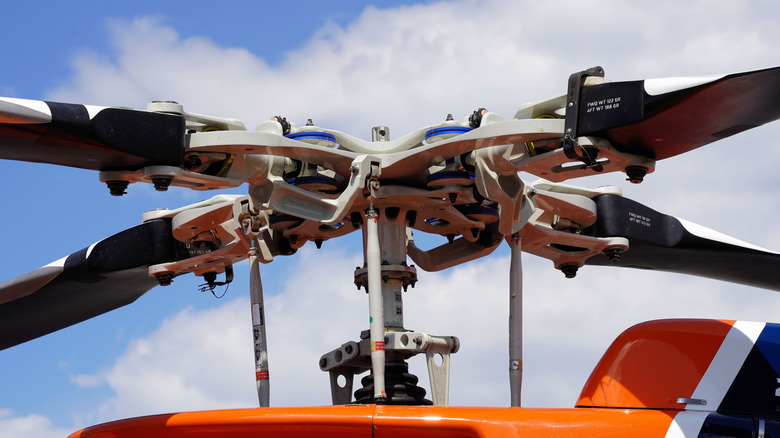
Nitrogen has some incredible properties, like lasting a surprisingly long time if you fill your car's tires with it. It also has surprising applications in aircraft, including in the blades of helicopters, where it can serve as an early warning system for potential structural failure. Rotor blades on helicopters have hollow main spars, the backbone of the blade, that serve as the primary load-bearing structure. Modern helicopters can reach incredible speeds, which can put heavy stress on those spars. If fatigue causes them to crack, the blade could potentially separate in flight, with devastating consequences.
To help spot hidden cracks, manufacturers often seal the spar and pressurize it with dry nitrogen. This way, if a leak develops, gas escapes and the pressure drops, revealing damage that may not be visible from outside the blade. The technique relies on a pressure indicator at the root of the blade or a cockpit warning system that tracks the spar's internal pressure, which will flag the blade as unsafe if pressure drops. Nitrogen is a great choice for this because it's inert, dry, nonflammable, and also so widely available.
Still a common technique
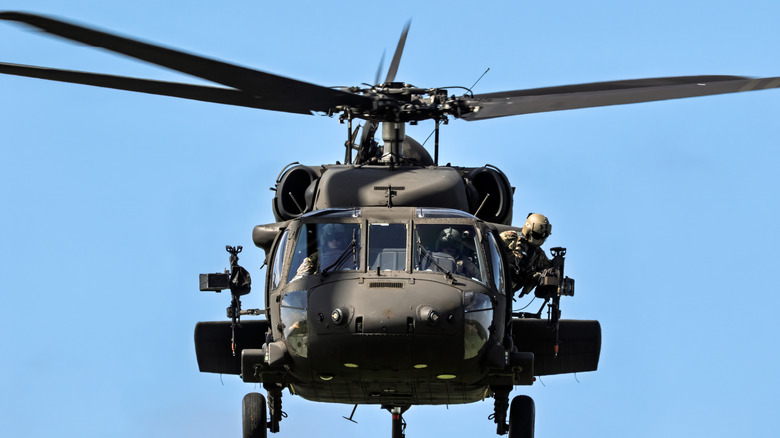
The method is still used today, though it's not universal on modern helicopters. The Sikorsky H-60 family of helicopters, for instance, including the famous Black Hawk, use main rotor blades with pressurized titanium spars filled with nitrogen specifically to detect cracks. Loss of pressure triggers an indicator found at each blade's root.
The system is also used on other Sikorsky choppers, like the CH-53E. It features an In-Flight Blade Inspection System with an indicator that triggers if depressurization is detected in a spar. That said, nitrogen filled spars aren't a feature of all contemporary rotor blades.
Alongside other innovations, like those that allow a chopper to rapidly change direction, new systems have been introduced to monitor spars for cracks. Beyond standard visual inspection, these include ultrasonic testing, radiography, or using liquid penetrant to expose cracks. Newer variants of the CH-53 use all-composite rotor blades that eliminate the pressurized spar, though older variants still rely on the nitrogen system.