

How Long Does Nitrogen Last In Tires?
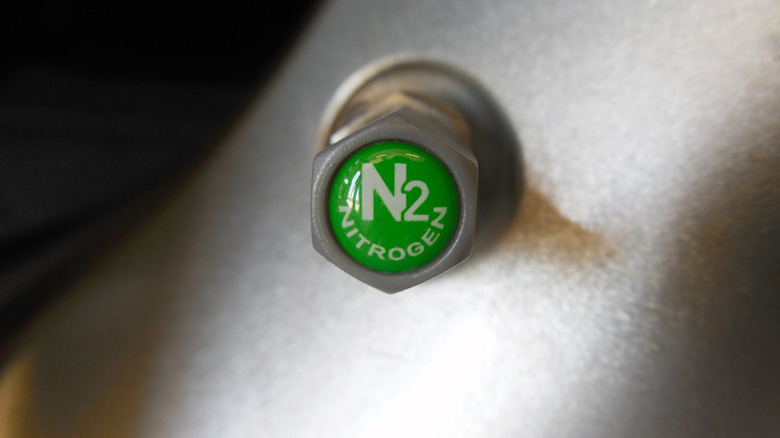
In the past decade, the idea of nitrogen-filled tires has gained popularity, with many willing to pay extra for it. And it makes sense to a certain extent, given that there are several benefits to filling your tires with nitrogen, such as improved fuel efficiency, extended tire life, or better pressure retention. However, not every benefit applies to the average car owner, and some don't make that big a difference. For instance, it's true that regular air degrades tires faster than nitrogen due to oxidation, but you are more likely to replace the tires from wear and tear before this degradation even becomes noticeable. Similarly, there's a lot of discussion about how long nitrogen lasts in tires, and as surprising as it may sound, there's no clear answer. Many factors are at play, but under ideal conditions, nitrogen-filled tires perform better, with lower pressure loss.
There is clear science behind this. While both regular air and nitrogen permeate rubber tires, given their porous nature, nitrogen holds up comparatively longer because it has larger molecules. The larger molecular size makes it harder for the gas to escape through the small pores. But nitrogen does escape, albeit at a lower rate compared to regular air. If you think your nitrogen-filled tires won't need top-ups, you are wrong, but it certainly wouldn't be as frequent. As for how long nitrogen-filled tires will maintain optimal pressure, you will need to consider other aspects as well.
It depends on several factors
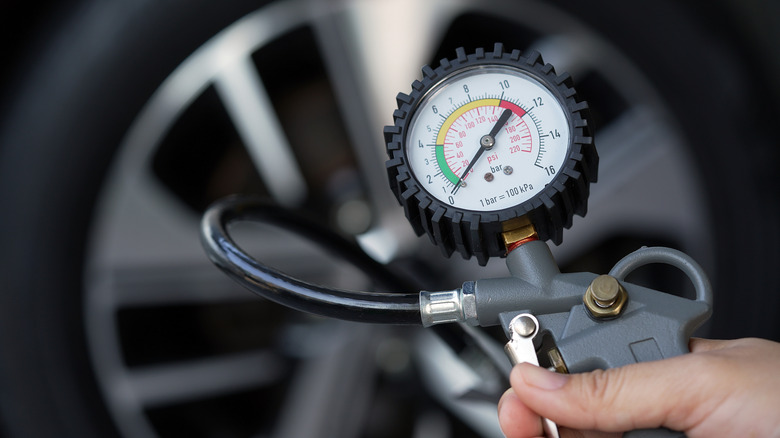
Consumer Reports performed a test in which they filled tires with nitrogen (95% purity) and regular air to 30 psi at room temperature, then left them outdoors. After 12 months, the tires filled with regular air lost 3.5 psi, while nitrogen-filled tires lost 2.2 psi. That's a difference of 1.3 psi over one year. As you can see, it's not much, but something worth considering if you are deciding between nitrogen and regular air for your car's tires. Another study by the Department of Mechanical Engineering at Clemson University also supports these results. The team behind the study found that nitrogen-filled tires maintained pressure about 35-55% better than regular air at room temperature. But these tests were largely conducted under ideal conditions, which is not what the average car owner deals with.
In real-world conditions, other factors like leakage and temperature matter too. For instance, if there is a leak around the valve or wheel, your tire will lose air pressure faster. Not having a tire valve cap can also increase pressure loss. The temperature also plays a key role. As temperature rises, so does the pressure of the gas inside the tire, which in turn can increase the amount of air or nitrogen permeating through the tire. So, if you drive in a region where the weather is generally warmer or regularly go on long drives, this may accelerate air loss.
Get the most out of nitrogen-filled tires
As you can see, there's no definite answer as to how long nitrogen will last in your car's tires, because there are a lot of variables at play. Even with the same set of tires, driving in different conditions can speed up or slow down air pressure loss. Generally speaking, you should get the tire's air pressure checked every month. Ideally, do this in the morning when the tires are cool for a more accurate reading. And if you notice a significant deviation from optimal tire air pressure, it's time to inflate the tires.
Keep in mind that maintaining optimal tire pressure directly affects the tire's lifespan, overall driving comfort, and your safety. If the air pressure is low, it decreases fuel efficiency, increases braking distance, and you also run the risk of a tire blowout. So, if you ever notice low air pressure, top it off immediately. That brings up another common question: Can you put air in a nitrogen-filled tire, especially since nitrogen pumps are still uncommon? The answer is yes. Remember, air already comprises 78% nitrogen. What's called nitrogen for tires simply has a higher concentration of the gas (90-95%) and fewer impurities. So adding air to nitrogen-filled tires just changes the nitrogen concentration, which isn't a problem.
Nitrogen-filled tires also have downsides you can't overlook, whether it's the higher cost or limited availability. That said, between air and nitrogen, the latter has an edge, but you should still regularly monitor your tire pressure, regardless of what you fill it with.