

What Could It Mean If A Spark Plug Is Black?
If you have a gasoline-powered car, spark plugs are what put the "combustion" into the term "internal combustion engine." The process of actually burning the fuel needs three things: the fuel to mix with air and enter the combustion chamber, the fuel needs to burn, and then the spent gas goes out. That's the basic principle behind all combustion-powered vehicles and why your spark plug is so important. Without spark, you get no ignition. Without ignition, your engine no worky.
At first glance, it seems like spark plugs are just another critical part of the car. You have a bunch of those, so what makes these little guys so special? The answer is because of how they interface with the car — when the service interval is up and you change the spark plugs, you're opening a window to the inside of the combustion chamber. You can actually read a lot of what's going on inside your engine just by looking at the head of the spark plug. Factors like moisture buildup, color, carbon fouling, and so on will tell you a lot about how your engine is running.
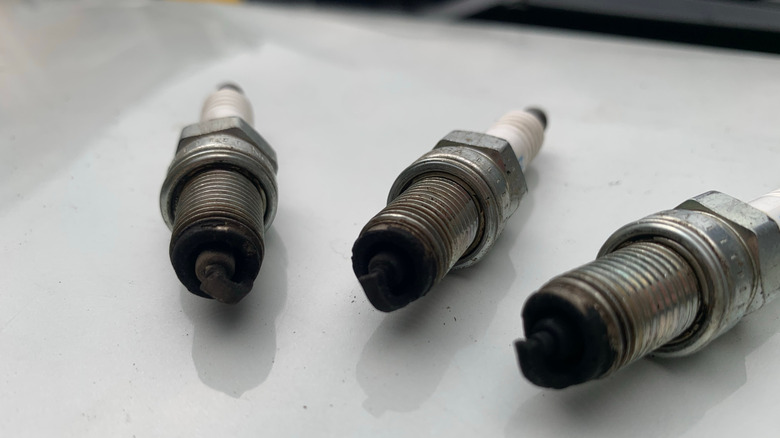
The secret is in the color and texture of the spark plug head — the part sitting in your combustion chamber. In this case, let's assume your spark plug is black. There is a whole host of issues that cause this, ranging from oil in the combustion chamber to running rich. Carbon fouling, dirt, wet grime — it all looks relatively similar, appearing as wet or dry soot. Let's have a look at the details, one by one.
The root causes of blackened spark plugs
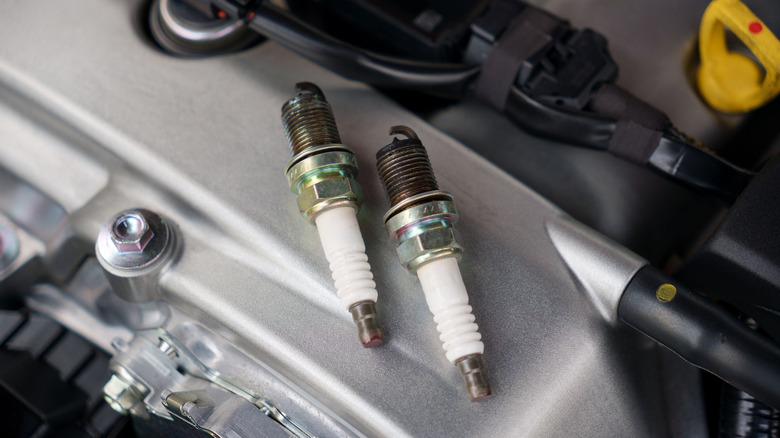
As a point of comparison, your spark plug should be relatively clean of contaminants, perhaps with some brown or sandy detritus on the electrode, but nothing should be flat-out black, like the thing had been in a fire or something. Nor should it be white — a white spark plug usually means your engine is running too lean.
Conversely, if you see a lot of carbon buildup and it's dry and crusty to the touch, that's all unburnt fuel. Your engine is running too rich, meaning it's injecting too much fuel for too little air in the combustion chamber, and some of that fuel isn't being ignited properly. This leads to carbon deposits forming on the working surfaces — the chamber walls, piston head, valves, and spark plugs.
However, that fuel is eventually being burnt, just not properly. If the fuel is straight-up unburnt, meaning your spark plug is black, wet, and reeks of gasoline, then you aren't producing combustion at all. This could be the result of failing to start the car and flooding the engine, a mechanical failure like the coil or plug itself going bad, or the injector leaking fuel into the cylinder.
If it's wet and doesn't smell like gas, that dampness is likely engine oil. Oil can enter the combustion chamber if you have worn piston rings, a bad head gasket, or improperly toleranced valve stems and guides. This also means your oil will disappear, since your engine is burning it, so check your oil levels.
What to do if your spark plugs are black

Generally, your spark plugs will be black either because of some other mechanical issue, or because you're doing a lot of short trips, which incidentally also harms turbochargers. The latter reason isn't specifically a mechanical fault; rather, it's because the engine doesn't reach a high enough operating temperature to burn off the fouling that naturally occurs when your engine is cold and running rich. So with all other things being equal, a good way to check if it's just this is to go for a longer journey and allow the engine to run at its ideal temperature.
Assuming that there is an underlying mechanical fault, however, you'll want to inspect the actual combustion chamber with a borescope to confirm the presence of deposits or oil, then act accordingly. Excessive carbon fouling due to a rich mixture is likely caused by a clogged air filter, so check that first. You can also check fault codes and test the injectors and coils or distributor. Also, make sure you have the correct plugs for your engine's usual operating temperature.
Wet and blackened spark plugs is another issue entirely, generally requiring a bottom-end service or a valve job. Oil is leaking past either the pistons themselves or the valves, so this is a far more intensive fix. Finally, to prevent spark plugs from blackening again, that's the easy part — do the maintenance. Change the air filter on time, keep on top of worn components in the fuel and ignition, and occasionally take the car out for extended drives.