

Porsche Turbocharged Its Largest Four-Cylinder To Create This Ultra-Rare Sports Car
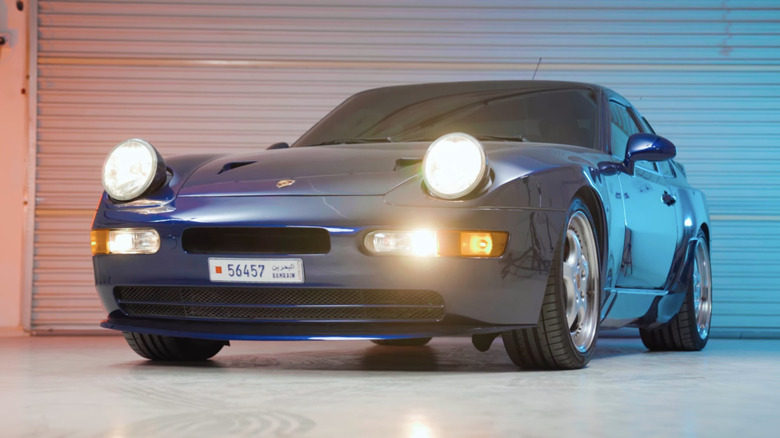
When you imagine a Porsche, you probably think about the 911,or maybe a GT3 with its iconic and rather rare 4-liter six-cylinder engine. After all, the 911 is the car that defined the brand, and we are now in an era where turbocharging isn't limited to just the 911 Turbo. Even the upcoming GT3 and GT3 RS are rumored to sport a turbocharged flat-six, which would be the very first time Porsche goes in that direction with its 911 GT3 cars.
Although we have yet to see that, Porsche's experience with turbocharging is actually quite vast. At one point, the German automaker even turbocharged one of its vehicles to create a truly ultra-rare sports car. Best of all, it actually was not a 911, nor did it have a flat-six. So what was it? The answer is the 968 Turbo S, and its 3.0-liter four-cylinder was built for an unusually small run of cars.
Only 14 street-legal Turbo S models exist, joined by four 968 Turbo RS race cars from 1993, for 18 cars in total. The street cars existed so the Turbo RS could race in the 1993 ADAC GT Cup. It ran 8:1 compression with eight valves, and the engine made 305 horsepower and 369 lb-ft of torque. Top speed was 175 mph, and curb weight came in at 2,866 pounds.
Porsche priced the Turbo S at 175,000 Deutsche Marks (around $105,000 in 1993 dollars) and planned for 100 units, but made only 14. For a spot of context, there were more than 1,400 964 Turbo 3.6s built — that gap explains values. A Turbo S prototype brought $516,500 at RM Sotheby's in 2023, and one example in 2021 sold for $792,000. For a four-cylinder Porsche that so few people bought, that is quite the second life.
What was the Porsche 968 Turbo S?
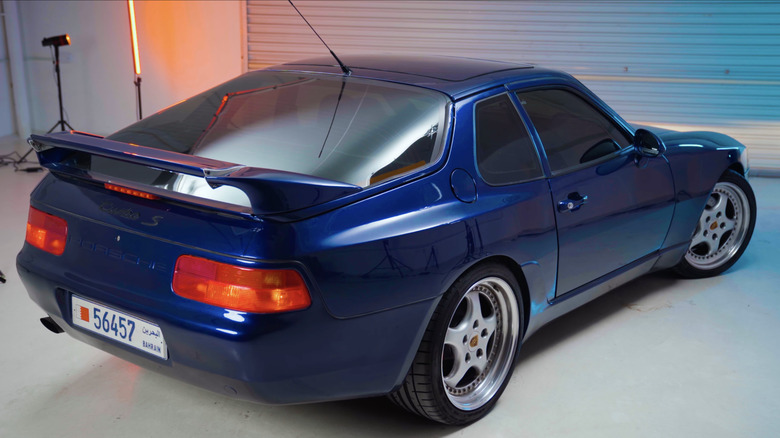
Porsche Motorsport assembled the 968 Turbo S in Weissach from parts across the 944 and 968 lineup: a 944 S2-type block, a 944 Turbo cylinder head and a KKK K27 turbocharger. That head has no VarioCam, the variable valve timing found on the regular 968. Boost topped out at 1.0 bar (about 14.5 psi), and torque peaked at 3,000 rpm. The differential was a 75 percent locking Torsen unit.
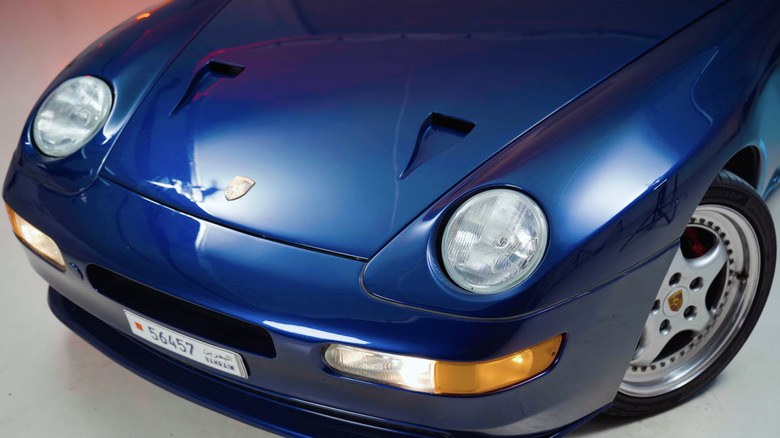
The Club Sport was the base, with NACA ducts in the hood and two Turbo badges under it. Factory option code M510 marks a genuine car, which matters because replicas exist. ADAC GT Cup rules set a limit of 4 kilograms per metric horsepower. The RS ran 337.5 PS (about 333 hp) and carried ballast. On May 9, 1993, at AVUS, Manuel Reuter started third and finished fourth for Joest — the best documented finish for the car.
Joest's white RS sadly crashed later in its only race at the Nürburgring. In total, only two teams entered a Turbo RS in the ADAC GT Cup, and other Porsche teams stuck with the 964 Carrera RSR. Team boss Michael Roock, whose team ran both models, was quoted at Elferspot, "The quality of the RSR was the 968 Turbo RS's undoing." Reuter's car, the RS prototype, went on to Seikel Motorsport in 1994 and reached the 1995 Sebring 12 Hours.
Porsche priced the RS at a rather feisty DM 228,000 (about $138,000 in 1993 US dollars) and built no more than four in total. Although the 968 Turbo RS is not one of the most successful Porsches ever, it does rival some of the rarest Porsche 911s ever made, and in the Porsche collector's world, this is often as important as winning.
Porsches with four-cylinder engines
As mentioned previously, Porsche is predominantly associated with the flat six or even with a V8 with some of its luxury cars like the Panamera and the Cayenne. However, there have been plenty of four-cylinder Porsches throughout history. Think of the 1950s 356A Speedster, the 1960s 904 Carrera GTS, 1980s 924 Carrera GTS Club Sport, or 1990s 944 Turbo S, each and every one of them iconic Porsche sports cars.
Porsche's 350 hp turbocharged 2.5-liter flat-four from the 718 Cayman and Boxster models is actually one of a few four-cylinder engines that pump out more power than most V8s. You can also get the compact luxury SUV, the Macan, with a two-liter turbo inline-four that puts out around 261 hp. The good bit is that this can give you combined mpg numbers in the mid 20s.
Once you step back from the 911s, Cayennes, Panamera, and Macans, you can actually see that Porsche stuck four cylinder engines in a wide variety of cars, most of which were never as famous as the ones we just noted. The Porsche 944, the 924, the Porsche 914, the 968 — all of these were offered with four cylinder engines.
Given just how strict modern day emissions regulations are, MotorTrend has recently also reported that the upcoming Macan replacement will also feature a new four-cylinder, meaning that four-pot Porsche engines are not going anywhere anytime soon.