

The World's Smallest Diesel Engine Is Pocket Sized (And Built For Flying)
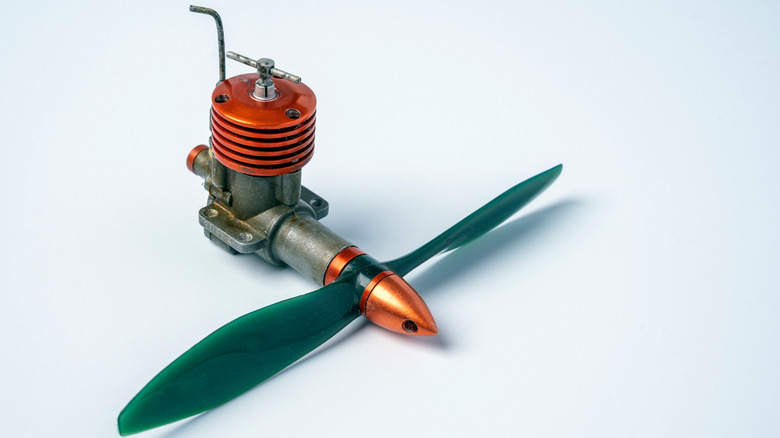
Diesel engines are often associated with size and power. One of the biggest engines that's truly massive measures 88 feet, 7 inches long. However, did you know there's a diesel engine that's not even a full inch in length? Back in 2011, Ronald Valentine and his brother Chris built the Nano Bee, considered the smallest working diesel engine in the world. It's 7/8 of an inch long, with a bore and stroke of just 2mm and the displacement of only 0.006cc. Oh, and it has a single-cylinder.
The numbers are astonishingly small, but the Nano Bee is fully functional, the product of decades of experience building miniature engines. It burns a tiny amount of diesel to spin its 1-1/4x1 inch aluminum propeller at up to 12,800 revolutions per minute. It's machined from aluminum and steel, with some tolerances held to one ten-thousandth of an inch. That precision also makes its quite delicate, and it can easily break.
Despite all this, the Nano Bee was designed to be a model airplane engine, about as far as you can get from the largest engine ever put on a plane. Valentine has been building tiny engines in small batches for decades, using them to test how compact a diesel engine can get while still running. As he explained on his now retired website, radio control equipment had became so small that it was finally possible to fly most of his miniature engine in planes.
What's the smallest mass-produced diesel engine?

It'd be extremely difficult to find a diesel engine smaller than the Nano Bee. Valentine's engines are made in small batches. If you're looking for one of the smallest diesel engines ever, used in a mass-produced car, look no further than the Suzuki E08A. The two-cylinder engine powered the diesel version of the Suzuki Celerio in India, and with just 973cc, it made 47 horsepower and 92 lb-ft of torque. Unsurprisingly, it wasn't very fast.
The diesel Celerio was was sold from 2015 to 2017, and it was quickly discontinued after a poor reception. The engine didn't offer much power, and it was known for being noisy, with vibrations you could feel through the peddle and the steering wheel. On the plus side, it had a rated fuel economy of about 65 miles per gallon. Today, the Indian market Celerio uses a 1.0-liter, three-cylinder K10C Dualjet engine, which brings it up to 67 hp, making it one of the least powerful new cars.