

Black Hawk Vs. Huey: What's The Difference Between These Military Helicopters?
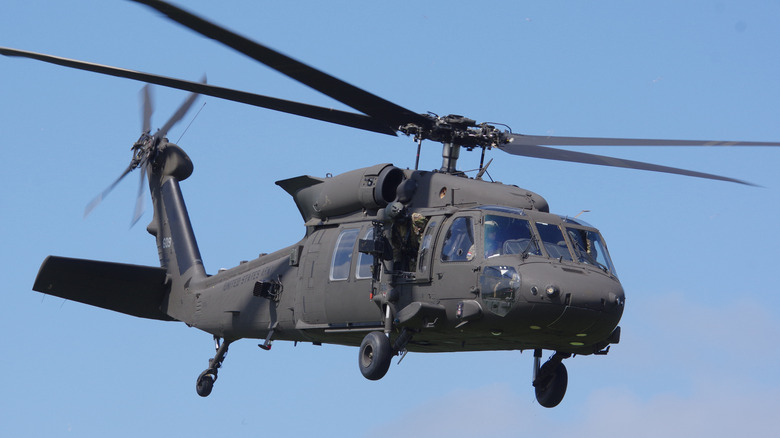
The Black Hawk is a special helicopter, known inside and outside military circles as one of the U.S. Army's most versatile aircraft. The Huey also has a big reputation as a legendary U.S. Air Force chopper. While both are utility helicopters used by certain branches of the military, there are some differences when it comes to configurations, capabilities, and intended uses.
The Sikorsky Black Hawk is powered by two GE T700 engines and has a large cabin that can be configured for a range of missions. Depending on that configuration, it can transport personnel or equipment, carry loads outside the aircraft, use additional fuel tanks, and operate in challenging environments. It can also be equipped with integrated sensor setups and is designed to operate in tight spaces. The Black Hawk has continued to receive upgrades over the years, with newer versions incorporating changes to improve its performance, survivability, and ease of maintenance.
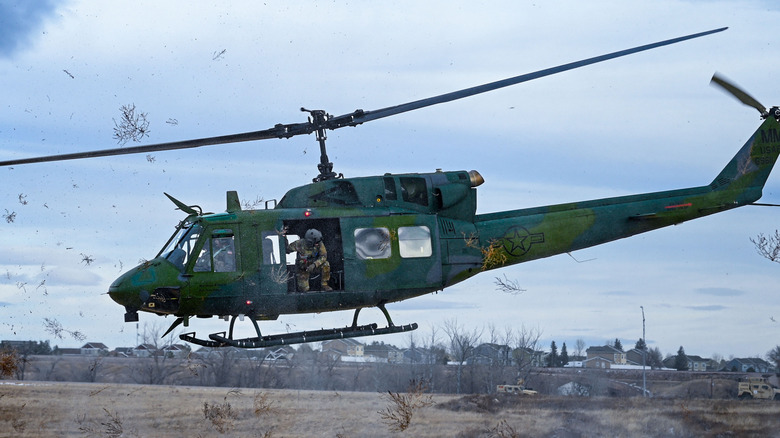
The Air Force's UH-1N Huey is a light-lift helicopter used for a range of support missions. It uses two Pratt & Whitney T400-CP-400 turboshaft engines and can transport personnel, support search-and-rescue operations, and respond to disasters. It can also perform medical evacuations and assist with security for off-base nuclear weapons convoys. When configured for passengers, the Huey can carry up to 13 people, though that number can vary depending on fuel and outside conditions. Its cabin can also be configured to carry up to six medical stretchers or other cargo when the seats are removed.
The histories of the Black Hawk and Huey
The Black Hawk entered U.S. Army service in 1979, after Sikorsky was selected to build the helicopter in 1976. As the years went by, the UH-60A Black Hawk was eventually replaced by the UH-60L and then the UH-60M, while the Black Hawk family expanded to include the Navy's SH-60B Seahawk version. Sikorsky also built Black Hawks for various foreign military organizations. However, the Marine Corps stayed with its Huey and Cobra helicopters, replacing the UH-1N and AH-1W with the UH-1Y and AH-1Z.
The Huey's history goes back further than the Black Hawk's, with the former helicopter's development beginning in the 1950s. Bell Helicopter's design was selected in 1955 and the Huey prototype first flew the following year. The Army began ordering the helicopter as the HU-1 in 1960, which is where the "Huey" nickname came from. By the mid-1960s, Huey variants were being used by every branch of the U.S. military. The Huey became well known for its service during the Vietnam War.
By 1969, the Army was planning a new utility transport aircraft that could carry about twice as many troops as the Huey. The proposed aircraft was also expected to provide the same lift capability at a lower estimated operating cost. That program eventually produced the UH-60A Black Hawk, which took over the Huey's role as the Army's primary utility helicopter.