

3 Drawbacks To Using Your Phone As A Mobile Hotspot
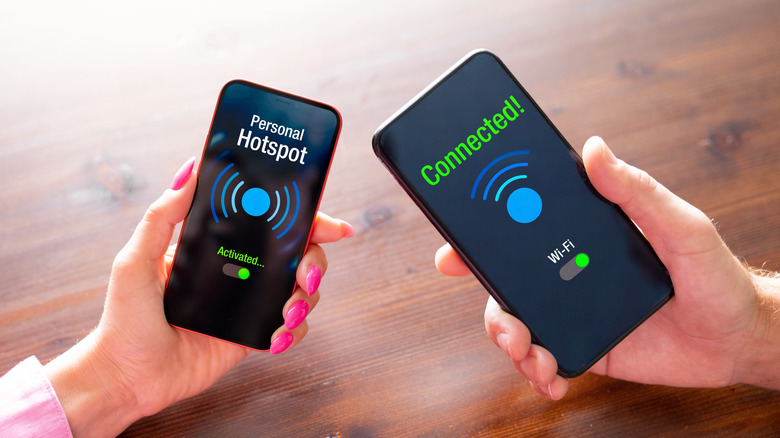
When you're in a public space like an airport or the subway, it's not advisable to connect to the available public Wi-Fi because doing so could carry security risks. And if you do, there are certain things you shouldn't do on your device when connected to any public Wi-Fi. But instead of depending on public Wi-Fi, you can use your phone as a mobile hotspot. Doing so provides a quick and easy way to get internet access on all your devices, either through tethering or by creating a wireless access point that multiple devices can connect to.
Your phone's mobile hotspot can also come in handy if you're in an area with no wireless access point whatsoever or when your regular Wi-Fi is down. However, while using your phone as a mobile hotspot offers flexibility and convenience, it isn't perfect. It comes with several drawbacks you need to keep in mind before making it a habit.
As someone who uses their phone as a mobile hotspot from time to time, most commonly to provide internet access to my car's infotainment system and also to get my household devices online when Wi-Fi is out, I've experienced several issues firsthand that I can share from my own experience.
Your phone batteries drain faster
One of the biggest drawbacks you'll run into every time you use your phone as a mobile hotspot is increased battery consumption. Typically, anything that makes your phone work harder than usual, such as gaming, does cause the battery to drain faster than usual, and the same applies here.
When you enable the mobile hotspot feature, your phone has to do two things. First, it has to maintain a cellular data connection and, second, broadcast a Wi-Fi signal so that other devices can connect to it. That adds an extra load on your device, resulting in more battery drain than simply using it to browse the internet. You might also experience your phone getting hot when the hotspot is turned on, an indication of just how hard it is working to keep your devices connected to the internet.
As a result of the faster battery drain, you'll need to charge your phone more frequently than you normally do. And don't forget batteries are consumable parts that degrade over time. So using your device as a mobile hotspot will also negatively impact your phone's overall battery health and longevity because you have to recharge it frequently.
Your mobile data consumption increases
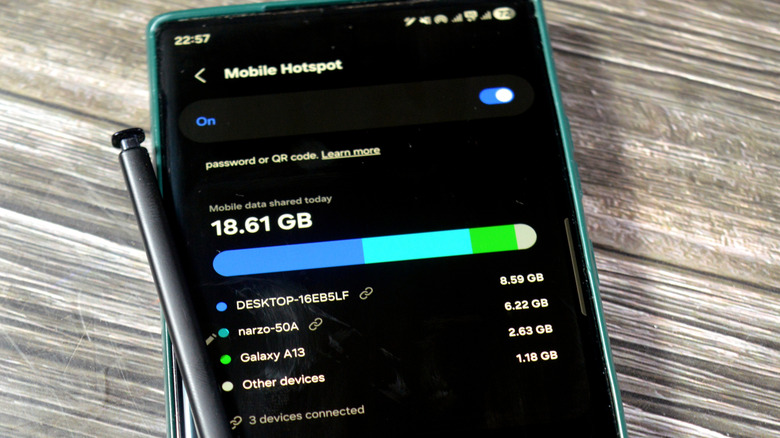
Another challenge with using your iPhone or Android phone as a mobile hotspot is that it'll increase the amount of data you use. If your cellular subscription has a certain specified limit each month, you might quickly run through your quota before the month ends if you're not careful. The reason for that is pretty simple: Sharing your connection with other devices means they'll be accessing the internet using the same data bundle you normally rely on to browse the web, stream videos, and other online activities.
With multiple devices accessing internet data from the same plan doing all kinds of things from streaming videos, playing games online, or browsing the web, they'll eat into your monthly allocation faster than you typically do, which can result in overages. Of course, if you pay for a cellular plan with unlimited high-speed data, that shouldn't be a problem.
However, some unlimited plans usually have a catch. They'll offer a specific amount of high-speed data, which once exhausted will throttle your internet speeds, forcing you to purchase more data within the month to continue enjoying fast internet access. For example, US Mobile's Unlimited Flex plan gives you 10 GB of high-speed data, which once exhausted, allows you to continue accessing the internet but at a slower 1 Mbps speed.
Your internet connection may be unstable or slow
The other drawback of using your phone's mobile hotspot is that the internet connection can be inconsistent. Unlike using Wi-Fi, which generally offers a more stable connection, your phone relies on a cellular network, which doesn't provide a consistent experience. Even if your ISP plan promised Gigabit speeds, the actual internet speeds that you'll enjoy when connected to a cellular network depend on factors such as coverage, signal strength, and network congestion.
If you live in an area where the cellular coverage isn't great (which is pretty common in some rural areas), or your house is located a distance from the tower so it doesn't get the best reception, your mobile hotspot can't deliver the best speeds. Instead, that speed will fluctuate depending on where you are and how many people are connected to the same cellular tower at that point.
To make matters worse, the multiple devices connected to your mobile hotspot mean they have to compete for the same bandwidth, which in turn leads to a sluggish experience for everyone. This doesn't only apply to mobile hotspots alone; connecting many devices to regular Wi-Fi can also slow down your internet connection.