

The US' Last WWII Aircraft Carrier Has A Truly Incredible Story
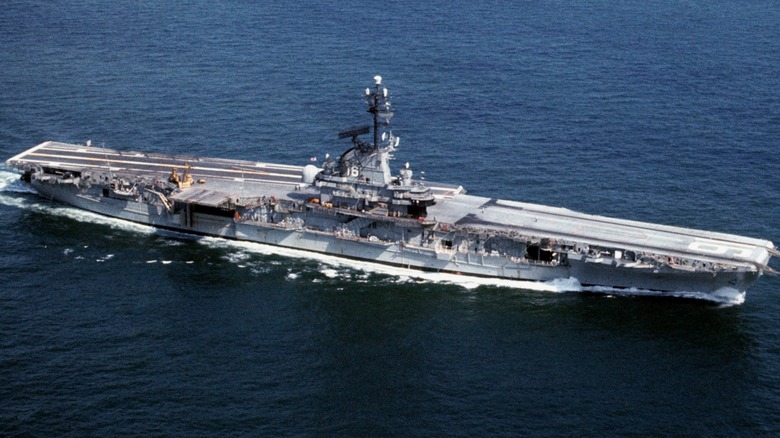
The United States Navy commissioned a lot of aircraft carriers in the 20th century, and the most-used class of carrier was the Essex-class. Ships of the Essex-class were built during World War II, and by 1950, 24 were constructed, making it the aircraft carrier class with the most ships as well as the most capital ships of a single design. Essex-class carriers helped the U.S. win the Pacific Theater of WWII, and while several American carriers were sunk during the conflict, many more survived.
Of the 24 Essex-class carriers constructed, four remain as functioning museum ships, one of which served the Navy the longest. The USS Lexington (CV-16) is the fifth U.S. Navy ship to bear the name that honors the Battle of Lexington, and was commissioned in 1943. The sailors who served aboard it called the Lexington "The Blue Ghost," and it took part in several major military engagements during WWII. Of course, the ship didn't get through the conflict unscathed, and the Japanese reported it sunk four times. That didn't happen, and the Lexington survived the war and continued serving longer than any other Essex-class carrier.
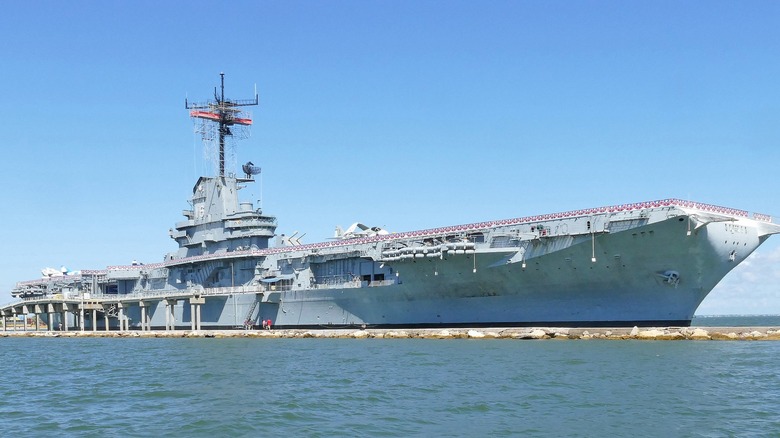
After WWII, the Lexington was decommissioned and later modernized following a significant overhaul, which changed its designation to an attack carrier, or CVA. Before long, it became a training carrier (CVT), and was finally decommissioned for the last time in 1991. That wasn't the end of the Lexington's story because the ship became a National Historic Landmark in 2003 and continues to serve as one of the U.S.' five aircraft carrier museum ships. It is permanently moored in Corpus Christi, Texas.
The USS Lexington's WWII combat record
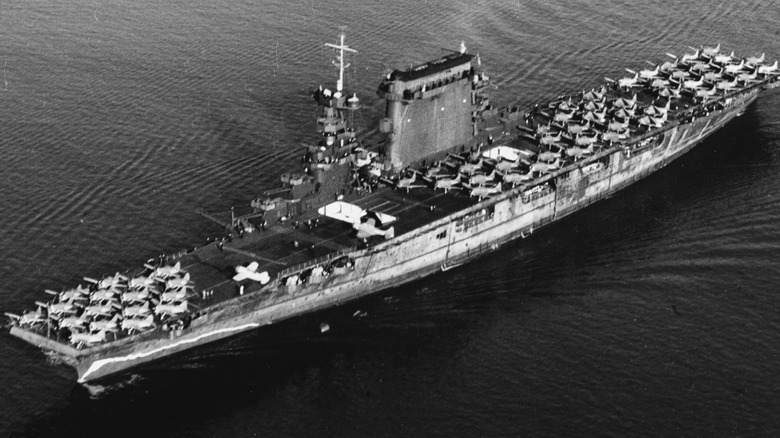
The USS Lexington was originally meant to be named Cabot, but was renamed Lexington after the USS Lexington (CV-2) sank at the Battle of the Coral Sea. After commissioning, the Lexington joined the Pacific Fleet and entered combat for the first time during a raid on Tarawa Atoll. This was followed by similar raids at Wake Island, the Marshall Islands, and Kwajalein Atoll. The Lexington achieved its first sinking when its aircraft destroyed the SS Kembu Maru, but it took a torpedo hit that caused significant damage.
The Lexington fought in the Battle of the Philippine Sea and the Battle of the Leyte Gulf, and it later participated in attacks on the Japanese home islands toward the end of the war. Throughout it all, the Lexington and its aircraft destroyed a large number of enemy airplanes and ships, including the sinking of the Ise, Japan's massive battleship. Other ships taken down by the Lexington's air wing include the battleship Musashi, as well as three aircraft carriers: Zuikaku, Chitose, and Zuibo.
For its combat service during WWII, the Lexington received 11 battle stars as well as several additional awards. While the ship never sank, Japanese propaganda claimed to have sent the Lexington to Davy Jones' Locker four times, and it always popped back up to return to the fight. Granted, it was hit several times, requiring repairs, and there were casualties, but for the most part, the USS Lexington's WWII service saw it get through the conflict to patrol the skies over Japan after the war ended.
The USS Lexington's post-war activities and retirement
Like many U.S. Navy ships at the end of WWII, the USS Lexington was decommissioned and added to the Reserve Fleet. It underwent extensive modernization efforts, beginning in 1953. The carrier was completely rebuilt, changing its flight deck from the WWII standard straight line to an angled flight deck now common in modern American aircraft carriers. This helped the Lexington launch jet aircraft, ensuring it remained relevant as new technology brought heavier, faster, and deadlier planes to its hangar.
It was recommissioned in 1955 and joined the 7th Fleet. Further modernization efforts kept the Lexington a working aircraft carrier, and it was briefly redesignated as an attack carrier during the Cuban Missile Crisis. For the remainder of the 20th century, the Lexington was used primarily as a training vessel, and it earned the honorable distinction of being the first aircraft carrier women were stationed aboard, though this didn't occur until 1980.
As time passed, the Lexington became less competitive as newer nuclear-powered aircraft carriers were filling the fleet. Finally, after recording more than 493,000 training arrested landings, the Lexington ended active fleet service on March 9, 1991, ending the ship's impressive five decades of service. Of course, the ship didn't go to the scrapyard or become an artificial reef. Instead, the USS Lexington docked at Corpus Christi, Texas, where it continues to operate as a museum ship, keeping its history alive as a popular tourist attraction and National Historic Landmark managed by the National Park Service.