

Trucker's Traffic Stop Turns Into 72 Charges After Officer Sees The Plates
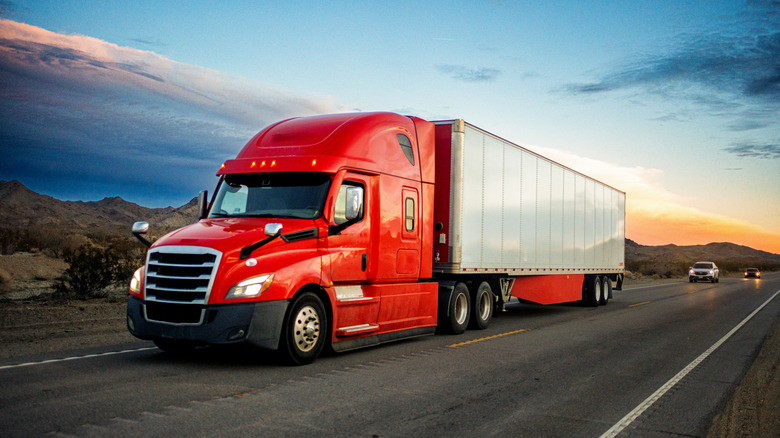
Police find plenty of odd things during traffic stops, but a piece of paper covering a tractor-trailer's license plate is an especially questionable sight on a toll road. That's allegedly what happened on July 15, 2025, when a Pennsylvania State Police trooper stopped truck driver Ashon Harris' Freightliner near the Pennsylvania Turnpike's I-83 interchange in York County. The paper partially covered the trailer's rear plate, allegedly preventing license plate readers from identifying it.
The traffic stop itself wasn't particularly kind to the truck. According to ABC 27, police said it wasn't displaying registration, and an inspection found 21 other violations. Earlier that month, Harris had reportedly drawn a fare-evasion citation after the same truck was involved in a crash and authorities found its plate obscured. Investigators subsequently dug through license plate reader data and alleged that the same truck had traveled the Pennsylvania Turnpike about 70 times between Aug. 15, 2024, and July 15, 2025. The Turnpike calculated the unpaid tolls at $16,097.74.
As of June 2026, Ashon Harris and his supervisor, Shawn Harris, were each charged with 72 counts: 70 counts of fare evasion, one count of theft of services, and one count of corrupt organizations. Those remain allegations, but they leave two particularly interesting questions. How did one truck allegedly accumulate more than $16,000 in tolls, and if investigators couldn't read its plate, how did they apparently find those 70 trips?
How commercial truck tolls can reach hundreds of dollars per trip
Seventy trips and $16,097.74 in allegedly unpaid tolls average roughly $230 per trip. That sounds steep until you look at what Pennsylvania charges a commercial truck for a long Turnpike run.
The Turnpike bases commercial-vehicle tolls partly on axle count and height, while its official toll calculator lists five axles as the configuration used by most commercial vehicles. Toll By Plate is also considerably more expensive than E-ZPass. The Turnpike's 2025 Toll By Plate schedule priced a five-axle high-profile truck traveling from Gateway near the Ohio border to Bedford at $197.16. Stay on until Breezewood, and that became $214.28, while Harrisburg West pushed the toll to $311.96.
Those aren't necessarily the routes Harris allegedly drove, but they put the $16,097.74 total in perspective: a big rig can burn through a couple hundred dollars in Turnpike tolls on one long trip. Repeating that over nearly a year can turn an unpaid-toll problem into a five-figure one surprisingly quickly.
Public reporting can't recreate the exact total because it hasn't disclosed the individual entry and exit points for those 70 alleged trips. The Turnpike did, however, calculate the amount from its records and reportedly produced an invoice for $16,097.74. More interestingly, those records apparently still existed even though police say the truck's plate had been covered.
Covering the plate doesn't make a semi disappear
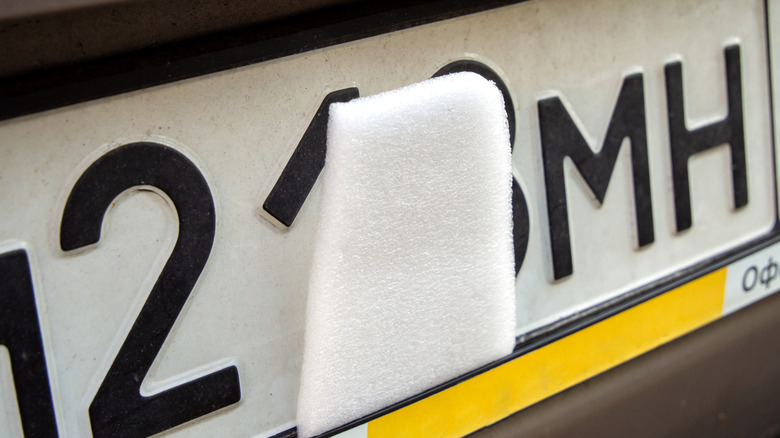
There's an odd detail at the center of the allegations. Police say the paper covering the trailer plate prevented license plate readers from identifying it, and the Turnpike reportedly couldn't determine which carrier should receive the bill. Yet investigators later reviewed plate-reader data and allegedly connected the truck to around 70 previous unpaid Turnpike trips. That sounds contradictory, but an unreadable plate doesn't necessarily mean the vehicle disappeared from the system.
With Toll By Plate, cameras photograph vehicles so registration information can normally be matched to an owner and an invoice mailed out. Pennsylvania's Revenue Assurance Plan classifies transactions with missing or unreadable plates as "unbillable," meaning a trip can still be recorded even when the system can't figure out whom to charge. It's the same basic weakness exploited by ghost plates used to dodge tolls, although the alleged method here was far less sophisticated than the ghost plates designed to evade traffic cameras.
Commercial trucks also leave more clues behind than just a plate. The Turnpike says its "enhanced commercial vehicle identification" process can use company names, logos, and USDOT numbers when commercial plates are missing or blocked, and that the program has helped cut the number of unbillable transactions involving unreadable plates.
None of that proves investigators used a USDOT number, company logo, or manually matched camera images to reconstruct Harris' alleged 70 trips; the publicly reported affidavit doesn't say exactly how they did it. But it does explain how covering a tractor-trailer's plate can disrupt automated billing without erasing the truck's trail entirely.