

The World's First Nuclear-Powered Civilian Ship Is In Danger Of Being Scrapped
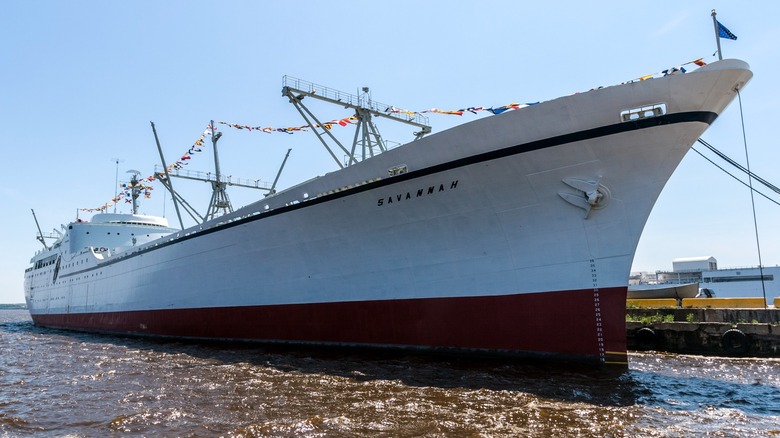
When people think of nuclear power in terms of ships, they go right to nuclear submarines and aircraft carriers, but they're not the only ones using nuclear energy to generate power. Civilian nuclear-powered ships exist and have for some time, though they don't capture the headlines like they once did. The first nuclear-powered non-military vessel was the Lenin, an icebreaker first launched in 1957 and used by the Soviet Union until 1989. In 1959, the first civilian merchant vessel powered by nuclear energy, the NS Savannah, began operation, and it continued sailing for years.
The Savannah's "NS" designation reflects its power source, as it stands for "nuclear ship." It was funded by the "Atoms for Peace" program and was used to show the world a peaceful application of nuclear energy. The NS Savannah is the first cargo vessel with a nuclear reactor, and it began full-scale operation in 1962. It continued sailing until 1971, and became a museum ship at Patriots Point, Charleston, South Carolina, in 1981.
Finally, in 2019, the NS Savannah was decommissioned, 60 years after the ship launched, but that wasn't the end of its story. As of this writing, the NS Savannah is moored at the Port of Baltimore, where it remains unused and awaiting its ultimate fate. The Nuclear Regulatory Commission is expected to end the vessel's license at the end of 2026, and without a new plan, it'll be scrapped. It was destined to find a new home as a museum ship in Savannah, Georgia, but the plan fell apart at the last minute, leaving the NS Savannah's survival at risk.
Efforts to save the NS Savannah have failed
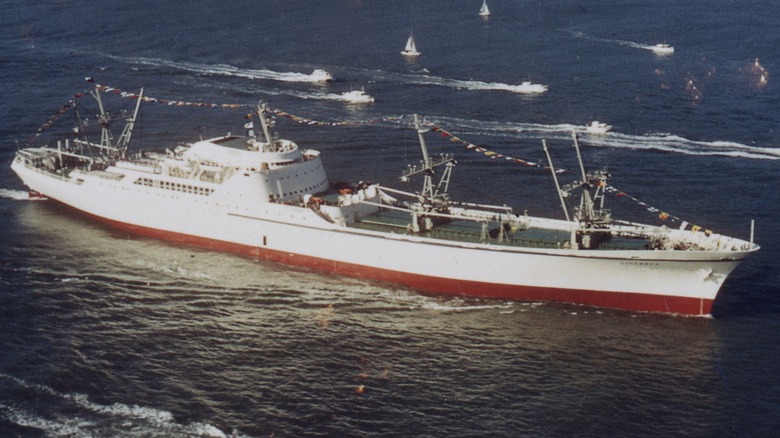
The NS Savannah sailed across the Atlantic and covered 450,000 nautical miles for the "Atoms for Peace" program. It used around 163 lbs. of uranium, which amounts to around 28.6 million gallons of bunker fuel. The ship didn't generate any profit, as it was something of a mishmash between a cargo vessel and an ocean liner. Still, it served its purpose, and it took a long time to retire the NS Savannah, largely due to its fuel source. The uranium was removed in 1971, leaving the reactor onboard without fuel.
Finally, in 2017, Congress funded the removal of the ship's nuclear reactor, which came out on November 8, 2022 — 52 years after the reactor was shut down. Dealing with the ship was problematic, as it's a National Historic Landmark, so it's required to remain intact despite the need to remove a great deal of its inner workings that had contact with nuclear material. Because the Nuclear Regulatory Commission's license is set to end, there are only three potential fates for the NS Savannah.
It can be preserved as a museum ship, it can be sunk to create an artificial reef, or it can be scrapped. The latter outcome seems to be the most likely after the plan to return the NS Savannah to museum ship status fell through. The biggest hurdle in the ship's preservation is cost, which is compounded by the fact that it no longer has a potential home in Savannah. This leaves its ultimate fate in doubt, but efforts remain at the NS Savannah Association to save the first nuclear-powered merchant ship.