

Dexron Vs. Mercon: What's The Difference Between These Transmission Fluids?
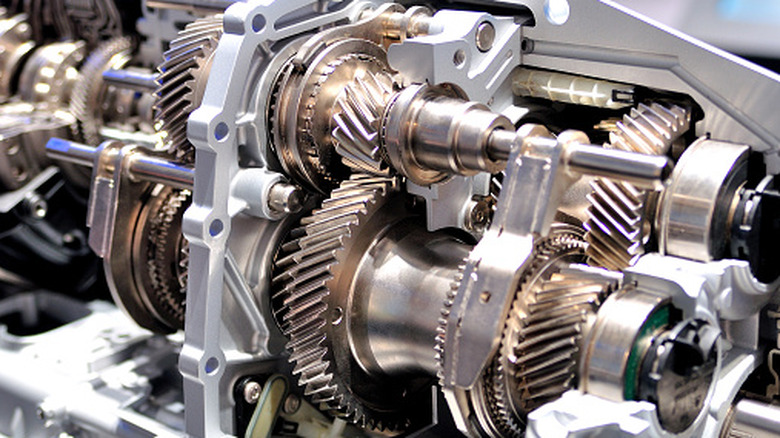
The difference between Dexron and Mercon automatic transmission fluids is very simple. It all comes down to the various vehicle manufacturers and the specific automatic transmission fluid that each one recommends. Transmission fluids may look the same, but they must be formulated to meet each manufacturer's specific performance requirements. This is why Dexron is designed for use in vehicles produced by the various divisions of General Motors, while Mercon has been formulated to be used in the nameplates belonging to the Ford Motor Company. It all comes under the heading of how to choose the right automatic transmission fluid for your car.
Dexron automatic transmission fluid was first created by GM in 1968 as a successor to the Type A fluid that had been previously used by the company. It was a higher-quality fluid that provided better performance in both the short and long term, and it was also approved for use in power steering systems. Today's Dexron VI automatic transmission fluid is made specifically for GM's six-speed and eight-speed automatics, and is backward compatible with earlier versions. Dexron HP is designed for GM's latest 8L90 and 10L80 eight-speed and 10-speed transmissions.
Ford has used the name Mercon automatic transmission fluid since 1987, when it began as a set of technical specifications for such a fluid. Today, the Mercon brand lives on in its latest ULV low-viscosity premium formulation, which is designed for use in Ford's Raptor and F-150 pickup trucks equipped with the10R80 10-speed automatic transmission.
Is there an automatic transmission fluid that can be used in both GM and Ford vehicles?
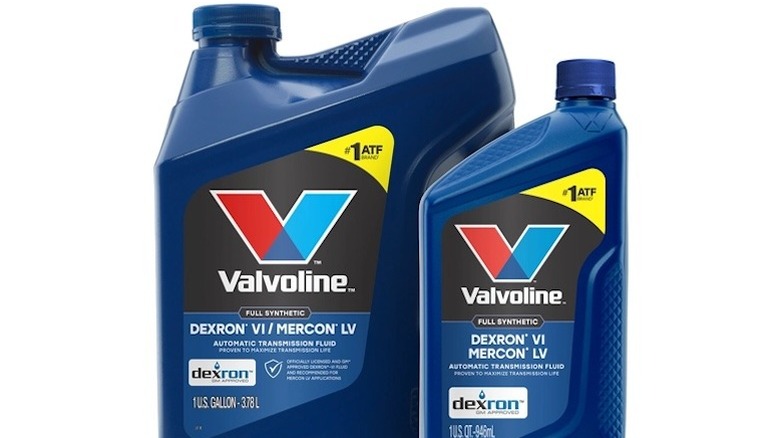
Automatic transmission fluid is available for both General Motors and Ford vehicles. Valvoline, Pennzoil, Castrol, and other popular transmission fluid producers currently make it. According to Valvoline's product information sheet, the fluid shown above is "officially licensed and General Motors approved for the Dexron-VI specification" and is "recommended for use in Ford Mercon LV applications." Keep in mind that this Dexron/Mercon automatic transmission fluid is backward-compatible, meaning it can be used in vehicles designed for Dexron-II and Dexron-III fluids. However, it is not intended for vehicles with transmissions that need either Dexron HP or Mercon ULV. Remember, mixing transmission fluids can destroy your car.
Automatic transmission fluid has developed in lockstep with the evolution of the automatic transmission. From the earliest Chrysler Fluid Drives and GM Hydra-Matics of the late 1930s to the 1970s' fuel-economy demands and modern eight- and 10-speed automatic transmissions, fluid technology has advanced alongside transmission design.
As contemporary transmissions are required to increasingly improve low-temperature performance and fuel economy, there has been a move toward lower-viscosity automatic transmission fluids. Likewise, the additive packages integral to these fluids are designed to stabilize their shear and oxidation characteristics. The overall objective, in terms of transmission performance, is to provide drivers with the highest degree of shifting consistency during the fluid's expected lifespan.