

What Does 'Spur' Mean On A Highway Sign?
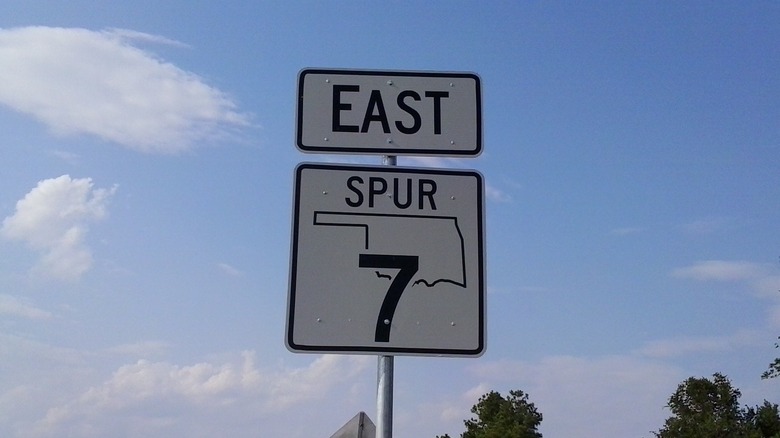
The U.S. has over 4.2 million miles of public roads, with the National Highway System of major routes making up around 220,000 miles of that total. Drive along any of these major routes and you'll see a wide range of signs giving you information about the road itself, the surrounding roads, and any nearby facilities and landmarks. One sign you might have seen on these routes says the word "Spur," accompanied by a number.
A spur is a specific type of road that branches away from an interstate and does not return to it. If you're traveling away from the interstate, a spur will always lead to a non-interstate road. In plenty of cases, spurs connect cities and urban areas to the interstate, but they don't have to — any non-interstate road can be connected to the interstate with a spur.
If a road connects a section of interstate with another section of interstate, it's not called a spur. Instead, it's referred to as a loop. Some loops travel away from an interstate before rejoining the same interstate later on, but a road that connects two different interstates can also be labeled as a loop.
As a result of research on driver perception, some road signs are transitioning to being in mixed upper-case and lower-case letters. However, neiter "SPUR" or "LOOP" signs are included in that new initiative, so you can still expect to see them entirely in upper-case lettering.
There are many other informative signs worth knowing about
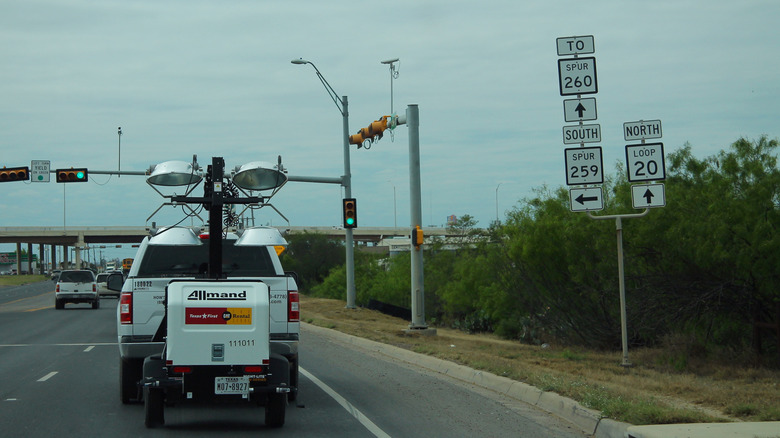
Signs for spurs and loops are designed to give drivers information about the type of roads they can expect ahead, but drivers who don't know what they mean will still be able to get around just fine in most cases. There's no significant safety risk posed by drivers who couldn't tell a spur from a loop, but the same cannot be said about some other types of highway sign.
One particularly important sign to know is the "divided highway ends" sign. It can be found where lanes of traffic are traveling in opposite directions and are separated by a median – any kind of barrier or marking — and it's designed to tell you that the median will be disappearing soon. As such, you'll need to be aware that traffic in the lane next to yours will be traveling in the opposite direction.
It's also worth brushing up on your sign knowledge so that you can quickly deduce which signs are relevant to you and which are not. For example, you might drive past a "No HM" sign and wonder what it's trying to tell you. It's designed to inform truck drivers that no hazardous materials can be transported down a specific route. Most car drivers can therefore safely dismiss it, since it isn't a relevant restriction for them.