

Why Are Some Road Signs In All Caps And Some Are Not?
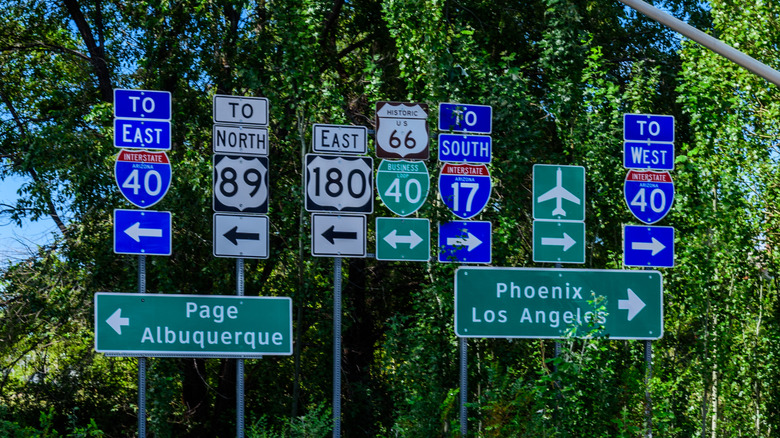
The purpose of any road sign is to convey specific information, but exactly how it's presented has changed over the years. Wind the clock back two decades or so and you'll find that the Manual on Uniform Traffic Control Devices (MUTCD) stated that all standard highway signs should be in capital letters. Yet, when the latest edition of this government-issued manual released in 2023, it stated that conventional green and blue road signs displaying the names of streets, places, and highways should use a mix of uppercase and lowercase letters.
Speaking to WLRN, Gene Hawkins, Professor Emeritus of Civil & Environmental Engineering at Texas A&M University, explained the reason for the change. He said that it was the result of additional research on how drivers perceive signs while on the road, especially when they need to see signs from far away. This research suggested that drivers find it easier to read signs when they can "recognize the shape of a word," and using mixed-case lettering formed "patterns" to make words more legible.
These patterns are standardized, with the MUTCD dictating how both uppercase and lowercase letters on a sign should look. As well as stating a minimum uppercase letter size for each type of sign, the manual also says that, on a standard sign, the "nominal loop height" of the lowercase letters should be ¾ the height of the uppercase letter. Nominal loop height refers to the main body of the letter, excluding any stems or tails such as the ones you'll find in the letters "d" and "q."
There are some exceptions to the new rules
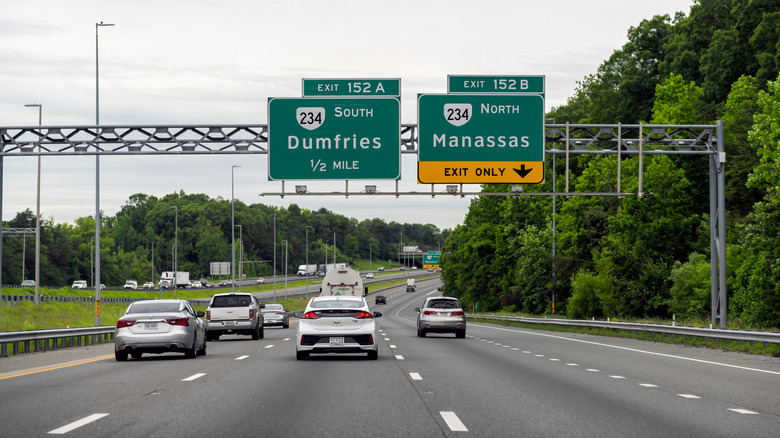
The mixed-case lettering has been proven to help drivers understand signs from a greater distance away, but there are some instances where the traditional all-caps lettering is still required. According to the latest edition of the MUTCD manual, "cardinal directions, action messages, and special characters" are still required to be entirely uppercase. Cardinal directions include "NORTH" and "SOUTH", while action messages include "KEEP RIGHT" and "AHEAD."
Beyond that, there are still plenty of road signs that don't follow this latest set of rules, simply because updating every single sign when there's a rule change would be extremely costly. Instead, signs that were put up before the new rules came into effect simply stay that way until they're replaced. Current Department of Transport rules say that road signs only need to be changed when they're damaged, vandalized, stolen, altered by someone, or when they reach the end of their service life.
It isn't just lettering either — every single aspect of a road sign is standardized to some degree to help drivers easily recognize them easily no matter where they are in the country. Some road signs are required to be a certain size and shape, while the different colors of highway signs are all used to convey specific categories of information. The system itself is complex and informed by decades of planning and research, but the signs produced as a result are designed to keep things as simple for drivers as possible.