

What's The Difference Between Green And Blue Street Signs?
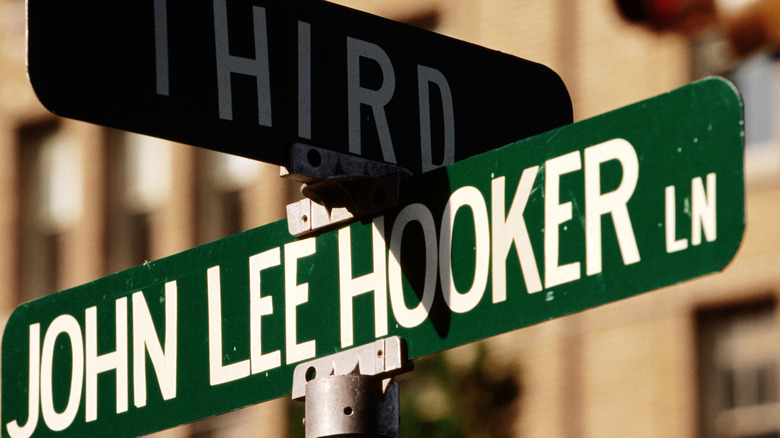
Street name signs can manifest in several colors, but the most common you spot at almost every corner is green. That's because the Manual on Uniform Traffic Control Devices (MUTCD) sets green with white lettering as the default background for a street name sign. It's why most of the signs marking an intersection — the ones reading something like "Main St." or "Oak Ave." — are almost always green.
Green is a color that is easy to live with and not too distracting. The idea is to delegate more attention-grabbing colors like red or yellow for the more important signs out there, like Stop signs. Another easy way to spot such signs is by their shape. Street signs are typically narrow rectangles with the longer side running perpendicular to the ground.
There are, however, some street signs that are blue. Often, those imply the road they're sitting on is privately maintained. Since most cities and counties already maintain their own green signs, any area that takes its roads into its own hands usually switches over to blue as a way to mark the change. That's why you'll notice a blue nameplate most frequently in subdivisions and gated communities, since they're run by homeowner associations. The same reasoning also applies to those somewhat rarer blue stop signs, which are mostly on private property.
There's a lot going on in a street nameplate
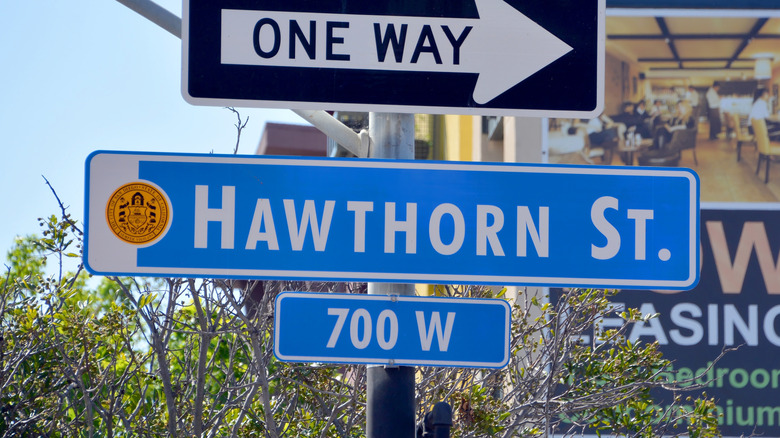
There are many other rules concerning street name signs, though those mostly involve green signs since the blue ones sit on private property and don't always fall under government regulation — or at least not directly. Still, blue tends to stick to the convention because it makes things easier for everyone.
One of these rules for the green signs is that they always use mixed case, as required by the MUTCD. One example is "Elm St" rather than "ELM ST." Mixed case gives the text a more distinct outline, and those distinct shapes are easier to read from afar, as opposed to all-caps. Moreover, the MUTCD also says that letter sizes should go up with speed. That means a 25mph lane is recommended to use 4-inch capital letters, while faster roads will have 6 or 8-inch capital letters.
There are rules for where the green nameplate hangs as well. In towns, every intersection is supposed to name both crossing streets. In quieter areas, a single signpost suffices. If it's a busier commercial road, however, you are supposed to have the signs placed on both diagonally opposite corners. A street can also be a numbered route. In that case, the sign is allowed to show the route's shield beside the name, which tells you the street doubles as that highway. For any colors besides green that a town may pick to use — like blue — the rules say that color has to be applied to all of the street signs. So if a neighborhood goes a particular color for a job, it sticks with it throughout the area.