

Engineers Have Built An Alternator Powered Entirely By Exhaust
Despite massive improvements in efficiency over the years, a gasoline engine still only converts about a quarter of the fuel it drinks into actual forward motion. The rest of it is mostly lost in heat, with a good share of that loss exiting the tailpipe as fast-moving gas. Even some of that useful quarter is consumed by the car's electrical system. That's because of the alternator, which took over from the generator decades ago and is what now keeps components like the headlights and the wipers alive.
The alternator runs thanks to a belt looped around the crankshaft, which spins it. When that alternator generates current, it produces magnetic resistance at the same time, which the engine has to push through. The more accessories that are turned on, the more electricity is consumed, and the more fuel is burned.
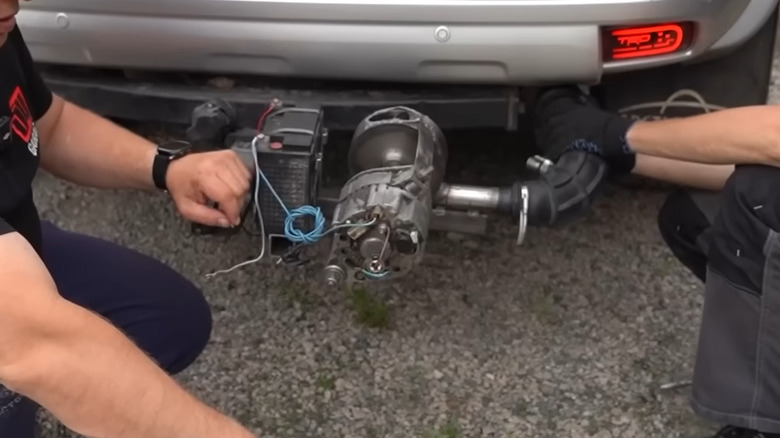
This is something a group of Russian mechanics from Novosibirsk attempted to address on the Garage 54 YouTube channel. For this alternator project, they went ahead and deleted the belt entirely. In its place, they built a turbine — specifically a steel wheel with blades on it — seated inside a metal ring. This is positioned such that it catches the gases emitted by the engine, which then shove the blades along. Connected to this wheel is a stubby driveshaft that runs to an otherwise stock alternator. Ultimately, the exhaust ends up doing the job the belt used to. In principle, all of this is quite similar to how turbocharging transforms engine performance.
An alternator that runs on tailpipe gas alone
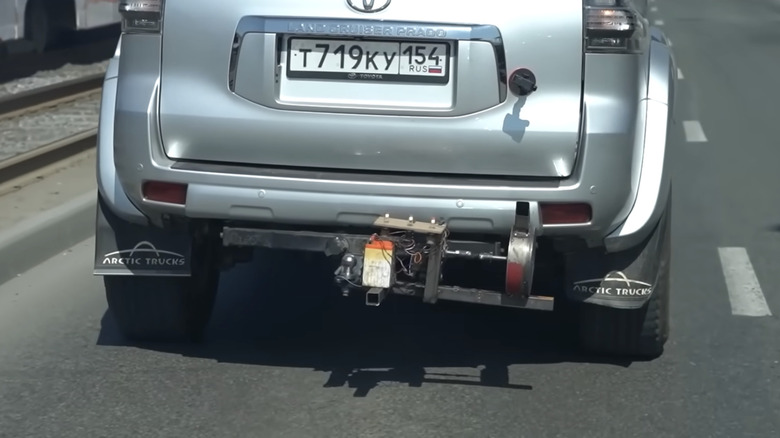
The difference here compared to a turbocharger is where the spinning ends up. A turbo sends that rotational energy to a compressor that crams extra air into the combustion chamber, while this one sends it to a generator. That said, there's simply not enough space to include all of this additional equipment in the engine bay of the car — which, in Garage 54's case, is a Toyota Land Cruiser Prado. The whole contraption instead sits out back, bolted to a trailer hitch that's been modified for the job, with a pipe running straight off the tailpipe.
The whole process took no less than two weeks, involving loads of cutting, welding, and testing. Some of the more resourceful things Garage 54's engineers did included stuff like raiding the parts bin they kept out in the forest and even pulling an alternator off a friend's snowmobile, which they coupled to their first turbine. None of that is out of character for a crew that once made an inline-four out of a Subaru boxer engine.
It's worth noting that this is more of a proof of concept. The crew simply wired three ordinary car light bulbs to the alternator rather than trying to run anything useful. Keeping all three lit at max brightness was the bar, which the turbine pulled off at around 2,500 engine rpm. In the end, three bulbs on a bumper are far from running a car's actual electrics, but it does settle the question of whether tailpipe gas alone carries enough energy to run a car's generator. The answer is that it does — as long as the engine is working hard enough.