

What Are Danforth Anchors Used For In Boating?
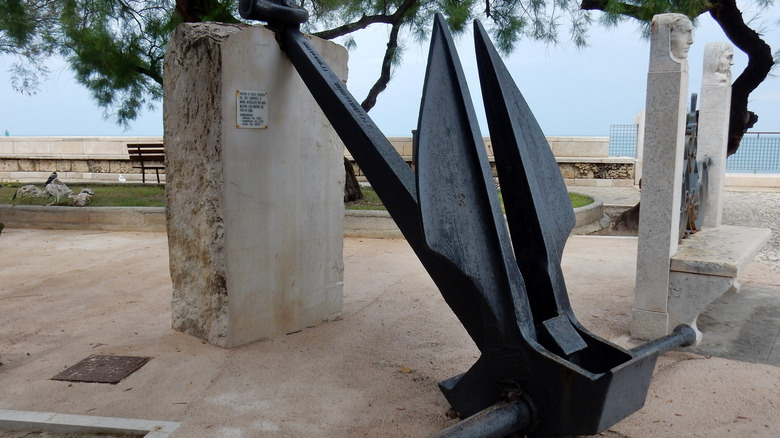
Leave a boat unanchored in any place that isn't a dock or a mooring buoy, and there's a chance it will drift away. That's why a lot of boats, specifically the smaller recreational kind, use a Danforth anchor. Unlike claw anchors, a Danforth is a type of anchor that basically looks like a metal bar, except it has two wide, triangular blades at one end called flukes. These flukes sit on a hinge that lets them swing out to roughly 32 degrees from the bar. When the boat pulls on the line, the sharp tips on those flukes catch the mud or dirt underneath, anchoring the boat down.
It's a simple design that does the job and has been around long enough for it to explode in popularity. First created by a civil engineer named Richard Danforth, the design dates way back to 1939. Not long after, it was used by the U.S. military for World War II landing craft, likely because it has such a lightweight design — at least for the amount of hold it has. It helps that the flukes themselves are unusually big for an anchor this light.
Because it punches above its weight, it's most suitable for smaller boats. These smaller boats lack a motorized winch to pull the anchor up, so that job is done by hand. At the same time, a Danforth is also easier to fold, since it lies flat. This lets it fit inside a small storage locker after it's hauled up, instead of simply dangling off the side of the boat.
Where Danforth anchors begin to show their limits
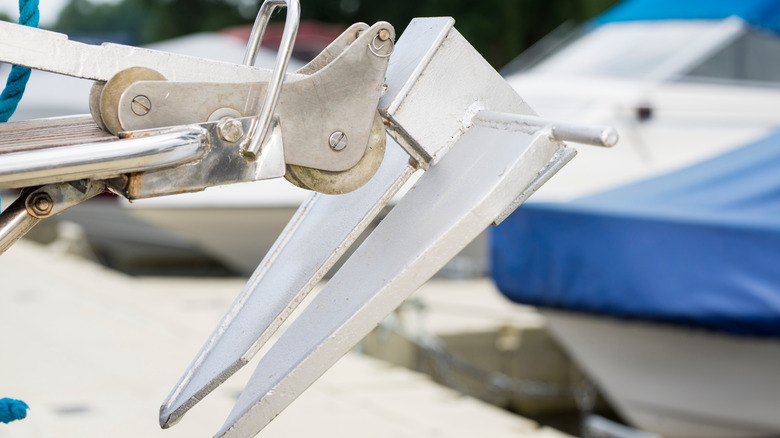
Danforth anchors work just fine even in soft mud. Fortress, a company that sells aluminum Danforth-style anchors, measured the holding power of various types of anchors in Maryland's Chesapeake Bay in 2014. On the bay's mud and clay bottom, the fluke anchors (which included Danforth) were able to sustain 1,200 pounds of pull. This was actually higher than that of the many plow-shaped anchors that were tested; only two of those were able to clear 1,000 pounds in total.
The thing is, Danforth-style anchors pull ahead in these scenarios because they're specifically designed for them. Plow anchors are still better when it comes to harder seabeds, however, since a Danforth's flukes simply can't dig into rock. Even if one of those flukes does grab onto a ledge, the entire boat's pull lands on it, which can actually bend the anchor.
Moreover, any sudden shift in wind or tide can actually pull a Danforth loose. Once that happens, it often won't dig back in on its own. Sometimes, these anchors can also end up doing their job a little too well, such as when the hinged flukes get jammed into mud and shells.
A Danforth isn't known for handling sudden changes in direction, either. Where a plow-shaped anchor usually resets itself after a strong pull, a Danforth can quickly become undone. This is perhaps why few sailors trust a Danforth as the main anchor on a sailboat, often ending up carrying one as a lightweight backup. That backup usually gets stowed aboard well before the boat hits the water, as part of the prep that goes into launching a boat for the first time.