

What Are Claw Anchors Used For In Boating?
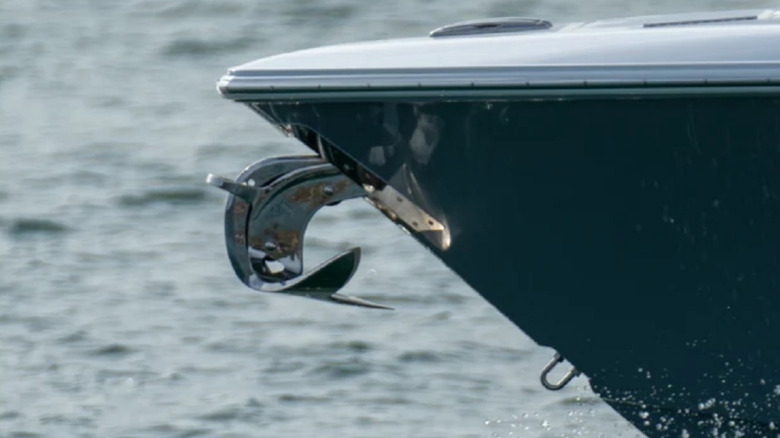
Boating can be intimidating to newcomers, whether it's deciding which boat brand to go with or knowing what to do the first time they launch a boat. A big part of that intimidation factor is also all the terminology, and it extends down to the anchors, with specialty equipment like claw anchors drifting around to confuse and beguile the uninitiated. Worry not, because claw anchors are relatively simple: They're general-purpose boat anchors designed for mixed bottom conditions, where they're able to set and reset reliably.
Sometimes referred to as "Bruce-style" anchors after their original designer back in the '70s, Scottish engineer Peter Bruce, they're composed of three curved flukes (the biting or digging pieces) at the end of a one-piece shank (the long central arm) shaped like a hook. The round, claw-like geometry helps the anchor land right-side up, then dig down into the bottom to find purchase. It also helps the anchor reset if it gets pulled up by strong tides or wind; the curve of the outer flukes allow it to roll back into a biting position.
Claw anchors are great for overnight anchoring, stopping off for lunch, or fishing stints. They're useful in spots where the bottom is a varied mix between mud, gravel, sand, etc., and tend to find homes on boats that move around a variety of different, unknown locations rather than sticking to their well-charted home waters. They tend to be extremely sturdy as well, due in large part to their single-piece construction, with no hinges or moving parts to seize up or get muddled with debris.
Where claw anchors work best
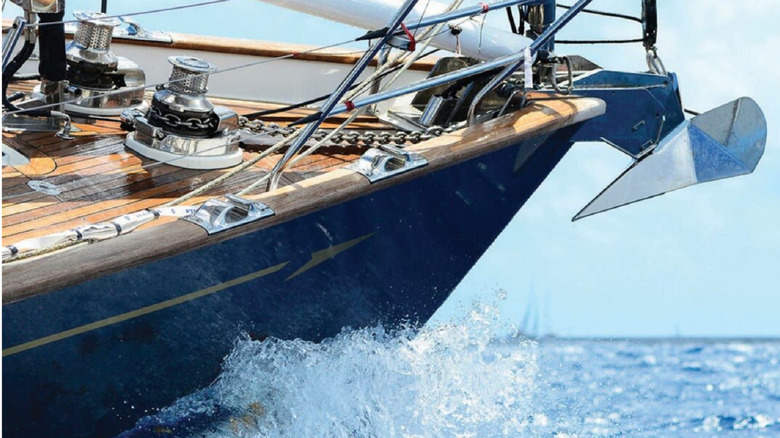
As intimated above, claw anchors work best on mixed, rocky/sandy, semi-firm bottoms. Claws have the advantage of being able to find purchase around uneven, irregular structures, unlike more conventional anchors that need to sink a broad fluke way down into sediment. This means they can hook onto rocks or coral and hold fast even when there's nothing softer like mud or sand to plunge down into.
Under normal conditions, a claw anchor should set quickly and will accommodate changes in pull force and direction fairly well. The trade comes in holding power per pound. An anchor needs good bottom contact to work (it's why ships can't anchor in the middle of the ocean), and in more uniform soft mud or sand, a large-fluke anchor will deliver more holding power because they provide a much wider surface area and will tend to sink down into soft muck more deeply.
Claw anchors also aren't great for harder surfaces, like clay or shale, or on bottoms that have a lot of thick grass or weed overgrowth. They might slide right across a harder surface without finding a snag, or get caught up in the vegetation without making it down to the bottom. But if you're looking for a versatile choice for short stops and tend to cruise around a lot of varied, coastal anchorages, a claw anchor may be just the thing.