

Why Is Ultra Low Sulfur Fuel Mandatory For Diesel Engines?
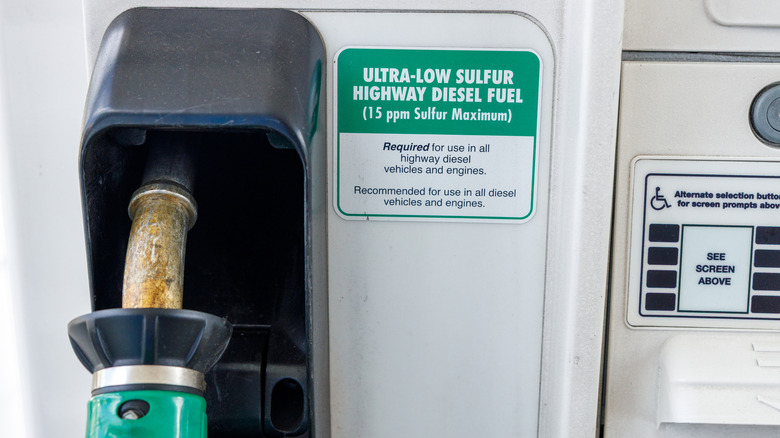
While it's certainly true that diesel engines have their downsides, many drivers prefer them to conventional gasoline-powered vehicles. But when it comes to diesel fuel, understanding the specifics of its formulation and how it performs in everyday diesel engines can be tricky. For example, ultra-low sulfur diesel (ULSD) is mandatory because reducing sulfur in diesel fuel helps control harmful emissions from diesel-powered vehicles, engines, and equipment.
The use of ULSD is tied to the EPA's efforts to allow newer engines to use more advanced emissions-control technology. Since higher levels of sulfur could interfere with that technology, a cleaner fuel was necessary. The EPA was also concerned about the health and environmental effects of diesel emissions, specifically particulate matter and nitrogen oxides. Since nonroad diesels, locomotive diesels, and marine diesels all played a part, it was important to get the proper controls in place.
The EPA began regulating sulfur in diesel fuel in 1993 and started phasing in the 15-parts-per-million (ppm) standard for ULSD fuel in 2006. By 2010, all highway diesel fuel supplied in the U.S. was required to meet that standard. Four years later, the standard was adopted for nonroad, locomotive, and marine vehicles. Before these requirements were introduced, diesel fuel could contain as much as 5,000 ppm of sulfur. The EPA says its diesel standards have collectively reduced harmful emissions from onroad and nonroad diesel sources by more than 90 percent.
What drivers should know about ultra low sulfur diesel
When the EPA began instituting ULSD requirements for on-road diesel vehicles, refiners were left with a problem to solve. That's because the sulfur-removal process reduces some of the compounds that contribute to diesel's natural lubricity, which helps limit the wear on fuel-system components. So in order to compensate, refiners add lubricity improvers to ULSD, helping to protect parts like fuel pumps and fuel injectors during normal operation.
For most diesel drivers in the U.S., there isn't an alternative to ULSD fuel. The EPA requires all highway diesel fuel supplied to the American market to meet the 15-ppm sulfur standard, and all highway diesel vehicles must use it. However, there are limited exceptions to the mandate during fuel-supply emergencies. This was the case in September 2026 when the EPA temporarily allowed higher-sulfur diesel for certain older vehicles and nonroad equipment that were originally designed and certified for that fuel. But newer engines that required ULSD still had to use it.
The distinction between older and newer diesel engines is important because sulfur levels can affect more than just whether the fuel meets federal requirements. For example, putting high-sulfur diesel in a 2007-model-year or later engine can interfere with the emissions control system. This can reduce the effectiveness of the catalyst and cause the particulate filter to become restricted. That restriction can increase exhaust back pressure and can even lead to engine damage.