

What Was The Top Speed Of America's Canceled Comanche Stealth Helicopter?
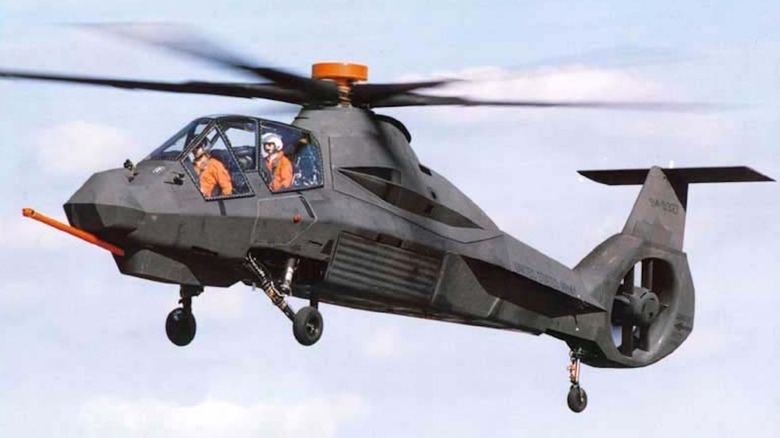
All told, the RAH-66 Comanche helicopter, developed as a joint-venture between Boeing and Sikorsky (now owned by Lockheed Martin) was a bit of a mess, to the point of the United States Government Accountability Office (GAO) issuing multiple statements about the program's long delayed schedule and significant cost overruns. The program lasted from the late 1980s all the way to 2004 without a successful helicopter coming out the other end.
The Comanche was supposed to be a stealth-capable reconnaissance and attack helicopter for the U.S. Army, complete with the wacky shape used by other early stealth aircraft like the F-117. The maximum weight 12,813 pound chopper was powered by two Rolls-Royce/Honeywell turboshaft engines making just around 2,800 horsepower. For comparison, the two General Electric engines in the functionally similar (although much heavier at a maximum 18,500 pounds) Bell/Textron AH-1Z attack helicopter put out a combined 3,600 horsepower.
But 2,800 horsepower is still quite beefy for a helicopter as light as the Comanche. So how fast could it fly? The program originally called for a maximum speed of more than 170 knots (195 miles per hour). During testing, the Comanche could reach speeds of 200 knots (over 230 miles per hour).
A dream to fly
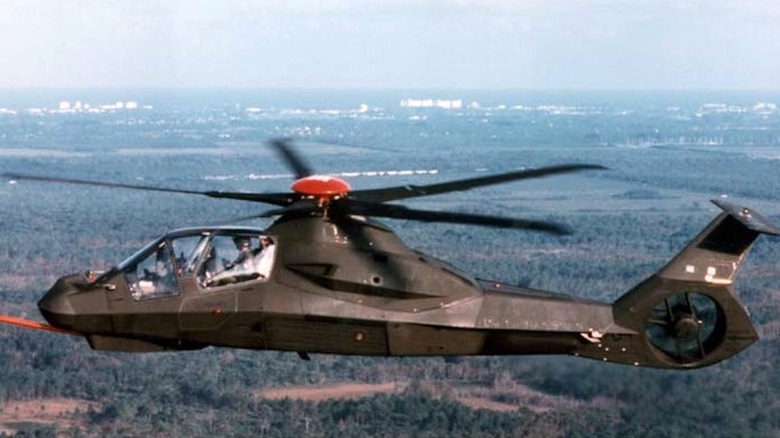
According to the Sikorsky Archive, an organization dedicated to documenting anything and everything related to Sikorsky founder Igor Sikorsky and Sikorsky Helicopters, notes that the Comanche was actually a dream to fly. It featured, at the time, state-of-the-art fly by wire controls. The Army's deputy Chief of Staff Lt. Gen. Richard Cody was quoted as saying: "It is the most flexible, most agile aircraft that we have produced in this country."
Eventually, upgraded versions of the Comanche's Rolls-Royce/Honeywell turbines saw life in the United Kingdom's Royal Navy Wildcat helicopter. Although still fast at a top speed of 160 knots (194 miles per hour), the Wildcat is a much bigger, multi-purpose helicopter.
So the Comanche was incredibly fast, nimble and maneuverable, and loved by pilots and the brass overseeing the project. Still, that couldn't save it from the cutting room floor. Alas, it was just too expensive over too long a period of time.