

5 Red Flags Mechanics Can Spot In Seconds When Inspecting Your Car

Unless you're a DIYer who loves tinkering with project cars, you probably bring your car to the mechanic when you sense something is wrong. There are so many components inside a vehicle that it can be tough to pinpoint exactly what's going on. Meanwhile, if you've been around cars as much as a mechanic, you start to develop a bit of a Spidey sense for possible issues before a car even fully rolls into the shop, just by taking a quick glance or smelling something that's not quite right.
From hearing a clicking sound to noticing uneven tire tread, there are a few things mechanics can spot on your car right away. Some mechanics will even judge the overall condition of the vehicle. While they will have to take a closer look at your vehicle to truly know the underlying issues, these instant red flags give mechanics a good idea of where to start the moment you pull into the bay.
Your brakes are making sounds
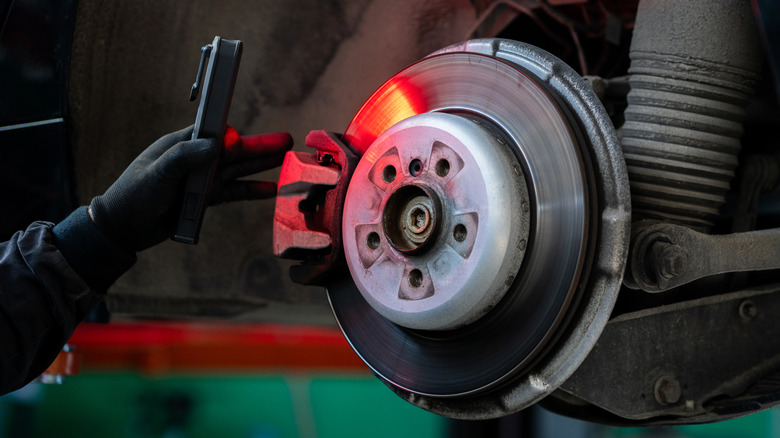
There is a lot a mechanic can tell just from hearing you pull into the parking lot. Before they even inspect the car, they will likely hear how your vehicle sounds as you stop in front of the garage. If there's nothing wrong with your brakes, there will barely be a sound — maybe a soft hiss or a low hum. But if there's a grinding noise or a clicking sound, mechanics will instantly know there's something wrong with your brake system. Squeaking could mean the brakes are worn down and getting thin, while a clicking sound could mean something is broken or loose.
Another thing mechanics will notice right away about your brakes is if it takes you a while to come to a complete stop. If your car doesn't brake fast enough, this could mean that you're low on brake fluid, the brake lines are damaged, or the shock absorbers are leaking. If your brakes are loud or slow, mechanics would have to inspect the brake pads, rotors, calipers, brake fluid, and other related components.
Your engine makes sounds while idle

If you park your car at the shop and leave it running, mechanics will get important information before you even step out the door. The sound your engine makes at idle can give a lot of insight into possible issues with the car. They will be listening for knocking, whining, hissing, ticking, and other unusual sounds.
Hissing could indicate that there's a leak somewhere under the hood, maybe related to the exhaust system or even a turbocharger — it often indicates escaping pressure. Rattling points to an array of (possibly expensive) issues, like a faulty piston, a failed AC compressor, or a faulty serpentine belt. Ticking can signal low engine oil, which can cause friction between metal components if there isn't enough lubrication. Engine sounds can point to so many different problems, but specific sounds at least give skilled mechanics a place to start.
The way the engine behaves is another instant indicator for mechanics. If it's shaking, you could have issues with the fuel or air systems — or even the motor mount. The smoke coming out of the exhaust can also give mechanics a lot of insight. White smoke could point to a coolant leak in the combustion chambers; black smoke may indicate that the engine is getting too much fuel and not enough air, while blue exhaust means the engine is burning oil.
There are puddles under your car
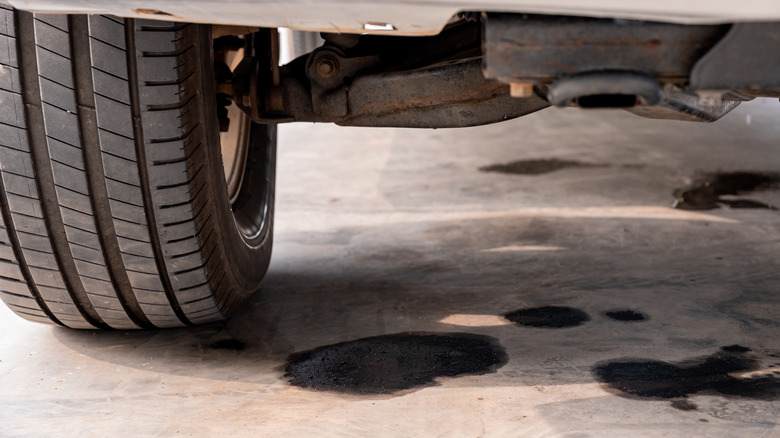
After your car has been sitting in the shop for a while and the mechanic finally has time to go over and inspect it, they are immediately going to notice any wet spots underneath the vehicle that formed while they were at lunch. Every puddle tells a different story, so they are sure to check for any leaks before even touching the car.
If there is clear water near the front of the car, this could just be condensation from the air conditioner. It's common if you were running it on the drive over, especially if it was a hot day. This is usually nothing to be concerned about. However, if the puddle under the front of the car is thick, oily, and dark, it could indicate an oil leak — maybe from the oil pan, oil filter, or valve cover gasket. If it's bright and sticky, this puddle in the front could be a coolant leak from the radiator or hoses.
If the puddle is closer to the middle of the car and appears greasy and red or brown, this could be a transmission fluid leak. An oily, amber puddle closer to the wheels could mean a brake fluid leak. These leaks are important to address right away before any of these fluids get too low.
The vehicle or tires look uneven
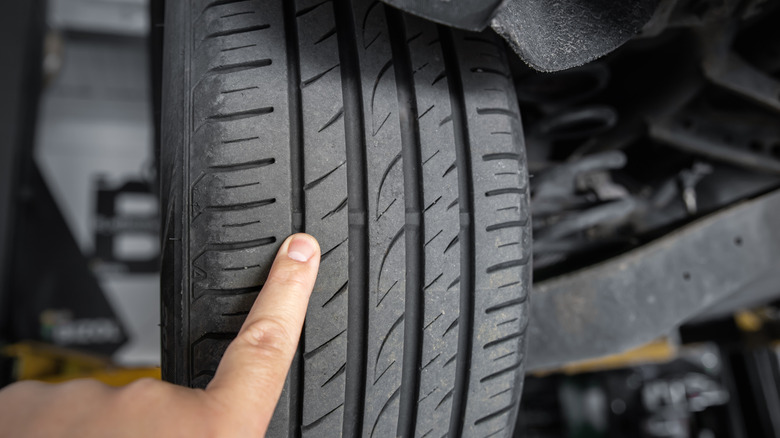
Another thing a mechanic will notice on sight is the way your car is sitting. If your vehicle doesn't sit evenly on all four corners, there could be a suspension or chassis issue — and the vehicle is likely not safe to drive. Suspension that needs replacement could also make noises or cause uneven tire wear, which can be spotted right away — this often comes in the form of feathering or cupping.
Uneven tire wear can also point to many other issues with your vehicle. If the tire shows excessive wear in the center, this could mean there's too much air pressure in the tires. Tires that have cup-like depressions that cause a thumping sound could indicate worn-out shocks or struts. If the tire wears most on the inner or outer edge, it often indicates improper wheel alignment or chronically underinflated tires. The mechanic may want to see whether your vehicle feels unstable or bumpy when they get behind the wheel to get a better idea of what components are making the vehicle and tires uneven.
The vehicle is in rough shape
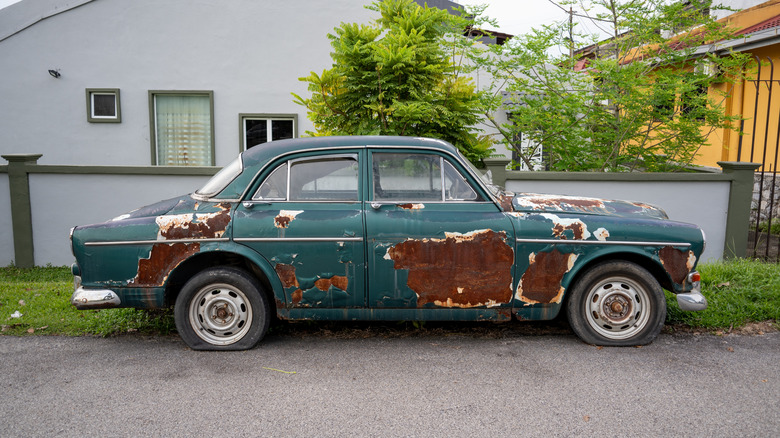
Sometimes, mechanics aren't only looking for obvious issues like puddles and tire tread. Often, they make insightful assumptions by looking at the vehicle as a whole. If the vehicle looks properly maintained and cleaned, they will probably conclude that you're up to date on all the proper maintenance you have to do at different mileage milestones. Someone who is diligently getting their oil changed, for example, is probably going to experience fewer problems than someone who lets their engine components lose that much-needed lubrication.
There are a lot of little details that point to a vehicle that may not be handled with care. The mechanic will notice things like scuff marks on the tire from hitting curbs, which can accelerate tire wear, and dents and scrapes in the paint, which could mean you are getting into minor impacts here and there that could be damaging your suspension, brakes, cooling system, and more. If you have poorly done repairs — ill-fitting panels, mismatched paint, uneven bumper alignment — that could lead to other issues the mechanic may dive into later as well.