

Chinese Team Earns New World Record Using A Swarm Of More Than A Hundred Drones
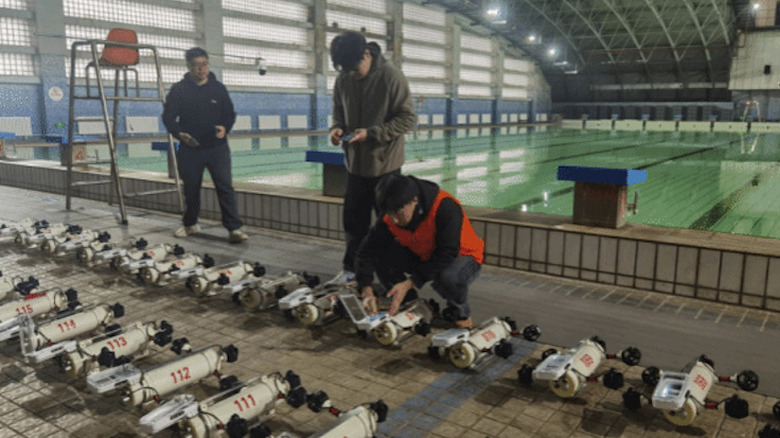
After successfully operating 116 autonomous underwater vehicles at once, a Chinese research team from Northwestern Polytechnical University has officially earned itself a new Guinness World Record. They now hold the title of "Most autonomous underwater vehicles operating simultaneously."
The test was done on August 29, 2026 (in the school's swimming pool, of all places). Their success comes after more than two decades of research on underwater sensing, acoustic communications, and visual perception to develop the drones alongside marine equipment and vehicle supplier Xian Tianhe Maritime Technologies. Underwater drones aren't cheap, either, so it makes sense why the university team would need some outside help to get 116 of them working together.
Guinness World Records officials were present and on hand to monitor the demonstration and certify the record-breaking achievement. At showtime, the 116 underwater drones were introduced to the 50-meter-by-20-meter pool one at a time. Once all were deployed, they traveled a predetermined route for 34 whole minutes, covering an entire 500 meters without any human intervention. The drones relied on cameras to be their eyes, guiding their movements and allowing them to make adjustments should their planned path have been obstructed at any point.
Specifics of the record-breaking underwater drones
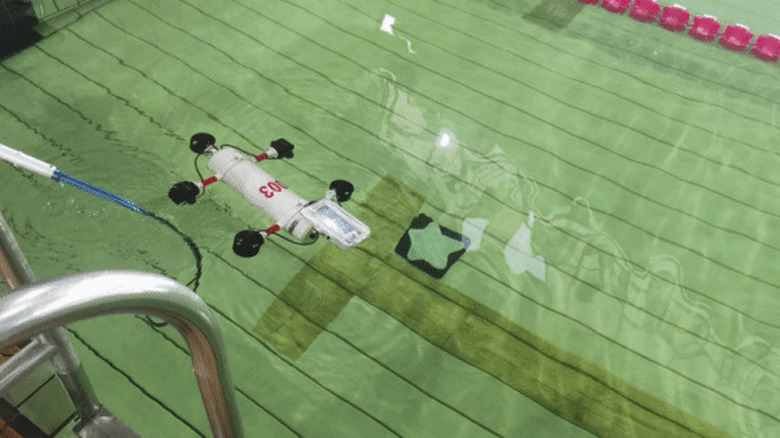
Each drone (individually referred to as a TH-618 Autonomous Underwater Vehicle) measures 61.5 centimeters long (about 2 ft.) and 20 centimeters wide (roughly 8 inches). They each weigh in at 5.14 kilograms, or just over 11 pounds. That's a fraction of the weight of the U.S. Navy's solar-powered underwater drone.
All 116 TH-618s have a max range of 30 kilometers, or 18 miles. (Range was no concern for a pool under 11,000 square feet in size, of course.) The more important spec is charge time: The drones were equipped with up to eight hours of battery life. And though the record-breaking demonstration only took 34 minutes in all, that battery life gave the team enough wiggle room to have run through it multiple times if they needed to.
The university described the Guinness World Record achievement as a step forward for coordinated, unmanned underwater systems. In the future, such tech could be used to support survey work like seabed mapping and oil or gas pipeline inspection. Not to mention the military uses, seeing as Xian Tianhe Maritime Technologies is a subsidiary of Xian Tianhe Defence Technology, a private defense contractor. Lockheed Martin's undersea drone is one such example.