

America's Newest AI Fighter Jet Won't Need An Aircraft Carrier To Launch
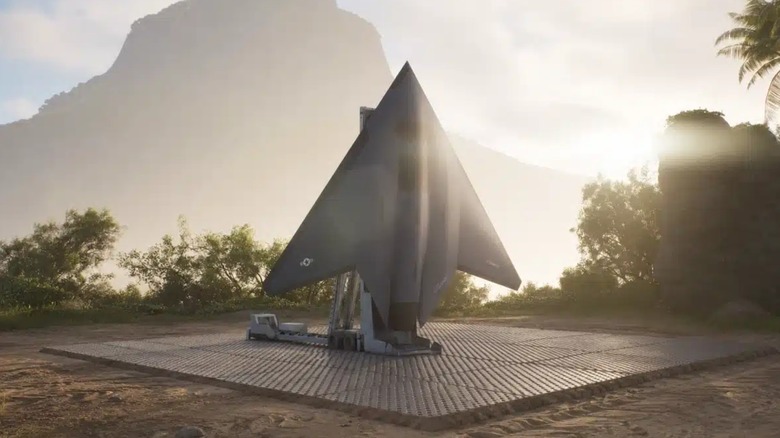
While the United States' development of its sixth-generation fighters gets a lot of attention, there's another area of airborne assets that's quietly being developed across the nation. So-called "Wingman drones" are being designed to fly autonomously alongside crewed aircraft, and a new model under development by Shield AI could pave the way for the future of AI-powered aerial warfare. The new aircraft is called the X-BAT, and it's one of the most advanced drones under development, packed with impressive capabilities.
Shield AI is producing the world's first AI-piloted fighter jet capable of vertical takeoff and landing (VTOL), which is a big innovation in that it will be able to take off and land almost anywhere in the world. The X-BAT system is being designed as a distributed, uncrewed fire network that can launch and be recovered by ships, islands, and forward operating bases in austere environments that lack runways. The X-BAT utilizes a towed trailer that moves it from a down position into a launch mode similar to a rocket.
Using this system, the X-BAT can go from its packed state to the air in only a few minutes. Additionally, because of their size and shape, three X-BATs fit in the same deck space as a single crewed fighter, making the drone aircraft a force multiplier for naval aviation operations. It's all powered by Shield AI's Hivemind system, which enables full AI functionality that doesn't require human input, communications, or even the Global Navigation Satellite System. While production isn't expected to fully kick off until 2029, Shield AI's documentation describes a one-stop solution for future drone operations around the world.
Shield AI's X-BAT
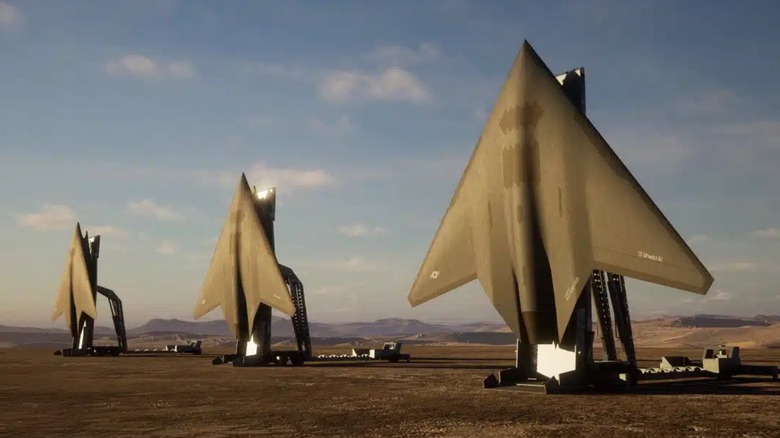
As of this writing, the X-BAT has yet to take to the skies, as it's still in the design and development phase at Shield AI. The company released the system's planned specs, and there's no denying how impressive they are. The X-BAT will be autonomous, runway-independent, and VTOL-capable. It measures 26 feet long with a 39-foot wingspan, and will have a service ceiling in excess of 50,000 feet. The goal is to operate the X-BAT with a 1,150-mile combat radius and a total range of 2,302 miles.
The X-BAT will be powered by a GE Aerospace F110 engine, currently used in the F-15EX Eagle II, though the X-BAT's intended top speed remains unclear. The system will function entirely autonomously, which will enable it to continue functioning in radar- and GPS-jammed environments, targeting based on onboard algorithms, and it will be ground-attack and air-to-air-capable with additional sensors for electronic warfare operations. In addition to the X-BAT's internal payload, it features several external hardpoints that will be capable of carrying large strike weapons, though Shield AI hasn't detailed which weapons it could carry.
A single commander can fly a team of X-BATs with the goal of supporting both U.S. Navy and U.S. Air Force operations. Shield AI's Hivemind is a tested, proven AI pilot that will handle the X-BAT's autonomous operation, which the Navy has already utilized with the company's MQ-35 V-BAT drones. The X-BAT's internal bay can hold up to 2,000-lb. weapons, and Shield AI intends to produce as many as 150 X-BATs per year by the early 2030s.