

Why Do Rockets Have Those Black And White Checkered Squares?

Rockets have been around for a long time, and they're used for a variety of purposes, from war to spaceflight. While there are many different varieties, rockets have similar features, including fins, and they generally all operate the same way. Some form of fuel ignites and propels a rocket away on its flight path, and it moves quickly through the air. If you look at modern rocketry, you might notice another common feature: their paint jobs. It's not something many people think about, but this is especially true of NASA rockets.
Take a rocket like the Saturn V, which took humanity to the Moon, and you'll notice that it's painted black and white, but not in whole parts. Instead, each of the rocket's stages features a mishmash of black and white paint, which often comes in the form of checkered squares or elongated rectangles. It's something you've probably seen before in pictures but never questioned. Still, NASA doesn't do anything without a reason, and the black-and-white painted patterns on rockets are there to help measure their progress.
It all comes down to the cameras used to track a rocket's progress during ascent. Powerful tracking cameras observe these black-and-white patterns as the rocket moves, so precise measurements can be recorded of a rocket's flight. When the rocket blasts off, it doesn't go straight up. Instead, the rocket curves toward its intended trajectory as it flies toward orbit, and the cameras can determine much about its position and movement because of the unusual checkered paint job that extends from the nose to the thrusters.
This practice goes all the way back to the first modern rocket
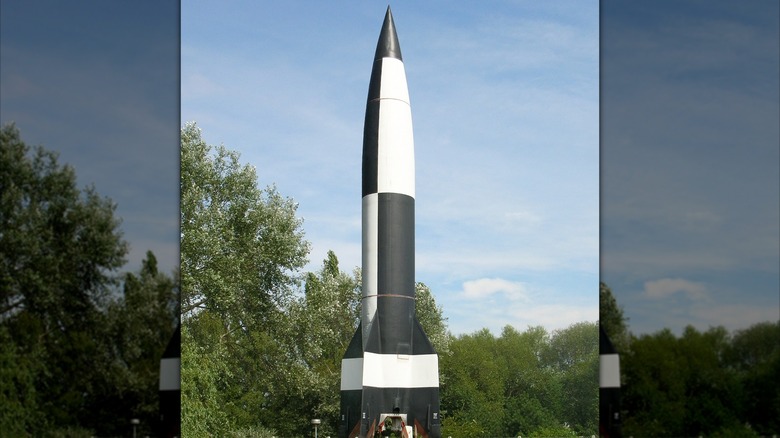
Checkerboard patterns on rockets extend further back in time than NASA's Mercury or Apollo missions. During World War II, the Germans produced rockets they dubbed "flying bombs," the most famous of which is pictured above. The V-2 flying bomb was the first long-range ballistic missile, and it was used to attack Allied cities toward the end of the conflict. When the war ended, Project Paperclip brought Nazi scientists like Wernher von Braun to the United States to aid in its rocket program.
As you can see from the picture above, the V-2 was painted with the same type of black and white checkerboard pattern as the Saturn V and other NASA rockets. Just as it does now, that checkerboard pattern helped scientists measure the rocket's ascent, so the practice goes back to 1944. More than 80 years later, scientists continue to mark their rockets in the same manner, using small chessboard-like checkerboards on parts of a rocket's fuselage alongside extended ones that cover large portions of the rocket's body.
Checkerboard patterns can be seen on the rocket boosters affixed to either side of NASA's Space Launch System (SLS) that are part of the Artemis program. Beth St. Peter, part of NASA's SLS imagery integration team, explained that "Each marking has a specific purpose. In general, the markings are used to precisely measure motion during dynamic events during liftoff and separation. With specific cameras, we will track those crosshairs of the markings and form 'triangles' of multiple patterns to help with our post-flight reconstruction analysis tasks."