

What Is An HID Flashlight Used For?
We may receive a commission on purchases made from links.
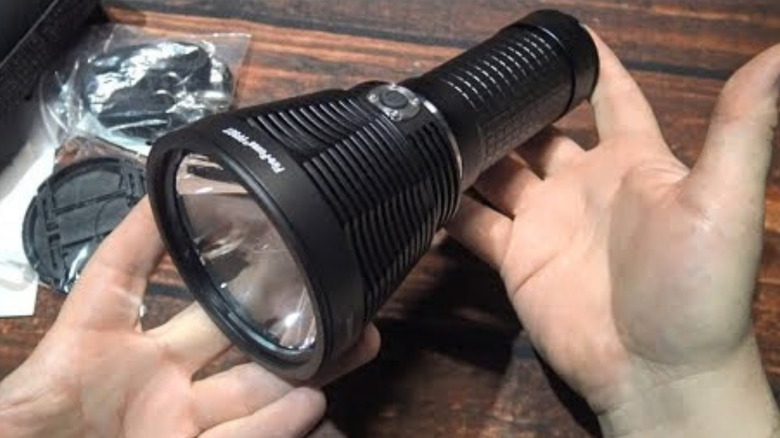
If you use flashlights around the house or on the job, you may be familiar with the differences between specific types, but if you're more of a turn-it-on-and-go user, you may just grab whatever's handy without knowing what it's designed to do. For example, a high-intensity discharge (HID) flashlight is ideal for situations where you need intense, focused illumination of a large area or a distant target.
Some models, like the Streamlight HID LiteBox, can be used for field maintenance, construction-site inspections, and work involving remote equipment. It has a 35-watt xenon HID lamp that produces 3,350 lumens and reaches a peak beam intensity of 1 million candela. In contrast, the Larson Electronics Xenide 25 is more of a handheld HID, with a blue lens that directs light onto distant areas, and can be used for boating. It has a 25-watt metal halide bulb that produces about 1,500 lumens and can project up to 3,000 feet. These models don't necessarily match the specifications of every HID flashlight, but they are good representations of the kind of high-intensity long-range light these devices can provide.
HID also isn't a single type of lamp — the technology includes several different variations. Metal halide, mercury vapor, and high-pressure sodium are among the common types of HID lighting, with the type of lamp affecting characteristics like the color. This means that there can be considerable differences between HID flashlights depending on the lamp technology specific brands and models use.
The tradeoffs of using an HID flashlight
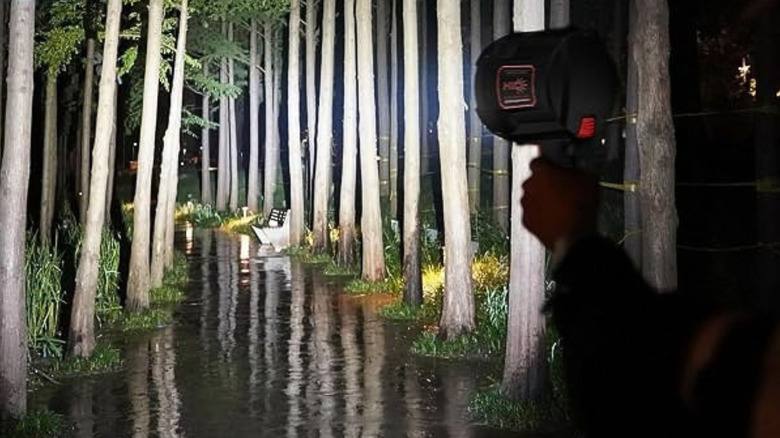
Beam intensity is not the only thing that separates an HID flashlight from other types. Unlike a conventional bulb that uses a filament, an HID lamp creates light with an electrical arc inside a sealed tube. The arc forms between two electrodes, and the heat it produces causes the materials inside the tube to vaporize, contributing to the light. This concentrated arc is what allows the HID lamp to produce such an intense source of illumination.
HID flashlights also differ from LED models in a few different ways. An HID lamp takes longer to reach full brightness after it's switched on, while an LED produces light almost immediately. HID flashlights can also have shorter burn times and shorter bulb lives than LED models. HID models are typically limited to a single brightness level as well, while LED flashlights commonly offer several output settings. Some HID flashlights can also show color fringing in the beam, while LED light tends to be more consistent.
There are some other drawbacks to using an HID flashlight. The lamp operates at very high temperatures, and repeatedly turning it on and off can decrease its service life. Turning one back on right after it has been switched off can also be a problem because the lamp may need to cool first. That allows the arc to be established once again. This can be inconvenient for users who need the flashlight to be ready to go at a moment's notice.