

Not BMW: This Brand Won JD Power's Award For Best Driver Assist Tech In A Premium Car
Modern cars are incorporating increasingly complex driver assistance technology, with the changes being driven partly by global government legislation and partly by consumer demand. However, finding the right balance of cutting-edge tech and driver convenience while accommodating all of the different systems that are being demanded by global regulators is a very difficult task. A new report from J.D. Power suggests that some carmakers are doing a better job of striking the right balance than others.
In its 2026 U.S. Tech Experience Index (TXI) Study, BMW received the third highest score from survey respondents for its tech innovation. Genesis, which is owned by Hyundai Motor Group, took the second place spot, but Cadillac took the crown as the most innovative premium brand for driver assistance tech.
In addition to being the best-ranked brand, Cadillac also won an award for the Escalade, which was crowned the top premium model for comfort and convenience. According to the report, its camera rear-view mirror technology stood out as being particularly well-liked by drivers.
Although Cadillac scored the highest of any eligible premium brand and therefore was crowned the winner in the premium category, it was outscored by both Tesla and Rivian in J.D. Power's survey data. However, the outlet said that both EV brands did not not meet the eligibility requirements to qualify for an award, leaving Cadillac to take the win.
The highest-ranked mass market brand for tech innovation was Hyundai, which scored only marginally lower than BMW in the overall brand rankings. GMC and Kia took second and third place in the mass-market segment, respectively.
Not every piece of assistance tech is well-received
Even if they own a car that they're largely satisfied with, most drivers with a new or nearly-new vehicle can probably think of at least one annoying feature that they want gone. The J.D. Power report found that many of these annoying features have one thing in common: they disrupt the driving experience rather than seamlessly blending in.
Doron Hikry, director of customer success at J.D. Power, said that "the technology customers value most is often the technology they barely notice because it simply works," adding that "more automation and additional screens don't necessarily translate into a better experience." Hikry pointed to smart ignition systems that turn the vehicle on and off in response to a driver's input and smart climate control as examples of systems that were generally well-liked by drivers.
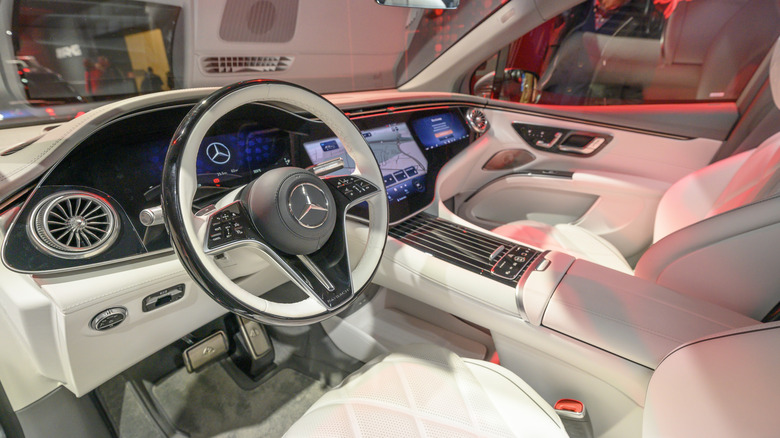
In contrast, the report claimed that passenger infotainment screens were among the least-liked tech features on modern premium cars. According to survey data, 35 percent of owners who had a car with a passenger infotainment screen say that it has never been used. To make matters worse, these screens also suffered more problems than most other parts of their car's infotainment system. A mere 6 percent of surveyed drivers said that their passengers regularly used the passenger infotainment system. If there's one car feature that's worth avoiding, the report suggests that it is passenger infotainment screens that cause more headaches than anything else.