

Is A Patch Cable The Same As An Ethernet Cable?
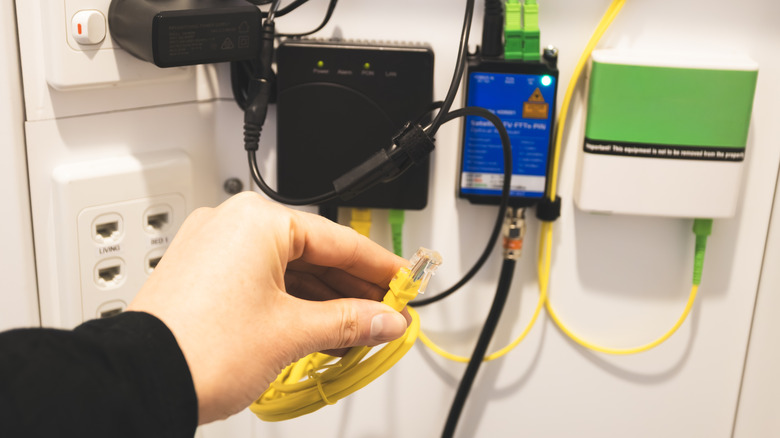
If you have ever searched for Ethernet cables, it's likely that you have seen some labeled as Ethernet "patch cables" or "patch cords," while others lacked the "patch" wording. That's understandably confusing for the average user, especially because there are plenty of devices that need to stay connected to an Ethernet cable for the best performance. So, if you end up buying the wrong one, the result can be vastly different. Keep in mind that patch cables are not exactly the same as Ethernet cables — but they aren't entirely different.
Patch cables are basically cables that are used to connect different types of devices. These include network devices and audio equipment, among other types. Even within the network space, you can have patch cables designed for different roles. For instance, you have Ethernet patch cables to establish wired connections between your PC and the router. These have RJ45 connectors on both ends. Apart from that, there are things like fiber optic patch cables for connecting a sound system to a TV, coaxial cables for connecting a TV to a video source, or audio patch cables used in music production.
Essentially, every Ethernet cable is a patch cable, but not every patch cable is an Ethernet cable. An Ethernet cable is a specific type of patch cable for networking two or more devices together.
Different types of Ethernet cables
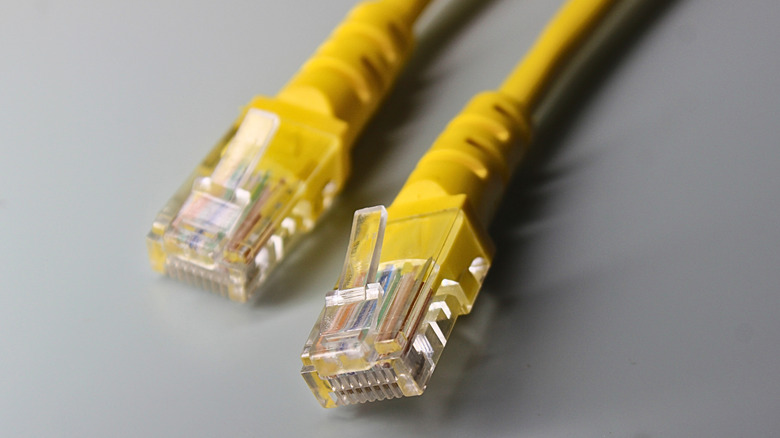
There are many more kinds of patch cables, and the term has nothing to do with the categories of Ethernet cables like Cat5, Cat5e, or Cat6 as is sometimes erroneously claimed. There are another kind of Ethernet cables that many peoply mistakenly think "patch cable" refers to, and that's what's called a twisted pair or crossover cable. Twisted pair cables can also be further divided into shielded and unshielded types, with unshielded twisted pair cables (UTP) being most commonly used today.
Unlike conventional Ethernet cables which follow the same wiring standards on both ends, crossover Ethernet cables follow the T-568A wiring standard on one end and the T-568B standard on the other. These standards basically define how the pins are assigned to different wires and how the Ethernet cable terminates. One end had a standard Ethernet cable wiring layout, while the other swapped two of the wires (hence the "twisted pair" moniker), and each end was plugged into a PC's Ethernet port. As for their use case, crossover cables, (which are largely unused today), allowed network connections between two similar devices, like two computers, and eliminated the need for an intermediary such as a router or network switch.
For a particularly old school example, in the early days of multiplayer PC games, two computers might be connected via a crossover cable to network the two and play something like "Doom" or "Half-Life." This was a cheaper way to create a "LAN party" type experience for two gamers without additional hardware like a router.
In the end, it's important to remember the terms Ethernet cables and patch cables are sometimes used interchangably, but you shouldn't confuse the two. More importantly, when buying an Ethernet cable, make sure to check the cable category and verify that it meets you requirements, in addition to the cable's length. For the average user, this should suffice.