

RJ45 Vs. Ethernet Port: Are They The Same Thing?
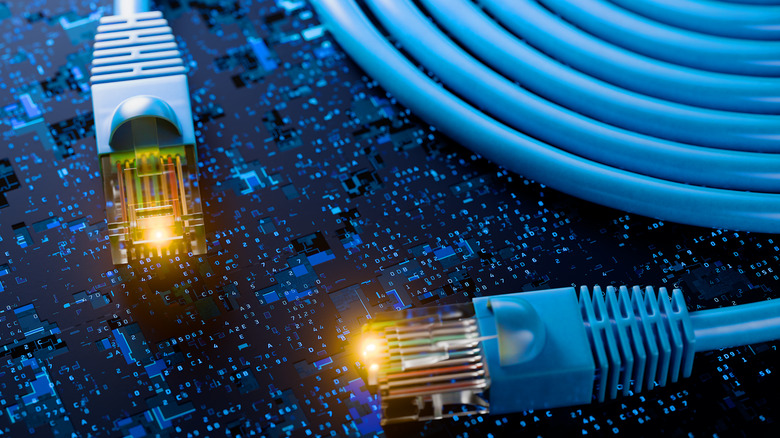
Both RJ45 and Ethernet port are sometimes used to describe the same thing. However, despite sharing similarities and going hand in hand, they are not the same thing. Basically, one is a type of connector, and the other is an actual port you plug it into.
RJ45 is short for Registered Jack 45, and it refers to the physical connector, the clear plastic plug with eight wires (pins) at the end of virtually all Ethernet cables. These eight pins are also known as 8P8C (eight-position, eight-contact).
RJ45 was originally used for the phone registration system, which is where the name comes from. Nowadays, it's used for Ethernet networking, linking computers and routers through the Ethernet port. It's capable of carrying fast internet data and can even supply power to devices through Power over Ethernet technology, which might be something you didn't know Ethernet ports can do.
On that note, an Ethernet port — sometimes called a LAN port — is the rectangular physical socket found on routers, computers, smart TVs, and other Internet-connected devices. You need an Ethernet cable to use the port and connect the devices to the local area network, or LAN. Most Ethernet ports also have two tiny LED lights that show whether there's a connection and if data is actively moving through.
Are Cat6 and RJ45 the same?
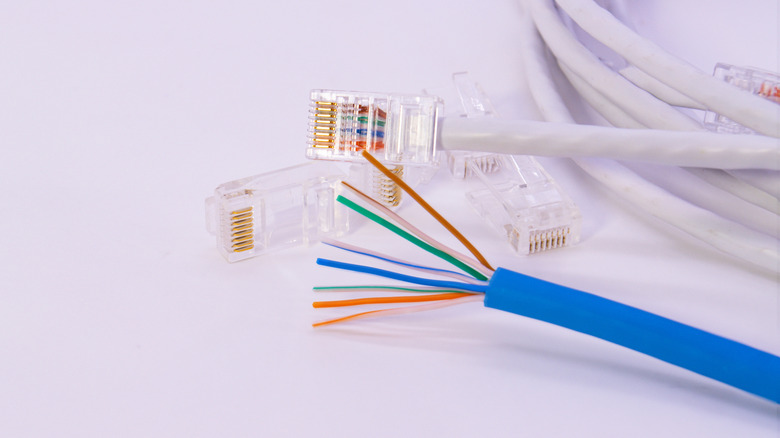
Another term that frequently comes up when talking about Ethernet and RJ45 is Cat6 or Cat5e. Cat6 refers to a type of twisted-pair Ethernet cable with a copper wire that has eight smaller wires inside, bundled into four twisted pairs, and the same goes for Cat5e. The Cat part is actually short for Category, and these abbreviations define the standards for how a cable is built and how well it performs.
For instance, Cat6 delivers better performance than Cat5e with a higher frequency of 250 MHz versus 100 MHz on Cat5e. It's also more resistant to dust and water damage, which makes it a better choice for outdoor use. Additionally, Cat6 supports up to 10 Gbps data transfer, while Cat5e supports up to 1 Gbps. These aren't the only categories available, as there are Cat7 and Cat8 too, allowing for some speedy Ethernet cables.
As such, RJ45 and Cat6 (or Cat5e) are not the same. You can think of Cat6 and other categories as the cable itself, while RJ45 is the plug on the end. The terminology isn't confusing in itself; it's just that several abbreviations are closely related. Some people call Ethernet cables LAN cables too, which is technically not wrong, but LAN cables and Ethernet cables aren't quite the same thing. Confusingly, all Ethernet cables are LAN cables, but not all LAN cables are Ethernet cables.