

Startup Gives Cargo Ship Diesel Engines An AI-Powered Hydrogen Upgrade
There is compelling evidence that supports the claim that Earth is warming as a result of climate change. According to NASA, the planet is warming at 10 times the rate it did at the end of the last ice age. While green energy initiatives like solar, wind, and hydroelectric power can start to move our energy demands away from fossil fuels, we still overwhelmingly rely on these fuels for transport. About 10 percent of transport emissions can be directly attributed to shipping, accounting for 3 percent of all global CO2 emissions. Hydrogen is a cleaner option, but the world's first 100% hydrogen-powered marine engine is only just ready for real-world operations.
That's why the new system developed by California startup Newlight Marine Technologies Inc. could be so important. Instead of replacing diesel engines entirely, the new approach adds hydrogen-burning capability to the engines that cargo ships already use. It's probably not surprising to find that AI has a role to play in the new system. The system relies on an AI-guided controller to inject small amounts of hydrogen into the diesel and continually adjust the mix in real time. We cover how this works in more detail later, but in a recent 8,500-nautical-mile trial, the results showed a substantial improvement in fuel economy, and emissions were also greatly reduced.
The shipping industry is already struggling to "go green," with slow progress being made towards industry targets. And while the new system isn't going to be a magic bullet that solves the crisis overnight, it does have one big advantage over other technological approaches — it can be retrofitted to vessels in a matter of weeks without dry-docking or major engine modifications, or even stopping normal operations.
How the hybrid hydrogen-diesel system works
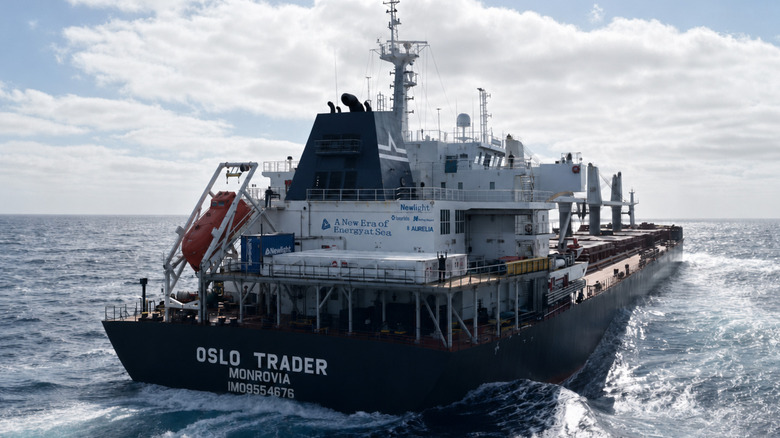
Newlight's system allows diesel engines to "sip a little hydrogen" to help with combustion. Basically, instead of replacing or converting engines, this system injects small amounts of compressed hydrogen into the air intake alongside diesel. Because hydrogen is a clean-burning fuel, even such modest amounts can help improve combustion efficiency and reduce emissions. For instance, to test the system, it was fitted to a 650-foot bulk carrier. The ship then went set sail a month-long voyage from Singapore to Ghana. Data collected during the journey showed that fuel consumption improved by 24 percent, and carbon dioxide and carbon monoxide emissions were cut by 28 percent and 22 percent, respectively.
To make such a system work reliably, Newlight's real-time controller uses AI to anticipate each combustion event and just how much hydrogen can be injected for each, down to incredibly fine levels. Among the metrics monitored by the AI controller are the combustion pressure, exhaust temperature, and the air intake pressure. Knowing this information allows the system to automatically adjust to changing loads and sea conditions.
Importantly, the engine remains fully dual-fuel when the system is fitted — when there is no hydrogen available to supplement the diesel, the engines continue to operate normally. According to lomarlabs, one of the project's supporting partners, the hybrid propulsion system as operated on the test vessel would save operators $500,000 annually.
Why this new hybrid system is important
Of course, for shipping companies, the promise of annual savings per ship running into hundreds of thousands is an obvious and large carrot. But it could also help the industry make the transition to fully green systems at a time when it's under increasing pressure to "clean up its act." Fully electric or hybrid electric cargo ships are one option.
Hydrogen is another fuel that's being touted as a greener option that could help the shipping industry cut emissions. However, despite the recent development of a record-setting hydrogen engine, for the shipping industry there are still major obstacles to address if it's ever to become a reality. For instance, there is not enough existing capacity or infrastructure to make it a current practicality. Additionally, the low energy density of hydrogen means hydrogen-only ships would require more storage room for fuel. Then, of course, there is the cost of installing the new power plants or building new ships.
While these obstacles may be overcome in the future, the hybrid system developed by Newlight could "hold the fort" while fully green systems continue to develop. According to lomarlabs, the cost of the system will be fully repaid within 18 months.
The industry certainly seems to be taking notice — at the time of writing, there were 12 confirmed orders for the system and two vessels currently operating the hybrid system. This might seem like no more than a drop in the ocean, but with global shipping emissions forecast to grow by another 50 percent by mid-century, schemes like this could help to reverse a worrying trend.