

Record-Setting Hydrogen Engine Rivals Diesel Power With None Of The Emissions
Researchers in Germany have reportedly developed an experimental "hydrogen cycle engine" they say can match diesel-level performance without the conventional exhaust emissions. If their engineering feat holds up in continued testing, it has the potential to open the door to a whole new generation of heavy-duty clean-energy machines.
Working at Otto-von-Guericke University Magdeburg, the team of researchers say their hydrogen engine has already reached efficiency levels above 60 percent. That figure actually puts it well ahead of the thermal efficiency of diesel engines, which is around 40-50%. Researchers hope the technology can eventually power long-haul trucks, agricultural machinery, construction equipment, large generators, and even ships.
Of course, let's not get too far ahead of this. So far, all the testing's only been done on a dedicated test bench and computer simulations. We'll have to wait for future studies to tell us how it holds up in real-world durability tests. However, we do know that similar battery-electric systems have fallen short when it comes to continuous high-load operation and strong power output. It'll be interesting to see how a hydrogen engine performs in comparison.
How the hydrogen cycle engine works
In the most basic of terms, conventional combustion engines work by continuously drawing in air and releasing exhaust gases. The hydrogen cycle engine operates differently, running more as a closed-loop system. That means most of the gases used during combustion stay inside the engine after each power cycle. From there, the carefully controlled mixture of hydrogen, oxygen, and argon is cooled, processed, and reused.
Hydrogen acts as the fuel source, oxygen drives the reaction, and argon stabilizes the combustion process. And because argon doesn't burn or chemically react under standard operating conditions, researchers say it translates to more controlled and efficient combustion than traditional diesel. The engine stays emission-free because it separates and liquefies hydrogen during operation, removing only select byproducts in the process.
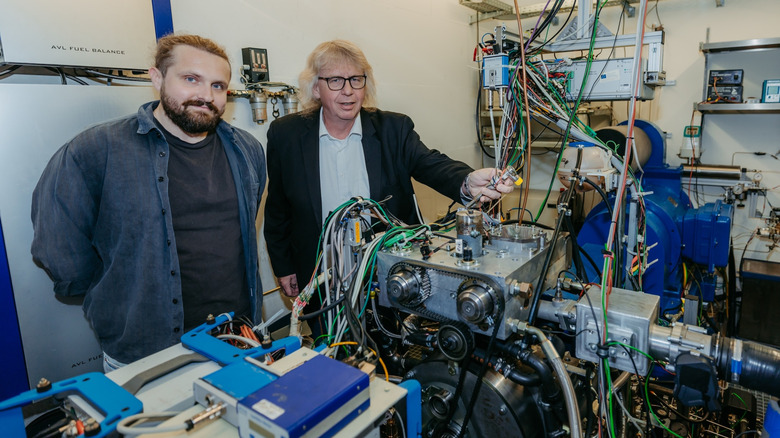
Still, one look at the photo tells you this engine is very much still in the experimental stage. That's sure to come with plenty of unresolved challenges before this engine is ready for a real-world rollout. Rest assured, it's all being sorted out by professor Hermann Rottengruber of the university's Institute for Engineering of Products and Systems. The team's also supported by Germany's Federal Ministry for Economic Affairs and Energy. They developed the engine in partnership with WTZ Roßlau gGmbH, a German research organization focused on finding future engines and fuel efficiency technologies.