

Do Buoys Have Anchors? Here's How They Stay In Place
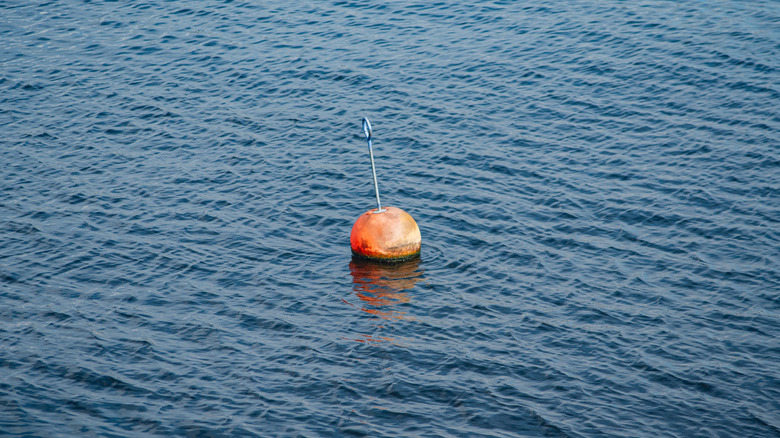
Whether you're looking at them in a large lake or the ocean coast, buoys are a familiar, frequent sight on the water. You often see them marking the boundaries of a boating lane or safe sections of beach waters, with distinct colors and patterns like orange for regulatory buoys, black and white for marking obstructions, or yellow for areas with special restrictions. Despite how they may appear, though, buoys aren't just floating aimlessly in the middle of nowhere. After all, if they were carried by nothing but the water, they'd almost certainly float away from the spots they're supposed to be marking. This is why, outside of your view, buoys are actually anchored down to the bottom of whatever body of water they're in.
It may seem like a buoy is just a random object floating on its own, but it's actually more like a balloon in the way it's anchored down to the seabed. By anchoring buoys in this way, they'll always stay exactly where they're supposed to be, ensuring they serve as vital markings for boaters, swimmers, fishers, and anyone else who regularly traverses the waters. Of course, those anchors can't keep a buoy down in perpetuity due to the stressful conditions of aquatic life, which is why they also need to be regularly maintained to ensure that job keeps getting done.
Buoys are anchored down by a mooring system
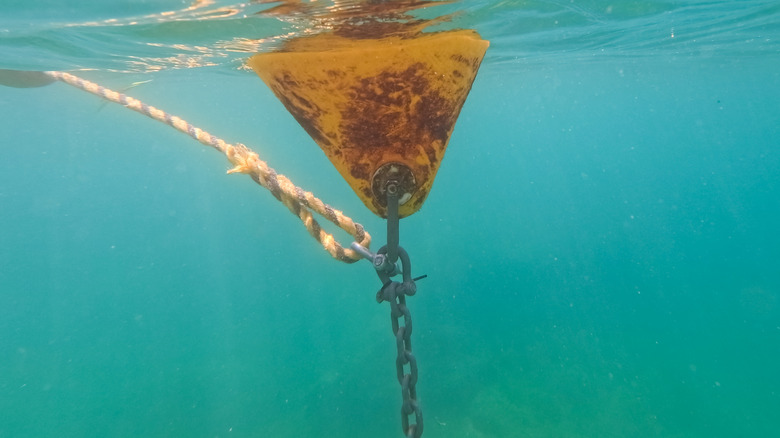
To clarify, when we say a buoy is "anchored," we don't mean it is tied to an anchor you'd see on a boat, or at least not exactly like that. The anchor on a boat is generally a temporary measure, something to keep the boat from drifting away on the currents for a few hours. If you tried to leave something as small and light as a buoy on an anchor pulled taut, the movement of the water would still carry it away eventually.
To avoid this, buoys are physically attached to the bed of whatever body of water they're in via a mooring system. Divers venture below the water and place sturdy anchor points on the bed, either large, heavy objects that even the waves can't move or thick hooks that are physically pounded into the rock. Once the anchor points are placed, the buoy is then attached to them via a long cable, usually made of a sturdy material like steel or Kevlar. These cables typically measure at least several times longer than the distance between the buoy and the bed in order to give it some extra slack. This way, even if the waves go high or tide changes, the buoy will still stay where it's supposed to be.
Buoys need periodic maintenance to keep from floating away
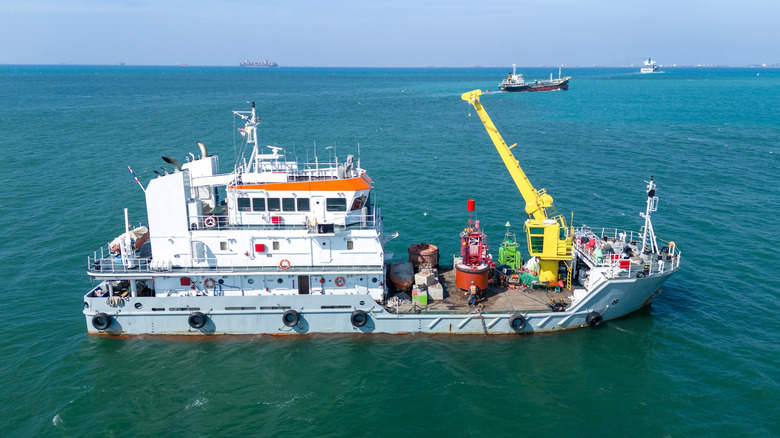
The tricky thing about maritime engineering is that, generally speaking, large bodies of water are known for moving a lot. The ocean, in particular, is a very stressful place even for a solid steel cable. Constant stretching and abrasion caused by waves in fierce storms, as well as salt water corrosion, gradually weaken them. If a buoy is left untended for too long, the mooring cable could eventually snap, and it'll drift away into parts unknown.
It's for this reason that all buoys must be regularly maintained, usually by teams hired by whatever governing body is responsible for them. For example, the National Marine Sanctuary in the Florida Keys regularly deploys teams of buoy-management experts to maintain the over-800 buoys under its jurisdiction. These teams have to inspect, clean, test, and service every buoy on a regular basis. This involves diving down to check the anchor points, inspecting the cables for corrosion, and replacing any buoys that have reached the end of their viability.