

The UK Has Fired The World's Deadliest Torpedo From A Robotic Sub
In May of 2026, the United States, Australia, and the United Kingdom entered into an agreement called the AUKUS Pillar 2. The agreement sought to develop "cutting-edge payloads and enabling systems for AUKUS partners' Uncrewed Undersea Vehicles (UUVs)." The goal was to achieve a delivery date sometime in 2027 with a specific focus on technologies that would extend the capabilities of UUVs utilized by the three partner nations of the AUKUS agreement.
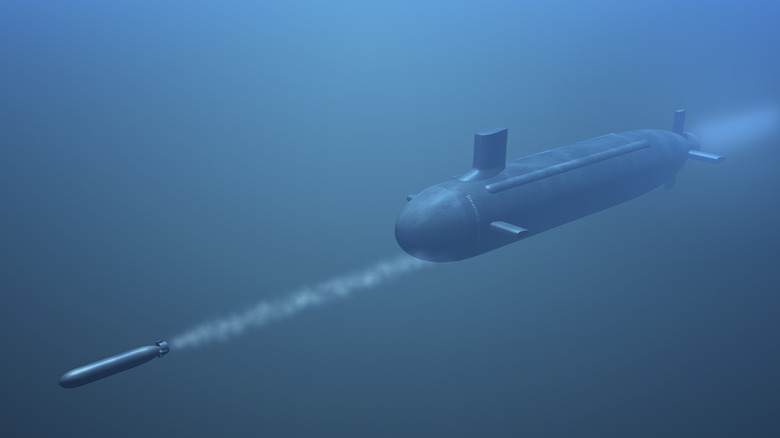
One of the biggest achievements of AUKUS Pillar II occurred on September 13, 2026, with the launch of an Mk. 48 heavyweight torpedo, dubbed the deadliest torpedo in the world. British Underwater Test & Evaluation Center in Scotland conducted the test, and while the torpedo wasn't modified, making it a run-of-the-mill Mk. 48 MOD 7, the vehicle that fired it was anything but typical. That's because the Mk. 48 originated inside a British XV Excalibur UUV, marking the first time an uncrewed vessel deployed the heavyweight torpedo.
It was a proof of concept, highlighting the capability to utilize the American-made torpedo inside a foreign ally's UUV, and it was successful. Both the U.K. and Australia outfit their militaries with the American torpedo, so it's not unusual that the Mk. 48 was fired from a British asset. What was remarkable was the fact that the torpedo integrated easily into the automated vessel, demonstrating weapon interchangeability between the allied nations of the AUKUS Pillar 2 agreement.
The XV Excalibur and the Mk. 48 torpedo
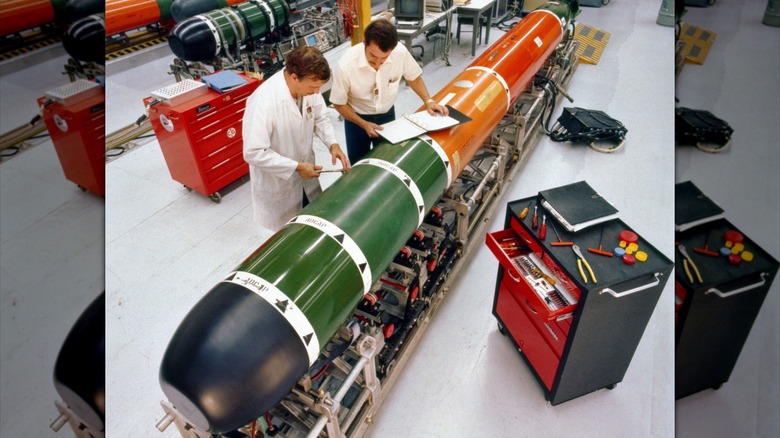
The Royal Navy's XV Excalibur isn't your average UUV. It's designated as an Extra Large Uncrewed Underwater Vehicle (XLUUV) and measures over 39 feet long. The 20.9-ton autonomous submarine is an experimental vessel that's the largest ever tested by the Royal Navy. It was first revealed at its naming ceremony in May 2025, and since then, the U.K. has put it to work. The Mk. 48 torpedo isn't a small weapon system, as it weighs 3,744 lbs., has a diameter of 21 inches, and is 19 feet long.
That kind of torpedo can't be fired by your average-sized UUV, which is why the XL Excalibur presented the perfect opportunity to test-fire one. According to the Navy's press release, the successful test "validated the mechanical, electrical, and software integration of a U.S. kinetic payload onto an allied autonomous vessel, proving that allied forces can rapidly achieve weapon interchangeability." What's interesting is that the XL Excalibur doesn't have torpedo tubes, and instead has a large central payload bay, so the torpedo was likely mounted in a cradle along the keel.
The successful test doesn't mean that the U.K. is going to field a fleet of XL Excalibur UUVs with Mk. 48 torpedoes; the vessel is designed for experimentation. But it demonstrates the feasibility of integrating American-made weapon systems into an ally's UUV without extensive hardware and software modifications. Further testing is likely required before anything like a mass procurement deal, or the manufacture of a fleet of UUVs capable of firing the heavyweight torpedo, could commence.