

Milwaukee Vs Flex: Which Brand Makes The Better Hammer Drill?
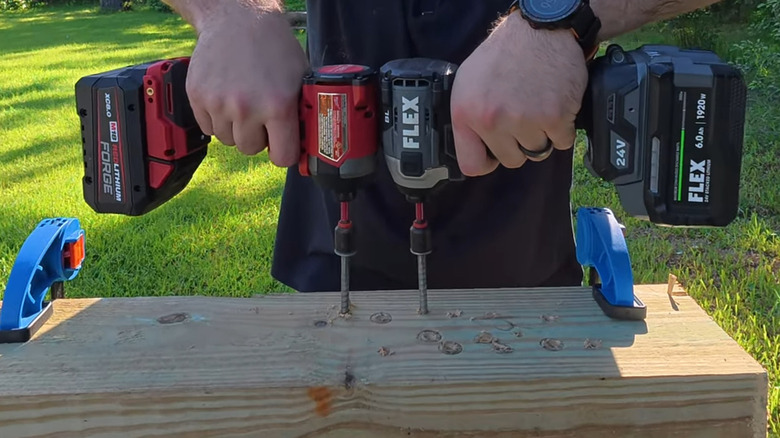
We may receive a commission on purchases made from links.
Milwaukee has a strong reputation for power and performance overall, but those metrics matter most for tools like a hammer drill, which needs the oomph to drill into hard materials like concrete, masonry, and brick. Milwaukee's hammer drills, like most of its catalog, come at a premium price, which is why many users opt for other brands. Sometimes, you not only save money but get better bang for your buck — there are cheaper impact drivers that outperform Milwaukee, for example.
One such impact driver comes from Flex, which begs the question: does Flex also make a better hammer drill than Milwaukee? Milwaukee's current Gen 4 M18 cordless hammer drill (model 2904-20) delivers up to 2,100 rpm and 1,400 in-lbs of torque, and its 3602-20 M18 compact hammer drill offers up to 1,700 rpm and 550 in-lbs of torque. By comparison, the Flex FX1272T spins faster (up to 3,000 rpm) and delivers more rotational force (1,500 in-lbs) than Milwaukee's flagship. Its FX1231 24V compact hammer drill is both faster and stronger than Milwaukee's compact, with up to 1,800 rpm and 650 in-lbs of torque.
Beyond specs, a broader look at user experience and direct comparisons from multiple experts and professionals gives a clearer picture of which brand makes the better hammer drill. Relying on user ratings alone isn't ideal, because Milwaukee has far more product reviews online than Flex, and a larger pool leads to a more reliable average. Rather than the brand's quality, its lack of ratings is why Flex doesn't even appear on our list of the best hammer drills according to users. This is why it's better to look at video tests and professional reviews.
Milwaukee's hammer drill is favored despite being less powerful
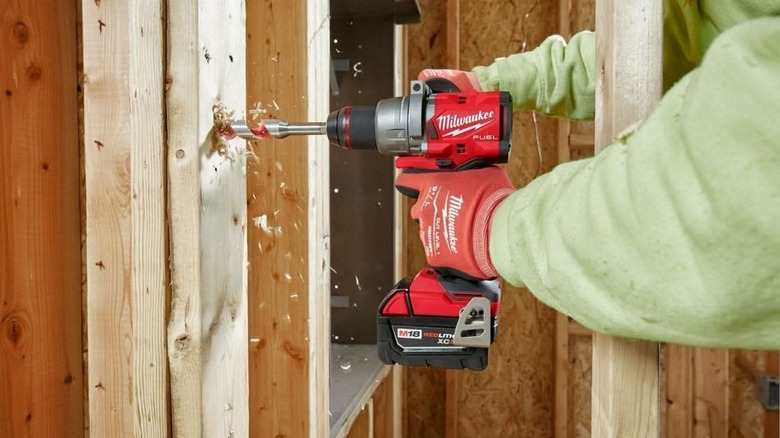
After drilling through concrete, brick, and wood with several hammer drills, including one from Flex, Bob Vila called Milwaukee's a "beast," praising its raw power and premium build quality. As its manufacturer's specs state, Flex outperforms Milwaukee in real-world speed and torque, but the Milwaukee weighs less and is much easier to handle. That's why the Milwaukee is Bob Vila's choice as "the hammer drill of choice for pros and serious DIYers."
Similarly, Pro Tool Reviews put multiple hammer drills to the test and found the Flex 24V Hammer Drill to have the best objective performance but still named Milwaukee's M18 Fuel Hammer Drill Driver to be the "Best Overall for Professional Contractors and Tradesmen." This is despite Milwaukee failing to drive fastest with spade, concrete, or self-feed bits, as well as having soft torque. But its extremely compact and lightweight size, as well as consistent performance and kickback control, is why PTR puts it over other tools that recommend it, saying one of its only drawbacks is its higher price.
The sentiment is echoed by Popular Mechanics, which tested the Milwaukee M18 Fuel Hammer Drill Driver for over a year. The reviewer called the tool their go-to, even though the Flex was the fastest of all the hammer drills tested. Again, Milwaukee's 2904-20 compact, lightweight design played a major role in its strong review. DIYers, such as Toolhead147, who recorded a head-to-head comparison of Flex and Milwaukee hammer drills, agree, praising the power of Flex's tool but criticizing its weight.
But the Flex hammer drill is no lemon
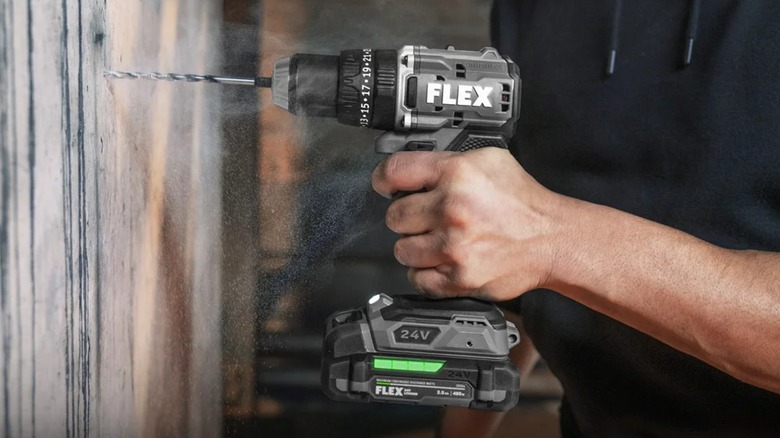
While many major tool reviewers, as well as DIYers, favor Milwaukee's hammer drill over Flex's, the latter is still a very capable tool. Objectively, it's more powerful, outperforming Milwaukee on paper as well as in most tests. Other considerations — especially its size and weight — are named as drawbacks, but some reviewers do choose Flex over Milwaukee.
For example, Project Farm calls the Flex FX1271T "the best drill I've ever tested." The tool ranked top in overall metrics after a series of tests comparing hammer drills from several major brands. Again, Flex proved faster at driving lag bolts and other jobs, though Milwaukee finished second and even edged out Flex in working torque, delivering 455 in-lbs compared to Flex's 454 in-lbs. The side handle of Flex's tool also beats out Milwaukee's. In its testing, Toolhead147 found that Flex's side handle had a superior metal and rubber construction compared to Milwaukee's cheaper-feeling plastic one.
Multiple video comparisons of the hammer drills, including those by Man Caver Tools and VCG Construction, also find Flex outperforms Milwaukee when it comes to thermal regulation and concrete drilling. Though it tested Milwaukee using a Gen 3 model, which still provided smoother driving than Flex, VCG Construction conceded that Flex's drill also heats up less during use. In its head-to-head test of the brands, it found that Flex could drill concrete faster than Milwaukee, confirming the findings of Man Caver Tools, Pro Tool Reviews, and other testers. So, while Milwaukee may be the better tool overall thanks to its design, quality, and M18 platform, concrete workers and other power-focused users may still lean toward Flex — though there are several other Milwaukee tools useful for concrete work.