

4 Times When Its Better To Use Milwaukee M18 Tools Instead Of M12
We may receive a commission on purchases made from links.
Milwaukee has long since adopted the cordless, battery-powered style for its power tools. In doing so, the brand has established two dominant battery types: M18 and M12. On the whole, M18 and M12 batteries and their respective tools remain priorities for the Milwaukee brand, though that's not to say that they're the exact same platform. The tools and batteries differ in key ways, so much so that when you're trying to determine which is the right variety for the task at hand, one will be much better equipped to help out than the other.
Generally speaking, M18 and M12 Milwaukee tools will get the job done so long as the task at hand isn't absurdly time-consuming or cartoonishly hard on the tools used. With that said, just as there are times when using M12 Milwaukee tools instead of M18 is better, sometimes an M18 tool is the superior choice. In terms of their physical power, their level of performance, and the tools they can run (among other criteria), the M18 battery line can stand out as the far and away better option over its 12-volt contemporary.
Though equally effective as Milwaukee battery platforms, sometimes M18 is the better choice than M12. These are some situations where the 18-volt battery-powered tools should be the ones you reach for first.
When power is the priority
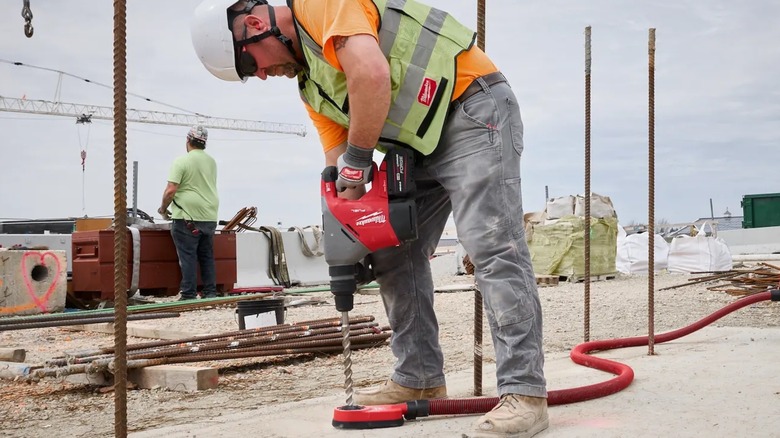
The Milwaukee M18 and M12 battery lines both pack a punch, delivering enough power to keep their respective tool assortments running without much trouble. With that said, the difference between 18 and 12-volt tools is unignorable, hence why M18 and M12 batteries aren't easily interchangeable. In situations where you need more power behind your tool, M18 is the best option. Think scenarios where you're trying to cut through hard wood or drill through something solid like concrete. The last thing you would want is to rely on a tool that couldn't handle such a job, resulting in longer work times or, worse yet, damage to the tool itself.
For comparison's sake, it's worth looking at M18 and M12 tools to see just how different their power specs really are. The M18 Fuel hex impact driver, for example, claims a 0 to 3,900 RPM range and a 0 to 4,400 IPM range with 2,000 inch-pounds of maximum torque. Meanwhile, the comparable M12 impact driver model advertises 0 to 3,600 RPM and 0 to 4,000 IPM with 1,500 inch-pounds of torque at most. Looking at a different tool type to further drive home this point, the M18 circular saw promises over 6,000 RPM, while the M12 model only achieves around 3,600 RPM, per their Milwaukee product descriptions. Thus, if you need power, M18 is definitely the way to go.
M18 offers longer runtimes on the job
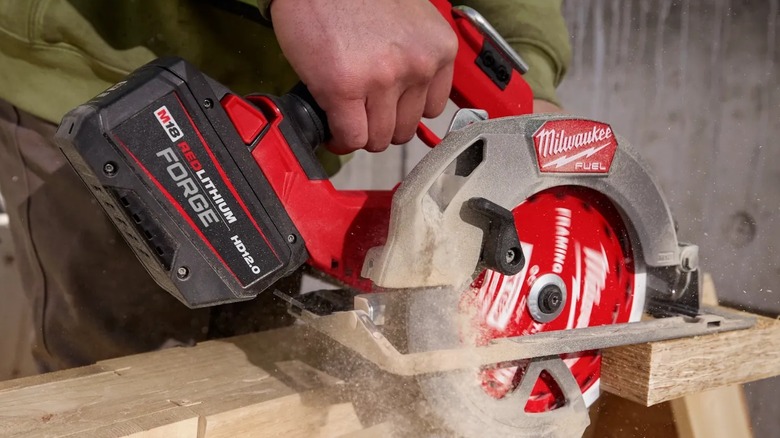
As important as power is on the jobsite, sometimes power tool-related work is a marathon, not a sprint. You need tools that will continue to perform consistently well over extended periods, not just those that will reach high speed and power in short bursts. Still, M18 tools are typically better-suited for these tasks than their M12 contemporaries. These Milwaukee tools are often advertised as getting more use time from their batteries, so they're the preferred choice for jobs where you have to make numerous cuts of wood or install multiple fastener in succession, among other similarly repetitive tasks where longevity is the name of the game.
This phenomenon is exemplified by the aforementioned M18 and M12 circular saws. According to Milwaukee, the M18 model will deliver around 300 cuts per charge using an M18 High Output 6.0 Ah battery, while the M12 tops out at around 170 cuts per charge. Not to mention, M18 batteries have a higher upper amp hour limit than the M12 line. At the time of publication, M18 batteries go as high as 12.0 Ah, with the M12 battery line only goes as high as 6.0 Ah. Neither line compares to the heavy-duty MX Fuel series, where the strongest battery in the Milwaukee line calls home, but put against each other, M18 can provide more power and runtime on the whole.
If space isn't a concern, go M18
The benefit of cordless, battery-powered tools is that you get more mobility than you would with plug-in models. This is a benefit that M18 and M12 tools share, with the M12 line having a leg-up on M18 when it comes to maneuverability. On a lower-power battery platform, M12 tools tend to be smaller and lighter, making them ideal for work in tight or awkward areas. Though they're not entirely useless outside of these scenarios, if you're not in a confined space, there's a case to make that M18 is the better choice.
As covered, M12 lack in power and battery longevity compared to M18, so if space isn't a concern, why not jump up to M18? When you have the ability to move freely in a space, you can prioritize these strengths of the M18 line over maneuverability. Their comparatively higher power level and longer runtime means getting the job done quicker. Yes, they may be a bit larger and heftier to use compared to M12, especially for longer jobs, but if you don't need to scale your tools down to fit in your workspace, it's more than worth it to power through with M18 rather than take your time with a smaller, less powerful M12 arsenal.
When an M12 option simply doesn't exist
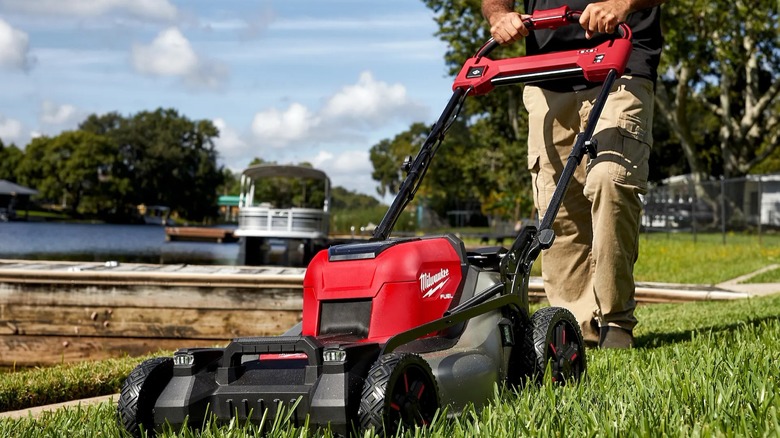
For the most part, M18 and M12 have been sustained by Milwaukee at an equal pace, meaning there's a lot of overlap in tool type between the two. However, given these battery platforms' inherent power differences, their respective catalogs aren't exactly the same. Considering their differences, it's no surprise there are a few M12 tools that lack M18 counterparts, as well as a handful of M18 products that haven't or simply can't be brought down to the M12 level. Therefore, if you're adamant about sticking with Milwaukee for specific items, you'll have no choice than to pick M18 to get ahold of these products.
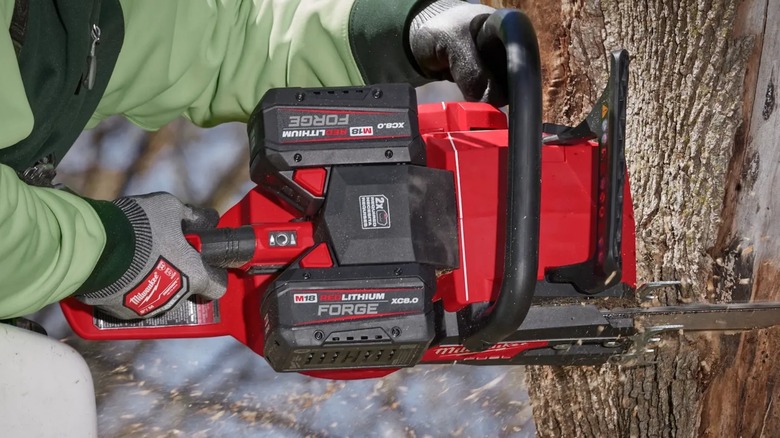
Naturally, the M18-only tools Milwaukee has released are predominantly those that need an extra push of power to operate. For instance, the M18 Fuel self-propelled dual-battery lawn mower, which demands two M18 batteries — the Milwaukee product listing specifically recommends a pair of M18 RedLithium Forge HD 12.0 Ah batteries — to function. That amounts to 36 volts of electricity, and not even a pair of M12 batteries at 24 volts can supply that. M12 is more limited in the chainsaw realm, too, specifically in terms of bar size. The M12 Fuel 6-inch pruning chainsaw is the largest you'll find on this battery platform. Meanwhile, the M18 line offers the M18 Fuel dual-battery 20-inch chainsaw, which is a lot, but for professional or otherwise big cutting jobs, it's much more effective than any M12 offering.