

The Highest Bird Strike Ever Recorded Involved A Critically Endangered Vulture
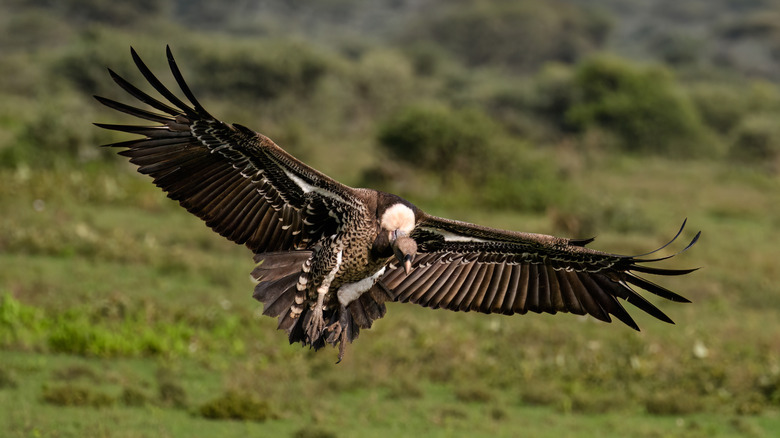
It's November 29, 1973, high above Abidjan, a city situated along the southern Atlantic coast of Côte d'Ivoire (also known as the Ivory Coast) in West Africa. A commercial airline — thought to be a four‑engine DC-8 — a plane that not only helped shape modern commercial flight but went supersonic before either the Concorde or Tupolev – was cruising at around 37,000 feet. Suddenly, it hit something that caused one of the engines to flame out. Fortunately, the plane was able to land safely.
Officials inspected the damaged engine and found the remnants of a tail, neck, breast, and assorted feathers. After consulting with the U.S. National Museum of Natural History, it was determined that the plane had struck a Rüppell's Griffon (Gyps rueppellii), an endangered type of vulture native to Africa. It can have a body length of 3.4 feet and a wingspan up to 8.5 feet, weighing as much as 20 pounds. This is large bird that can live up to 50 years, and a modified protein in its body allows it to fly at altitudes with lower pressure and much less oxygen.
This unfortunate incident made the Rüppell's Griffon the highest-flying bird on record (according to Guinness World Records). It also became the highest altitude at which a bird collided with an aircraft; the prior record was recorded when a Mallard (Anas platyrhynchos) hit a plane at 21,000 feet between Battle Mountain and Elko, Nevada, on July 9, 1962. If the Mallard name sounds familiar, that's because it's the most common duck living in the Northern Hemisphere.
Planes must always be aware of birds

On December 9, 1967, pilots flying at 27,000 feet saw (and radar confirmed) approximately 30 whooper swans (Cygnus cygnus) migrating from Iceland to Loch Foyle, a lake on the border between Northern Ireland and the Republic of Ireland. Migrating geese have been seen at 29,000 feet flying over the Himalayas, while Bearded Vultures (Gypaetus barbatus) have been seen at over 24,000 feet.
Scientists estimate that some 85 billion birds inhabit the planet. Granted, 33 billion of those are chickens, but that's still a lot of birds. In fact, there are about 10 birds for every living human. However, within that vast number, very few birds can actually soar at heights above 20,000 feet. Most keep below 500 feet, and those that migrate in and around the Eastern U.S. typically stay between 1,300 and 1,600 feet. Most birds out West cruise at about 2,600 feet, with some popping up as high as 6,000 feet.
Between 1955 and 1999, 33 planes (27 of them military) collided with seven different species of vultures. While collisions like this don't make it on the list of aviation history's worst accidents, they still happen more often than you likely realize. Per the Federal Aviation Administration (FAA), between 1990 and 2025, some 344,000 were reported in the U.S., with carriers at foreign airports reporting another 5,700. Roughly 97% happen below 3,000 feet. Between 2009 and 2018, fewer than three in 10,000 departures were affected, and only 2% to 8% of those resulted in any meaningful damage, avoiding the list of aviation history's worst accidents.