

What's The Thickest Grade Motor Oil And Which Engines Can Use It?
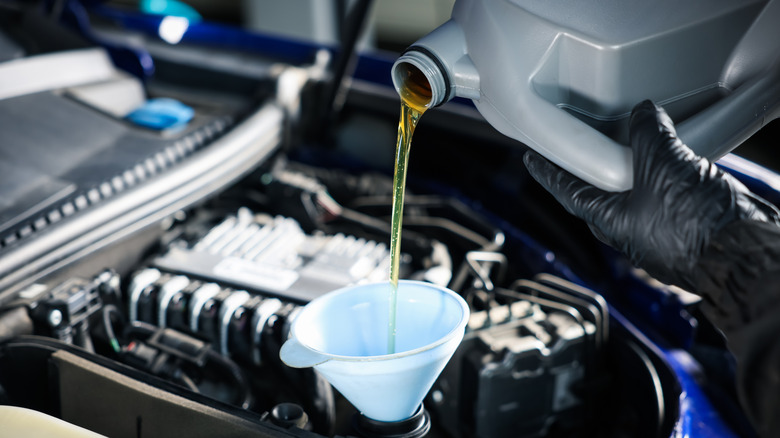
The Society of Automotive Engineers (SAE) categorizes oils by their flow rate (viscosity) when measured at 100 degrees Celsius. An oil's viscosity refers to its thickness and its resistance to flow, with a higher oil viscosity number meaning its thicker. The SAE released the J300 Engine Oil Viscosity system in 1911 with five grades: 10, 20, 30, 40, and 50. However, over the past century, other types, such as full synthetic, synthetic blend, and high-hour oils, have emerged. Today, there are 14 viscosity grades.
The thickest motor oil on the market today is SAE 70 for single-weight oils and 25W-60 for multi-weight oils. While the former can be used in specialized race engines and nitro-burning dragsters running on methanol, ethanol, and race gas, the latter can be used on air-cooled V-Twin motorcycles (such as certain Harley-Davidson models).
SAE 70 is better suited for heavy-duty diesel engines and powering fleet buses, boats, tractors, and construction machinery routinely used in hot climates. Meanwhile, 25W-60 motor oil is best used in older vehicles with over 75,000 miles that are constantly driven in hotter climates, along with airplanes with piston engines.
The higher the number, the thicker the oil

Back in the day, engines weren't built with quite as exacting standards and tolerances as they are today. The standard for most cars was 10W30, which simply doesn't work in today's high-tech engines that require much thinner oil to lube those bearings properly. What's more, today's engines don't require as much oil.
Six of the SAE's 14 grades are considered thinner, low-temperature oils aimed for winter use and marked with the letter "W." The other eight are thicker, high-temperature oils, best used in the summer or under hot engine operating conditions. These lack a "W" on the label. The first number before the "W" signifies cold-weather viscosity. A lower number means it pumps easier when cold. The second number (after the W) indicates the oil's viscosity at the operating temperature. The higher the number, the thicker the oil, and the better it'll retain film strength while hot. Since thicker oil doesn't transfer heat as well as thinner oil, engine temperatures will rise and may lead to faster oxidation and sludge buildup. So yes, using thicker oil in older engines can have some big downsides.
Single-weight (aka monograde or single-grade) oils have just one number, like 10W or SAE 30. Those with two numbers — such as 5W-30 or 15W-40 — are considered multi-weight (or multi-grade) and are well-suited to work in both hot and cold environments. It's critical to understand these motor oil classifications and use the oil explicitly recommended in the owner's manual for the machine or vehicle you're operating. However, if you need to use one in a pinch that's plus or minus a grade, it likely won't cause irreparable harm to the engine.