

How WWII's Hand-Held & Backpack Radios Helped Shape Today's Wireless Communication
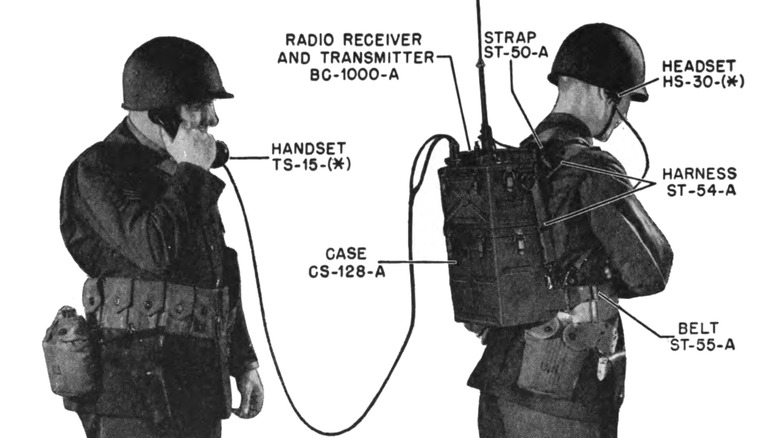
During World War I, ground communications relied on various methods, including runners and long wires connecting links in a small, closed network. The former were people who literally ran from one area to another to carry messages, which is the central plot of the film "1917." Wires were often cut or damaged in attacks, so the military eventually upgraded to wireless communications. That said, the systems employed during World War II weren't much like the phone you might be reading this article on, but they did help shape the technology that went into it.
It may seem counterintuitive, but the brand-new iPhone 18 Pro probably wouldn't exist were it not for WWII communications systems like the SCR-300. The backpack radio holds a place in history, as it's the first radio given the name "walkie-talkie" because, well, you can walk and talk while using it. The Galvin Manufacturing Company produced the SCR-300 and other communications gear used by the United States during the war.
While you may not be familiar with that name, it's now called Motorola, which is the same company that pioneered cellular technology decades later. The SCR-300 offered a significant leap in radio communications technology, which is something we often take for granted in the 21st century. Cell phones use radio waves just like the SCR-300, though at a much higher frequency and with encryption. Regardless, hand-held communications gear and backpack radios like the SCR-300 laid the foundation for what would eventually evolve into the 21st century's modern cellular telecommunications networks.
The first cell call happened much earlier than most realize
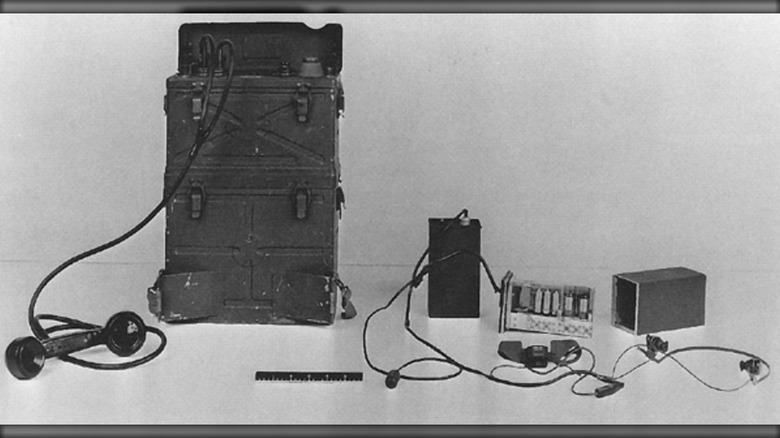
Modern cellphone communications first arose in the early 1970s, but if you want to get technical about it, the first cell phones were installed in cars all the way back on June 17, 1946. That was less than a year after the end of WWII, and while the 80-lb. phones were cumbersome and only available in cars in certain cities, they laid the groundwork for what we now consider cellphone technology. A few years earlier, the SCR-300 offered much the same in terms of communications, and it was a game-changer for the military.
The SCR-300 weighed between 32 and 38 lbs, depending on which type of battery was installed, and it had a range of 3+ miles. While that may not seem like much, and it isn't for today's telecommunications, it was an impressive technological feat on the battlefields of WWII. The system was typically carried on one soldier's back, and the commander would make calls with the attached handset. The SCR-300 utilized the FM band between 40 and 48 megacycles, divided into 200 MHz segments, utilizing 41 channels.
It made its combat debut during the Sicily Campaign of August 1943 and remained a vital piece of military technology throughout the rest of the war. The same technology that went into the SCR-300 evolved after the war, replacing vacuum tube with transistors, incorporating a wider bandwidth, smaller batteries, and better power. This enabled longer-range communications, and eventually, cell towers and satellites went up to manage communications between phones across worldwide distances, thanks largely to the pioneers at Motorola who kept soldiers talking during WWII.